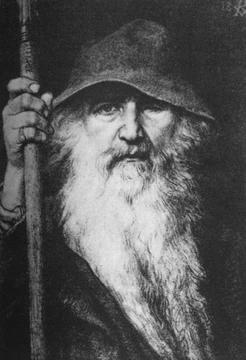
Discover Odin
Julian Cope's album exploring Norse myth and misinterpretation.
Last updated
In 2001, Julian Cope released a limited-edition album and booklet called Discover Odin, created alongside the British Museum. The project served as a companion to Cope's two evenings of spoken word and music at the museum on 4–5 October 2001 in London. The album mixes musical pieces with spoken tracks, drawing on Norse mythology and its history.
Background
The album opens with 'The 18 Charms of Odin,' where Cope sets Kevin Crossley-Holland's version of the epic Norse poem Hávamál to music, as published in The Norse Myths. The second track, 'Discover Odin,' is a spoken account in which Cope argues that Roman historians and Christians misinterpreted the Norse myths, and he comments on the religious traditions of Nordic cultures and their Neolithic predecessors. Cope proposes that Odin began as a weather god and as the shaman Óðr.
Later tracks mix music and speech about the Odin stone of Orkney, the Neolithic hill of Silbury, and Yggdrasil, the ash tree depicted as the world tree. The final track is a recording of a poem read by its author Vachel Lindsay (1879–1931). The music ranges from ambient to psychedelic and space rock, especially on 'Ode to Wan,' which features Japanese psychedelic rock band Karuna Khyal.
Track listing
| No. | Title | Length |
|---|---|---|
| 1 | The 18 Charms of Odin | 8:56 |
| 2 | Discover Odin | 11:47 |
| 3 | Ode to Wan (Parts 1&2) | 2:20 |
| 4 | Yggdrasil & the Stone of Odin | 3:26 |
| 5 | Road to Yggdrasilbury | 18:03 |
| 6 | I want to go Wandering | 1:33 |
Track listing from the source article.
More in Odin
Sources
Compiled from Wikipedia and the sources listed below. Text from Wikipedia is available under CC BY-SA 4.0; this entry is adapted from it.
- Wikipedia: Discover Odin (CC BY-SA 4.0).
Spotted an error? Know more?
Reader corrections go straight into our review queue. Suggest an edit · How this site is sourced