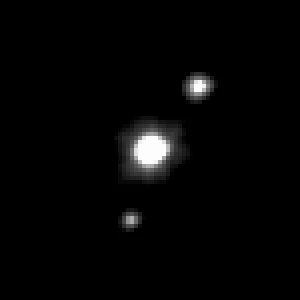
135 Hertha
Asteroid from the inner belt, possibly hydrated M-type.
135 Hertha is a roughly 77-kilometer-wide asteroid located in the inner main belt. German-American astronomer Christian Peters discovered it on February 18, 1874, from New York's Litchfield Observatory. It was named for the Germanic fertility goddess Hertha, also called Nerthus. Though it travels within the Nysa–Polana group, its metallic M-type classification is unusual for that family, which typically contains carbonaceous or silicaceous bodies. Spectral data hint at hydrated silicates, suggesting it might be reclassified as a W-type. Lightcurves show a flattened shape, and radar indicates it is not truly metallic. Five stellar occultations were recorded between 2000 and 2015.
Quick Facts
- Discoverer
- C. H. F. Peters
- Discovery site
- Litchfield Obs.
- Discovered
- 18 February 1874
- Named after
- Nerthus (Norse mythology)
- Inclination
- 2.3052°
- Mass
- (1.21 ± 0.16) × 10; 18; kg
- Density
- 5.23 ± 0.96 g/cm; 3
- Albedo
- 0.1436
Facts from the source article.
Physical properties
Discovered in 1874, the asteroid 135 Hertha had its orbit pinned down by 1884. As early as 1904, astronomer G. W. Hill noticed its brightness fluctuated by half a magnitude over a short period. In October 1992, a team led by Dotto spent 20 hours across six nights studying Hertha’s rotation, shape, and spin axis. They confirmed a rotation period of 8.398 hours, give or take 0.001 hours, matching a measurement published earlier that year by Harris and colleagues. The same study gave axis ratios of a/b = 1.34 and b/c = 1.22, with small margins of error. Two possible orientations for the rotation axis were identified, but picking the right one needed more observations at different points in the asteroid’s orbit. In August 2003, Torppa and co-authors published updated results on Hertha’s shape and spin, using 42 lightcurves collected between 1978 and 2002. This larger dataset yielded refined axis ratios of a/b = 1.1 and b/c = 1.5, and a detailed shape model built through inversion. They also measured the pole direction but, like Dotto’s group, could not settle between two candidates: one with ecliptic coordinates (β=+58°, λ=96°) and another with (β=+53°, λ=274°). In 2017, Hanuš and colleagues resolved the ambiguity, confirming the correct pole solution, though the specific coordinates are not given here. They also produced the first non-convex shape model for Hertha, combining lightcurve data with stellar occultation measurements. Hertha has long been labeled an M-type asteroid based on its spectrum, but observations in 1996 by Rivkin and others using the IRTF at Mauna Kea Observatory suggested a possible reclassification. They detected a dip at 3 micrometers in the spectrum, a sign of hydrated minerals on the surface, which points to a W-type, or “wet M-type,” classification. Drawing on laboratory work by Salisbury and Walter, Rivkin’s team estimated the asteroid’s water content at 0.14 to 0.27 percent by mass. They noted, however, that this estimate came from lab experiments and might not directly apply to asteroids in space.
Asteroid family
135 Hertha sits in the inner main belt and is thought to be the largest object in two overlapping asteroid families, both called the Hertha families, which were once known as the Nysa family. These two groups overlap with several other unrelated families, forming a larger grouping called the Nysa–Polana complex. The Hertha families are split by color and spectral type: the Hertha1 family contains S-type asteroids, while the Hertha2 family contains X-type asteroids, with Hertha1 being the more populous of the two. Scientists believe the asteroids in both families are fragments from collisions involving Hertha, but it is not known whether they came from a single impact or separate ones. Regardless, the differing compositions between the two families indicate that the original parent body had layers of different materials.
More in Objects Observed by Stellar Occultation
Spotted an error? Know more?
Reader corrections go straight into our review queue. Suggest an edit · How this site is sourced