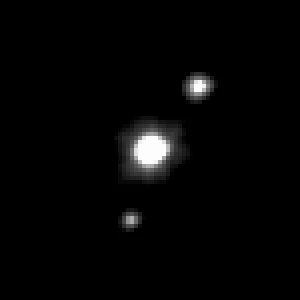
131 Vala
A main-belt asteroid named after a Norse prophetess.
131 Vala is an asteroid located in the main asteroid belt, discovered by C. H. F. Peters on 24 May 1873. Its name derives from völva, a prophetess in Norse paganism. An occultation of a star by Vala was observed from Italy on 26 May 2002.
Quick Facts
- Discoverer
- Christian Heinrich Friedrich Peters
- Discovery site
- Litchfield Observatory
- Discovered
- 24 May 1873
- Named after
- vǫlva
- Inclination
- 4.9632°
- Average speed
- 19.08 km/s
- Surface gravity
- 0.0113 m/s²
- Escape velocity
- 0.0214 km/s
Facts from the source article.
Did You Know?
- Vala was announced by Peters on 3 June 1873 in the journal Astronomische Nachrichten.
- The asteroid's orbit has an inclination of 4.96° with respect to the ecliptic.
- Vala is classified as a background asteroid with no known relationship to an asteroid family.
Physical characteristics
The asteroid 131 Vala is classified as an SU-type under the Tholen system, but the Bus system designates it a K-type. A 2007 study at New Mexico’s Organ Mesa Observatory produced a nearly symmetric bimodal light curve. This indicated a rotation period of 10.359 hours, with a brightness variation of 0.09 magnitude per cycle. That period is twice the 5.18-hour figure listed in the JPL Small-Body Database.
More in Objects Observed by Stellar Occultation
Spotted an error? Know more?
Reader corrections go straight into our review queue. Suggest an edit · How this site is sourced