Riboflavin
Water-soluble vitamin essential for energy metabolism and coenzyme synthesis.

Riboflavin, or vitamin B2, is a water-soluble vitamin that belongs to the B-complex group. It is crucial for creating two key coenzymes: flavin mononucleotide (FMN) and flavin adenine dinucleotide (FAD). These coenzymes play roles in energy metabolism, cell respiration, antibody production, and normal growth and development. Riboflavin is also used medically to treat thinning of the cornea, and when taken by mouth, it may help lower the frequency of migraine headaches in adults.
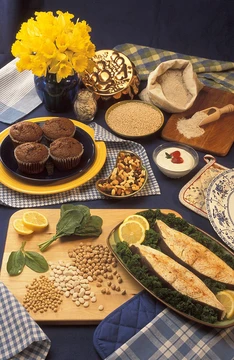
Riboflavin deficiency is uncommon and typically occurs alongside shortages of other vitamins and nutrients. It can be prevented or treated with oral supplements or injections. Because it is water-soluble, any extra riboflavin beyond what the body needs is not stored; it is either not absorbed or is quickly flushed out in urine, which can turn a bright yellow color. Natural food sources include meat, fish, poultry, eggs, dairy, green vegetables, mushrooms, and almonds. Some countries mandate adding riboflavin to grain products.
In its pure, solid form, riboflavin is a yellow-orange crystalline powder that dissolves in water. Besides being a vitamin, it is used as a food coloring agent. Living things that can produce riboflavin include bacteria, fungi, and plants, but not animals. Industrial production originally used chemical methods, but today most commercial manufacturing relies on fermentation with fungi and genetically modified bacteria. In 2023, riboflavin ranked as the 294th most prescribed medication in the United States, with over 400,000 prescriptions written.
Riboflavin is a single chemical compound, unlike folate or vitamin B6, which have multiple related forms called vitamers. It serves as the starting point for making FMN and FAD. FAD is the more common flavin coenzyme, binding to about 75% of flavin-dependent protein genes across all species and acting as a coenzyme for 84% of human flavoproteins. In purified powder form, it has a slight odor and bitter taste, is soluble in water and salty water, slightly soluble in alcohols, and not soluble in non-polar solvents like chloroform, benzene, or acetone. It withstands heat well when dry or in solution, as long as it is kept away from light. If heated to decomposition, it releases toxic fumes containing nitric oxide.
The coenzymes FMN and FAD are vital for energy metabolism, cell respiration, antibody production, and growth. Riboflavin is needed to metabolize carbohydrates, proteins, and fats. FAD helps convert tryptophan into niacin (vitamin B3), and FMN is required to turn vitamin B6 into its active coenzyme form. Riboflavin also helps maintain normal homocysteine levels; a deficiency raises homocysteine, increasing cardiovascular disease risk.
Flavin coenzymes support about 70 to 80 flavoenzymes in humans (and many more in other organisms) that handle one- or two-electron redox reactions, taking advantage of flavins’ ability to shift between oxidized, half-reduced, and fully reduced states. FAD is also needed for glutathione reductase, an enzyme essential for making the antioxidant glutathione.
Riboflavin, FMN, and FAD are involved in processing niacin, vitamin B6, and folate. For example, making NAD and NADP from tryptophan requires an FAD-dependent enzyme, so riboflavin deficiency can reduce NAD and NADP production and promote niacin deficiency. Converting vitamin B6 to its active form uses an FMN-dependent enzyme. Folate metabolism also relies on FAD for an enzyme that turns homocysteine into methionine. Riboflavin deficiency can impair iron metabolism, and correcting it in people low in both riboflavin and iron improves the effectiveness of iron supplements for treating iron-deficiency anemia.
Biosynthesis of riboflavin occurs in bacteria, fungi, and plants, but not animals. The process starts with ribulose 5-phosphate and guanosine triphosphate. Ribulose 5-phosphate becomes L-3,4-dihydroxy-2-butanone-4-phosphate, while guanosine is broken down to 4-hydroxy-2,4,5-triaminopyrimidine, which turns into 5-amino-6-(D-ribitylamino)uracil. These two compounds then react in a step catalyzed by lumazine synthase. In the final step, two molecules of 6,7-dimethyl-8-ribityllumazine are combined by riboflavin synthase, producing one molecule of riboflavin and one of 5-amino-6-(D-ribitylamino)uracil, which is recycled back into the pathway.
- field
- Biochemistry, Nutrition, Medicine
- known_for
- Essential vitamin for coenzyme formation, treatment of corneal thinning, migraine prevention, food coloring agent
- chemical_formula
- C17H20N4O6
- E_number
- E101 (food additive)
Lore & Background
Riboflavin is a starting compound in the synthesis of the coenzymes FMN and FAD. FAD is the more abundant form, binding to 75% of flavin-dependent protein encoded genes across all species and serving as a co-enzyme for 84% of human-encoded flavoproteins. In its purified solid form, riboflavin is a yellow-orange crystalline powder, soluble in water and polar solvents, and heat stable if not exposed to light. Biosynthesis of riboflavin occurs in bacteria, fungi, and plants, but not animals. Industrial synthesis initially used a chemical process, but current commercial manufacturing relies on fermentation methods using strains of fungi and genetically modified bacteria, such as Bacillus subtilis.
Reader's Guide
Riboflavin is significant for its essential role in human health, particularly through its conversion to the coenzymes FMN and FAD, which are critical for redox reactions, energy metabolism, and the metabolism of other vitamins such as niacin, vitamin B6, and folate. Its deficiency is rare and usually accompanied by other deficiencies, but it can impair iron metabolism and increase homocysteine levels, elevating cardiovascular risk. As a food additive (E101), it provides a yellow-orange color. The National Academy of Medicine has established dietary recommendations, with RDAs of 1.1 mg/day for women and 1.3 mg/day for men.
Did You Know?
- Riboflavin is the only chemical compound of vitamin B2, unlike folate and vitamin B6 which occur in several related forms.
- Excess riboflavin is not stored in the body and is excreted in urine, causing a bright yellow tint.
- Riboflavin is used as a food coloring agent, designated as E101 in Europe.
Frequently Asked Questions
What are Riboflavin's powers / role?
Its primary function is acting as the precursor for two coenzymes, FMN and FAD, which power the cell's energy-harvesting and respiration pathways. It also plays a supporting role in building antibodies and guiding normal growth and development.
How does Riboflavin's story end?
Because the body flushes excess riboflavin out in urine rather than storing it, a long-term shortfall can cause cracked lips, a sore throat, and vision problems. On the bright side, clinicians can use it therapeutically to help thicken a weakened cornea.
Why is Riboflavin important?
Without adequate riboflavin, cells struggle to convert the food you eat into usable energy, and immune defenses weaken. Research also suggests that regular oral intake may help some adults reduce the frequency of migraine episodes.
Where does Riboflavin come from?
You'll find it naturally in dairy products, eggs, leafy vegetables, and fortified grains, and it also serves as a yellow colorant in processed foods. Because it dissolves in water, cooking in excess liquid can leach some of it away, so a varied diet is the best way to stay topped up.
More in Nutrition And Diet 1-22
Spotted an error? Know more?
This is a living reference — every entry is fact-audited, and reader corrections feed straight into our audit queue. Suggest an edit · See this site's audit record