Biotin
Essential B vitamin, cofactor for carboxylase enzymes in metabolism.

Biotin—also called vitamin B7 or vitamin H—belongs to the B-vitamin family, a set of essential micronutrients the body cannot make on its own. It exists in every living cell, acting as a cofactor for enzymes that handle the metabolism of fats, carbohydrates, and amino acids in humans and other organisms. In its pure form, biotin appears as a white, needle-like crystalline solid. People get it from foods, especially meats and liver, and it is also sold as a dietary supplement. The name comes from the German *Biotin*, which traces back to the Ancient Greek *βίοτος* (bíotos, meaning “life”) plus the chemistry suffix “-in.”
Chemically, biotin is a heterocyclic compound built from a sulfur-containing tetrahydrothiophene ring fused to a ureido group, with a five-carbon carboxylic acid side chain attached to the ring. The ureido group (with its –N–CO–N– structure) carries carbon dioxide in carboxylation reactions. Biotin acts as a coenzyme for five carboxylase enzymes involved in breaking down amino acids and fatty acids, building fatty acids, and making glucose. It also plays a role in chromatin stability and gene expression through the biotinylation of histone proteins in nuclear chromatin.
For dietary recommendations, the US National Academy of Medicine updated its Dietary Reference Intakes for many vitamins in 1998. At that time, not enough data existed to set an estimated average requirement or recommended dietary allowance for biotin, as is done for most vitamins. Instead, the academy established adequate intakes (AIs), expecting that better understanding of biotin’s physiological effects would eventually allow more precise numbers. The AIs for biotin are the same for males and females. Australia and New Zealand set similar AIs. The European Food Safety Authority (EFSA) also uses AIs: 40 μg/day for adults, 40 μg/day during pregnancy, and 45 μg/day while breastfeeding. For children aged 1 to 17, AIs rise with age from 20 to 35 μg/day.
Regarding safety, the US National Academy of Medicine sets upper limits for vitamins and minerals only when there is enough evidence of a true limit. For biotin, no upper limit exists because adverse effects from high intake have not been identified. The EFSA reviewed the matter and reached the same conclusion.
For labeling in the US, food and dietary supplement packages show biotin content as a percent of daily value. Originally, 100% of the daily value was 300 μg/day, but as of May 27, 2016, it was revised to 30 μg/day to match the adequate intake. Manufacturers with $10 million or more in annual food sales had to comply by January 1, 2020; those with lower sales had until January 1, 2021.
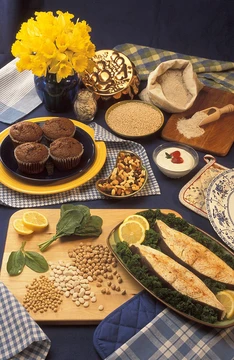
Biotin is stable at room temperature and survives cooking. In Western populations, typical dietary intake ranges from 40 to 60 μg/day. Nursing infants need about 5 μg/day. Biotin is sold as a standalone supplement or as part of multivitamins. According to the Global Fortification Data Exchange, biotin deficiency is so rare that no country mandates food fortification with it.
As a water-soluble B vitamin, biotin taken in large supplement doses is absorbed and then excreted in urine as biotin. When consumed through a normal diet, urine contains both biotin and its metabolites.
In food, biotin is bound to proteins. Digestive enzymes break those proteins into biotin-bound peptides. The intestinal enzyme biotinidase—found in pancreatic secretions and the brush border membranes of all three small intestine sections—frees the biotin, which is then absorbed from the small intestine. When taken as a supplement, absorption is nonsaturable, meaning even very high amounts are effectively absorbed. Transport across the jejunum is faster than across the ileum. Bacteria in the large intestine produce biotin in amounts estimated to be similar to dietary intake, and much of this biotin is free (not protein-bound), so it is available for absorption. How much humans actually absorb from this source is unknown, though one review noted that human colon epithelial cells in culture can take up biotin. Once absorbed, the sodium-dependent multivitamin transporter (SMVT) carries biotin into the liver. SMVT also transports pantothenic acid, so high intakes of either vitamin can interfere with the other’s transport.
Biotin is broken down through two pathways. One cleaves the valeric acid side chain to produce bisnorbiotin; the other oxidizes the sulfur to form biotin sulfoxide. Urine content is roughly half biotin, plus bisnorbiotin, biotin sulfoxide, and small amounts of other metabolites.
Several factors can affect biotin requirements. Chronic alcohol use is linked to significantly lower plasma biotin. Intestinal biotin uptake appears sensitive to the anti-epilepsy drugs carbamazepine and primidone. Relatively low biotin levels in urine or plasma have been reported in patients with partial gastrectomy or other causes of achlorhydria, as well as in burn patients, elderly individuals, and athletes. Pregnancy and lactation may increase demand—possibly due to faster biotin catabolism during pregnancy, though the reason during lactation is unknown. Recent studies suggest marginal biotin deficiency can occur during human gestation.
- chemical_class
- Heterocyclic compound with a sulfur-containing tetrahydrothiophene ring fused to a ureido group
- dietary_reference
- Adequate intake (AI) for adults: 30 μg/day (US), 40 μg/day (EFSA)
- deficiency_status
- Rare; subclinical deficiency may cause hair thinning, brittle nails, or skin rash
- upper_limit
- None established; adverse effects of high intake not determined
- food_sources
- Meats, liver; stable at room temperature, not destroyed by cooking
Lore & Background
Biotin, when isolated, appears as a white, needle-like crystalline solid. It is a heterocyclic compound, structurally characterized by a sulfur-containing tetrahydrothiophene ring fused to a ureido group, with a C5-carboxylic acid side chain attached to the tetrahydrothiophene ring. The ureido ring, which contains the -N-CO-N- group, functions as a carrier for carbon dioxide in carboxylation reactions. As a coenzyme, biotin is essential for five carboxylase enzymes that participate in the catabolism of amino acids and fatty acids, the synthesis of fatty acids, and gluconeogenesis. Additionally, biotin plays a role in chromatin stability and gene expression through the biotinylation of histone proteins in nuclear chromatin. Present in every living cell, biotin is obtained from dietary sources such as meats and liver, and is also available as a dietary supplement. The name "biotin" is derived from the Ancient Greek word for 'life' combined with the chemical suffix "-in".
Reader's Guide
Biotin is a water-soluble B vitamin essential for metabolic processes in humans and other organisms. Its primary biochemical role is as a cofactor for five carboxylase enzymes, including acetyl-CoA carboxylase and pyruvate carboxylase, which are critical for fatty acid synthesis, gluconeogenesis, and amino acid metabolism. Dietary biotin is obtained from foods like meats and liver, and deficiency is rare due to its wide availability. The US National Academy of Medicine and the European Food Safety Authority have established adequate intakes rather than recommended dietary allowances due to insufficient data for more precise requirements. No upper limit for biotin intake has been set, as adverse effects from high intake have not been determined. Biotin is stable during cooking and is absorbed efficiently from the small intestine, with the large intestine microbiota also synthesizing biotin. Factors such as chronic alcohol use, certain anti-epilepsy drugs, and pregnancy may increase biotin requirements. Biotin deficiency, though rare, can result from genetic disorders like biotinidase deficiency, which is screened for at birth in many countries and treated with lifelong biotin supplementation.
Did You Know?
- Biotin is also known as vitamin B7 and vitamin H.
- The name biotin derives from the Ancient Greek word βίοτος (bíotos; 'life') and the suffix '-in'.
- Biotin is a coenzyme for five carboxylase enzymes involved in metabolism.
- No countries require foods to be fortified with biotin due to the rarity of deficiency.
More in Nutrition And Diet 1-22
Spotted an error? Know more?
This is a living reference — every entry is fact-audited, and reader corrections feed straight into our audit queue. Suggest an edit · See this site's audit record