Henry Street Settlement
Social service agency founded by nurse Lillian Wald in 1893.
Last updated

via Wikipedia: Henry Street Settlement · see source
Where it is
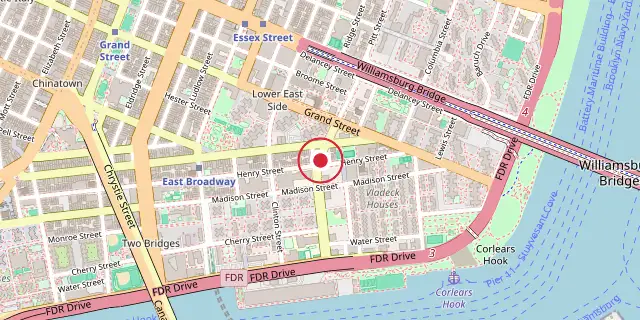
Coordinates: 40°42′50″N 73°59′06″W (40.7140, -73.9850) · Open in OpenStreetMap
Coordinates and connected clubs: the infobox of Wikipedia: Henry Street Settlement (CC BY-SA 4.0). Map: drawn by Codexery from OpenStreetMap tiles.
The Henry Street Settlement is a not-for-profit social service agency on the Lower East Side of Manhattan, New York City. It was founded in 1893 as the Nurses' Settlement by progressive reformer and nurse Lillian Wald. The organization provides social services, arts programs, and health care services to New Yorkers of all ages.
History
In 1892, Lillian Wald, a 25-year-old nurse enrolled in the Women's Medical College, volunteered to teach a home health care class for immigrant women at the Louis Down-Town Sabbath and Daily School on the Lower East Side. A young girl approached her, repeating 'mommy ... baby ... blood'; Wald gathered sheets from her bed-making lesson and followed the child to a cramped two-room tenement apartment, where she found the child's mother who had recently given birth and needed health care.
The doctor had left because she could not afford to pay him. Wald called this her 'baptism by fire' and dedicated herself to bringing nursing care, education, and access to the arts to the immigrant poor. She founded the Nurses' Settlement the next year, later renamed the Henry Street Settlement. Mabel R. Goodlander, later a significant figure in progressive education through her work with the Ethical Culture School, worked with Wald at the Settlement.
In 1895, banker and philanthropist Jacob Schiff purchased the Federal style townhouse at 265 Henry Street for the organization; an additional story was added, and Schiff donated the building in 1903. The year before, the Settlement had added a gymnasium at 299, 301, and 303 Henry Street. In 1906, Morris Loeb bought the building at 267 Henry Street for the Settlement; this Greek Revival townhouse had been purchased from the Hebrew Technical School for Girls, which had employed Buchman & Fox in 1900 to redo the facade in Colonial Revival style.
Alice P. Gannett served as Associate headworker in 1912. In 1915, the Neighborhood Playhouse, one of the first 'Little Theatres', was created by sisters Alice and Irene Lewisohn at the corner of Grand and Pitt Streets, offering classical drama; it still operates as the Harry De Jur Playhouse.
Description
Each year, roughly 50,000 people turn to the Henry Street Settlement for support. Its clients include low-income families, domestic violence survivors, youth from ages 2 to 21, people with physical or mental health conditions, seniors, and those who visit the Abrons Arts Center for performances, classes, or exhibitions. The organization’s main offices remain in the original federal-style row houses at 263, 265, and 267 Henry Street, built around 1832.
It runs programs at 17 locations across the area, many inside New York City Housing Authority buildings. The three Henry Street buildings were named New York City landmarks in 1966, added to the National Register of Historic Places in 1974, and designated a National Historic Landmark in 1989. In 2022, 265 and 267 Henry Street were relisted on the NRHP as the Lillian Wald House.
Services
Henry Street Settlement provides housing through four homeless shelters, one specifically for survivors of domestic violence, along with permanent supportive housing for formerly homeless people dealing with mental health conditions. Its senior offerings include a Naturally Occurring Retirement Community, the Good Companions Senior Center, a Senior Companion Program, and Meals-on-Wheels. Youth programs feature day care, after-school activities, college preparation, job opportunities, GED classes, sports and recreation, a peer HIV prevention initiative, and a summer day camp.
The Workforce Development Center supplies job training, placement, and customized staffing. Health and Wellness Services run state-licensed mental health and primary care clinics, psychological counseling, a continuing day treatment program, a parent center, HIV family services, and home housekeeping. The Abrons Arts Center at 466 Grand Street offers affordable classes in dance, music, visual arts, and theater, with performances in three theaters including a 1915 playhouse, plus exhibitions, artist residencies, an arts-in-education program, and two summer camps focused on arts and architecture.
Did You Know?
- Lillian Wald was only 25 years old and enrolled in the Women's Medical College when she founded the Nurses' Settlement in 1893.
- The Settlement's first building at 265 Henry Street was purchased by banker Jacob Schiff in 1895 and donated to the organization in 1903.
- The Henry Street Music School, which opened in 1927, premiered the play-opera 'The Second Hurricane' in 1937 with music by Aaron Copland and direction by Orson Welles.
- In 2021, the New York State Historic Preservation Office designated 265–267 Henry Street as an LGBT historic site based on Lillian Wald's relationships with the women she called 'The Family'.
More in Nursing Organizations in the United States
Sources
Compiled from Wikipedia and the sources listed below. Text from Wikipedia is available under CC BY-SA 4.0; this entry is adapted from it.
- Wikipedia: Henry Street Settlement (CC BY-SA 4.0).
Spotted an error? Know more?
Reader corrections go straight into our review queue. Suggest an edit · How this site is sourced