Frequently Asked Questions
The most-asked questions about nudibranchs and sea slugs.
What exactly is a nudibranch?
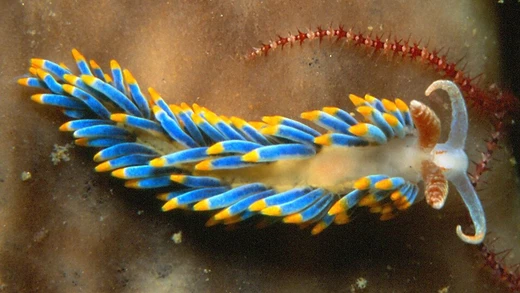
A nudibranch is a shell-less marine gastropod belonging to the order Nudibranchia, a subgroup of opisthobranch sea slugs that evolved away from carrying a protective shell. They are instantly recognizable by their exposed gills, often vivid warning coloration, and soft, slug-like body.
How are nudibranchs different from other sea slugs?
All nudibranchs are sea slugs, but the broader Opisthobranchia group also includes sea hares, sea butterflies, and bubble shells, which retain a shell or have very different body plans. Nudibranchs are the shell-less, typically brightly colored subset with a pair of rhinophores and a posterior gill plume that gave the group its name.
Can a nudibranch harm a human?
No. Nudibranchs lack venom, stinging cells, or any other mechanism to injure people. A few species may taste or smell unpleasant as a chemical deterrent aimed at fish and other marine predators, but they pose no risk to divers or swimmers.
Where in the world can you find them?
Nudibranchs occur in tropical, subtropical, and temperate seas on every continent, with the highest diversity in Indo-Pacific reef systems such as the Coral Sea and the Great Barrier Reef. They are commonly spotted on coral rubble, seagrass meadows, rocky intertidal zones, and even kelp forests at moderate depths.
How do nudibranchs reproduce?
The vast majority are simultaneous hermaphrodites, carrying both a testis and an ovary, and they typically mate in pairs, swapping sperm at the same time. After fertilization, the female deposits eggs in a coiled ribbon or spiral that is cemented to a substrate, and the young hatch as free-swimming veligers before settling.
What are some of the most famous or visually striking species?
Chromodoris species (often called rainbow nudibranchs) are among the most photographed for their electric blue-and-yellow patterns, while the giant nembrotha (Nembrotha kubaryana) can reach roughly 30 cm and is one of the largest in the group. Flabellina nudibranchs, with their feathery cerata and translucent bodies, are another fan favorite on tropical reefs.
How do nudibranchs defend themselves without a shell?
They rely on aposematic (warning) coloration to advertise unpalatability, and many sequester toxic compounds from their sponge, hydroid, or tunicate prey, storing the chemicals in their skin or cerata. Some aeolid nudibranchs can also autotomize individual cerata to distract a predator, and a few flabellines practice kleptoplasty, incorporating stolen chloroplasts to supplement their energy intake.
What do nudibranchs eat?
Diet is highly specialized: chromodorids and many dorids graze on sponges, aeolids feed on hydroids or anemones, and pleurobranchids consume tunicates or bryozoans. Because of this narrow menu, a species that thrives on one reef type may starve if transplanted to a habitat lacking its particular food source.
Can you keep a nudibranch in a home aquarium?
It is possible but demanding; most species require a steady supply of live, species-specific prey, stable salinity, and low nitrate levels, and many are sensitive to copper-based medications. For these reasons experienced aquarists generally advise beginners to observe rather than keep them, as captive lifespans are often only a few months.
How long do nudibranchs typically live?
In the wild most species complete their life cycle within one to three years, though larger dorids and nembrothas may persist a bit longer. In captivity, where stress, diet mismatches, and water-quality fluctuations are common, lifespans are usually shorter, often only a few months.