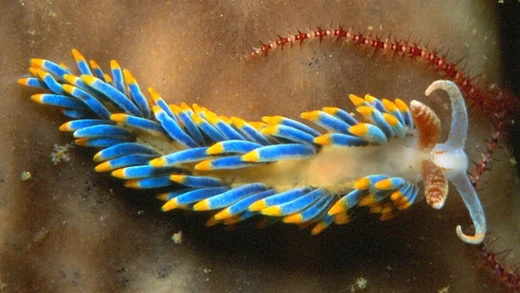
Phyllidiella striata
A dorid nudibranch with black body and grey-pink tuberculate ridges.
Last updated

N Yonow · via Wikipedia: Phyllidiella striata · CC BY 3.0
A dorid nudibranch lacking a shell, Phyllidiella striata belongs to the family Phyllidiidae and is a marine gastropod mollusc.[1] On its black back, this sea slug displays longitudinal grey-pink ridges that are broken and covered with small bumps.[1][2]
Scientific classification
- KingdomAnimalia
- PhylumMollusca
- ClassGastropoda
- OrderNudibranchia
- FamilyPhyllidiidae
- GenusPhyllidiella
- SpeciesPhyllidiella striata
Named by (Bergh, 1889)
Close relatives
Other species of Phyllidiella with a Codexery entry.
- Phyllidiella pustulosa Phyllidiella pustulosa
Sources: Wikipedia taxobox: Phyllidiella striata (CC BY-SA 4.0) · order, family and genus agree with WoRMS AphiaID 599828 (CC BY 4.0)
How big is it?
Largest length in the source, 0.04 m, next to a 1.8 m person.
Diagram: drawn by Codexery, schematic shapes to scale (not a likeness). Length: Wikipedia: Phyllidiella striata
Where the phyllidiella striata has been recorded
Each dot is a place where the species has been observed and reported (157 records, half-degree grid) — not a modelled range. 2 inland records left out (institution coordinates).
Map: drawn by Codexery. Data: GBIF occurrence search (records CC0 / CC BY) · Natural Earth basemap (public domain)
Key facts and history
The maximum recorded length for Phyllidiella striata is 35 mm.[3] Longitudinal rows of tubercles in pink, grey, greenish, or bluish colors cover the black dorsal surface.[4] A uniform pale grey coloration is found on the underside of the body.[4] The Philippines served as the location for the original description of this species.[4]
Sponges constitute the diet of this species.[4] Phyllidiella striata, like all nudibranchs, possesses both male and female reproductive organs.[4]
What the cited sources add
The DORIS account notes that all species of the genus Phyllidiella have black rhinophores.[3] The ridges of Phyllidiella striata are always discontinuous, unlike the continuous ridges of similar species.[3] Some authors consider this species a variant of Phyllidiella pustulosa, but WoRMS maintains it as valid.[3] This species exudes a milky-white defensive substance from its dorsal glands.[3]
The ventral side is uniformly grey, which sets it apart from Phyllidiella rosans, a species that exhibits two dark bands on its underside.[3]
References
- Wikipedia, "Phyllidiella striata" (CC BY-SA 4.0), which cites: Bouchet, P. (2015). Phyllidiella striata (Bergh, 1889). In: MolluscaBase (2015). Accessed through: World Register of Marine Species on 2016-11-05. (original not read by us) en.wikipedia.org
- Wikipedia, "Phyllidiella striata" (CC BY-SA 4.0), which cites: Yonow N., Anderson R.C., Buttress S.G. (2002) Opisthobranch molluscs from the Chagos Archipelago, Central Indian Ocean. Journal of Natural History 36: 831–882. (original not read by us) en.wikipedia.org
- Poddubetskaia Ossokine, Marina, "Phyllidiella striata (Bergh, 1889)", DORIS, 10 May 2020. facts only, no text reused. doris.ffessm.fr
- Wikipedia, "Phyllidiella striata" (CC BY-SA 4.0), which cites: Poddubetskaia Ossokine, Marina, "Phyllidiella striata (Bergh, 1889)", DORIS, 10 May 2020 (we also read that source) en.wikipedia.org
Each numbered sentence above was checked against the source it cites before publication. Sentences citing Wikipedia adapt text from the English Wikipedia article Phyllidiella striata (contributors), used under CC BY-SA 4.0; this entry is available under the same licence. Other sources were used for facts only; no text or images are copied from them.
More in Nudibranchs and Sea Slugs
Sources
Compiled from Wikipedia and the sources listed below. Text from Wikipedia is available under CC BY-SA 4.0; this entry is adapted from it.
- Wikipedia: Phyllidiella striata (CC BY-SA 4.0).
- Classification: the source article's taxobox; order, family and genus checked against WoRMS, the World Register of Marine Species (CC BY 4.0).
- Occurrence records: GBIF (CC0 / CC BY). Basemap: Natural Earth (public domain).
- Word definitions: the Codexery glossary, each quoted from its Wikipedia article.
Spotted an error? Know more?
Reader corrections go straight into our review queue. Suggest an edit · How this site is sourced