Frequently Asked Questions
The most-asked questions about nudibranchs and sea slugs, part 2.
What's the actual difference between a nudibranch and a sea slug?
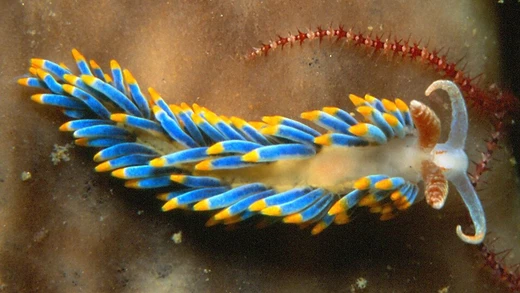
A nudibranch is a specific order (Nudibranchia) within the broader group of shell-less sea slugs, which also includes sea hares, aeolids, and other opisthobranch molluscs. In casual use, 'sea slug' is the umbrella term while 'nudibranch' refers to the group with the distinctive external gills, well-developed rhinophores, and often vivid coloration.
How do some nudibranchs 'steal' stinging cells from their prey?
Certain species, especially aeolid nudibranchs like those in the family Aeolidiidae, feed on cnidarians such as anemones or hydroids and store the undischarged nematocysts in specialized structures called cnidosacs near their tips. When threatened, they can fire those borrowed stinging cells at predators, effectively weaponizing their own food source.
What are rhinophores and how do nudibranchs actually use them?
Rhinophores are the two horn-like sensory organs on a nudibranch's head that function as chemical detectors, analogous to a nose. They contain thousands of chemoreceptor cells that sample dissolved compounds in the water, allowing the animal to locate food, detect predators, and find mates over considerable distances.
What is kleptoplasty and which sea slugs are known for it?
Kleptoplasty is the process by which a nudibranch ingests the chloroplasts of its algal prey and incorporates them into its own tissue, where they continue photosynthesizing for weeks or months. The most famous examples are the sea butterflies (Pteroplacota) and the sacoglossan slug Elysia chlorotica, which can sustain itself on photosynthetic products for extended periods.
Why do some nudibranchs display aposematic (warning) coloration?
Many nudibranchs accumulate toxic compounds from their sponge, tunicate, or cnidarian diets and store them in their skin, making them unpalatable or dangerous to eat. Their bright reds, yellows, and electric blues serve as an honest advertisement to predators that the animal is toxic, a strategy called aposematism.
How do nudibranchs reproduce, and what's unusual about it?
Nearly all nudibranchs are simultaneous hermaphrodites, carrying both male and female reproductive organs, and they typically mate in pairs, exchanging sperm. After fertilization, the female lays a coiled ribbon or spiral of eggs on a hard substrate, and some species even guard the clutch until the young hatch.
Which nudibranch species are most popular in home reef aquaria and why?
The blue-ringed nudibranch (Chromodoris annae), the Mexican sunflower sea slug (Hermissenda crassicornis), and the flame shell (Crimora papillata) are commonly kept because they are hardy, visually striking, and feed on readily available sponges or algae. They generally tolerate stable salinity and temperature but require a well-established tank with live rock to forage on.
What makes the 'blue-ringed' nudibranch particularly dangerous to handle?
Chromodoris species with blue rings over a brown or black body sequester potent tetrodotoxin-like alkaloids from their sponge prey, which can cause severe skin irritation, numbness, and in rare cases systemic toxicity in humans who handle them. Their small size and cryptic coloration when not displaying the rings make accidental contact more likely than with larger, brighter nudibranchs.
What are the major subgroups within Nudibranchia and how do they differ?
The order is broadly split into Doridina (with a well-developed branchial plume and often a distinct mantle), Aeolidiida (with elongated, feathery cerata and no external gill cluster), and Gymnodoridina (with a reduced or absent gill structure and a more streamlined body). These groups differ in feeding ecology, defensive strategy, and geographic range, with aeolids tending toward carnivory on cnidarians and dorids favoring sponges and tunicates.
Are there any nudibranchs that are bioluminescent, and how does that work?
A small number of deep-sea and temperate nudibranchs, such as certain species in the family Facelinidae, produce faint blue-green light through a luciferin-luciferase reaction in their tissue. The exact ecological role is still debated, but hypotheses include startle-defense against predators, communication during mating, or attracting small prey organisms in low-light environments.