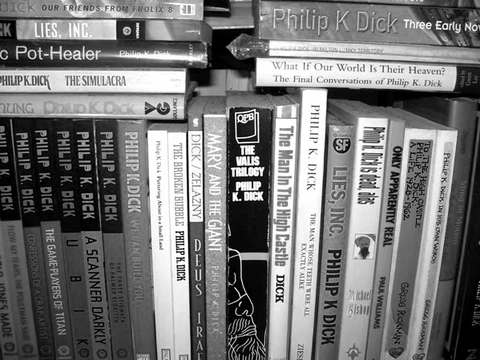
A Scanner Darkly
A semi-autobiographical novel about drug addiction and identity.
American writer Philip K. Dick published the science fiction novel A Scanner Darkly in 1977. This semi-autobiographical work, set in a dystopian Orange County, California, during the imagined June of 1994, offers a deep look into recreational and abusive drug use. Among Dick's most famous works, it was adapted into a 2006 film directed by Richard Linklater.
Quick Facts
- Author
- Philip K. Dick
- Country
- United States
- Language
- English
- Genre
- Science fiction
- paranoid fiction
- philosophical literature
- Publisher
- Doubleday
- Released
- 1977
- Format
- Print (Hardback & Paperback)
- Pages
- 220 (1st edition)
Facts from the source article.
Did You Know?
- Dick joined a Canadian Synanon-type recovery program called X-Kalay, convincing staff he was a heroin addict, and while doing publicity for the facility he devised the idea of rehab centers secretly harvesting drugs.
- The novel's scramble suit emerged from one of Dick's mystical experiences in early 1974.
- In the afterword, Dick dedicates the book to his friends who experienced debilitation or death from drug use, including himself.
Plot summary
The protagonist, Bob Arctor, is a member of a household of drug users who lives a double life as an undercover police agent assigned to spy on that same household. To avoid collusion and corruption, narcotics agents remain anonymous, a requirement that becomes a critical plot point. While posing as a user, Arctor becomes addicted to "Substance D" (also called "Slow Death", "Death" or "D"), a powerful psychoactive drug. His love for Donna, a drug dealer, creates a conflict, as he intends through her to identify high-level dealers of Substance D. As an undercover agent, Arctor goes by the name "Fred" and wears a "scramble suit" that conceals his identity from other officers. He sits in a police facility and observes his housemates via "holo-scanners" placed throughout the house. His drug use causes the two hemispheres of his brain to function independently, so when he sees himself in the videos he does not recognize himself. Tests reveal his addiction has made him incapable of his job, but his superiors do not know his identity because of the scramble suit. Donna takes Arctor to "New-Path", a rehabilitation clinic, as he begins withdrawal. It is revealed that Donna has been a narcotics agent all along, working to infiltrate New-Path. Without his knowledge, Arctor is selected to penetrate the organization, renamed "Bruce", and forced into cruel group-dynamic games intended to break patients' wills.
Autobiographical nature
Philip K. Dick turned his own life into the raw material for A Scanner Darkly, insisting that everything in the book was something he had witnessed. After his fourth wife left him in 1970, he opened his four-bedroom home in Marin County to a revolving cast of mostly teenage drug users, filling the empty space with street people. During this stretch, Dick stopped writing entirely and became fully hooked on amphetamines, a drug he had taken on and off for years. The character Donna was based on an older teenager he met in 1970; they were never romantically involved, but she remained his closest female companion until early 1972, when he traveled to Vancouver to give a speech called "The Android and the Human." That talk supplied many of the novel's recurring ideas. Around the same time, Dick's home was allegedly burglarized and his papers stolen. After the speech, he joined X-Kalay, a Canadian recovery program modeled on Synanon, and convinced the staff he was a heroin addict. His time in the program later appeared in the posthumous collection The Dark Haired Girl. While doing publicity for X-Kalay, Dick came up with the concept of rehab centers that secretly harvest drugs, which became the New-Path clinics in the book.
Background and publication
A Scanner Darkly was one of the few Dick novels to gestate over a long period. By February 1973, newly clean and sober, Dick had prepared a full outline to prove his amphetamine usage effects were psychosomatic. A first draft was in development by March. This labor was supplanted by a new family and the completion of Flow My Tears, The Policeman Said, released in 1974 and receiving the John W. Campbell Award. Additional preoccupations included mystical experiences of early 1974 that became the basis for VALIS and the Exegesis journal; a screenplay for an unproduced film adaptation of Ubik; occasional lectures; and the expedited completion of the deferred Roger Zelazny collaboration Deus Irae in 1975. Because of its semi-autobiographical nature, some of the writing was torturous. Tessa Dick, Philip's wife at the time, stated she often found her husband weeping as the sun rose after a night-long writing session. She said he wrote A Scanner Darkly in under two weeks, but they spent three years rewriting it, and she was "pretty involved in his writing process." Tessa later stated she "participated in the writing" and considered herself "the silent co-author." Philip wrote a contract giving Tessa half of all rights to the novel, stating she "participated to a great extent in writing the outline and novel A Scanner Darkly with me." There was also the challenge of transmuting events into science fiction, as Dick felt he could not sell a mainstream novel after several failures. Judy-Lynn del Rey, head of Ballantine Books' SF division, suggested the timeline change to 1994 and emphasized futuristic elements like the scramble suit, which emerged from one of the mystical experiences. Much dialogue used hippie slang, dating events to their true timeframe of 1970–72.
General and cited sources
Sources for the novel include a 2006 article by V. Bell in The Psychologist titled "Through a scanner darkly: Neuropsychology and psychosis in A Scanner Darkly.
More in Novels by Philip K. Dick
Spotted an error? Know more?
Reader corrections go straight into our review queue. Suggest an edit · How this site is sourced