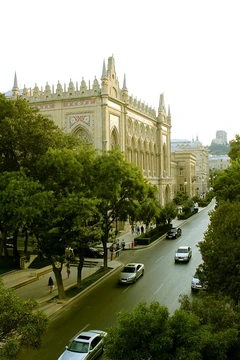
Doge's Palace
Palace of the Doge, seat of Genoese government and justice.

via Wikipedia: Molo (Genoa) · see source
The Doge's Palace, a prominent landmark in Venice, Italy, is a prime example of Venetian Gothic architecture. Originally constructed in 810 after the seat of government moved to the Rialto area, the building served as the residence of the elected Doge of Venice and housed the republic’s government offices and a jail. The initial structure was partially destroyed by a fire set by rebels in the 10th century. Reconstruction under Doge Sebastiano Ziani in the late 12th century introduced Byzantine-Venetian features, including a base of Istrian stone and herringbone brick paving, though few traces remain. A major rebuilding campaign began around 1340, focusing on the lagoon-facing side, and extended in 1424 to the wing overlooking the Piazzetta, which included law courts and the Porta della Carta, completed in 1442. A fire in 1483 damaged the Doge’s Apartments, leading to a Renaissance-influenced reconstruction by Antonio Rizzo along the canal. Subsequent fires in 1574 and 1577 destroyed key rooms, including the Great Council Chamber and works by artists like Giovanni Bellini and Titian, but the original Gothic style was preserved despite neo-classical proposals from Andrea Palladio. The palace later became linked to the prison by the Bridge of Sighs. After the Napoleonic occupation in 1797, it housed administrative offices and cultural institutions. By the late 19th century, decay prompted restoration, and in 1923 the Italian State turned it into a museum managed by the municipality. Since 2008, it has been part of the Fondazione Musei Civici di Venezia.
- Original construction
- c. 814
Verified Timeline
Lore & Background
The Doge's Palace in Genoa began its life in the late 13th century, built as the seat for the Captain of the People. In the late 16th century, architect Andrea Ceresola redesigned the building into the form that would define it for centuries. A devastating fire in 1777 partially destroyed the palace, leading to a reconstruction by Simone Cantoni, who gave it the neoclassical facade that now overlooks Piazza Matteotti. After the Republic ended, the palace served as the town hall and later as a court, a role it held until 1970. The annex tower, the Torre Grimaldina, was used as a prison for political prisoners; in 1833 the patriot Jacopo Ruffini committed suicide there. Contiguous to the palace is the so-called 'Criminal Palace,' built at the end of the 16th century, which housed the court and prison for common criminals during the Republic and now holds the State Archives.
Reader's Guide
The Doge's Palace sits in the Molo neighborhood, which for centuries was the seat of political and religious power in Genoa. The palace complex includes the main building, the Torre Grimaldina, and the Criminal Palace. The Torre Grimaldina was used for political prisoners, most notably holding the patriot Jacopo Ruffini, who died by suicide there in 1833. The Criminal Palace, built at the end of the 16th century, served as the court and prison for common criminals during the Republic; today it houses the State Archives. After a complete renovation in the 1980s, the palace opened in 1992 to host exhibitions and cultural events. In 2001, it was the venue for the G8 summit conference, where Heads of State and Government met. The palace is located near St. Lawrence cathedral and the old harbour, in an area that has seen recovery and restoration in recent decades.
Did You Know?
- The Doge's Palace was originally built in the late 13th century as the seat for the Captain of the People.
- A fire in 1777 partially destroyed the palace, leading to a reconstruction by Simone Cantoni who designed the current neoclassical facade.
- The Torre Grimaldina, an annex tower, was used as a prison for political prisoners; the patriot Jacopo Ruffini committed suicide there in 1833.
- The Criminal Palace, built at the end of the 16th century, served as the court and prison for common criminals during the Republic and now houses the State Archives.
- In 2001, the palace hosted the G8 summit conference where Heads of State and Government met.
Architectural Metamorphosis: From Medieval Seat to Neoclassical Landmark
The Doge's Palace in Genoa is a structure reshaped by centuries of ambition, disaster, and reinvention. Its story begins in the late 13th century, when the building was first erected to serve as the seat of the Captain of the People, a key figure in the young self-governing commune. By the late 16th century, the architect Andrea Ceresola had reimagined the palace into the form that would define its identity for generations. Yet the building's most dramatic transformation came after a devastating fire in 1777 left it partially destroyed. The reconstruction fell to Simone Cantoni, who crafted the neoclassical façade that still greets visitors overlooking Piazza Matteotti today. Alongside the main structure stands the so-called Criminal Palace, also dating from the end of the 16th century, which once functioned as a court and detention facility for common offenders during the Republic. Together, these two buildings form a compact architectural ensemble that traces the evolution of Genoese governance from medieval communal rule through the Baroque era and into the modern age.
Heart of a Maritime Republic
For centuries, the Doge's Palace stood at the very center of political life in Genoa, serving as the official seat of the doge who led the Republic. The neighborhood of Molo, where the palace sits at the foot of the Castello hill, had long been the nerve center of both political and religious authority. In the 12th century, powerful noble families who had built their private citadels and palaces near the cathedral of St. Lawrence gave rise to a self-governing commune, dividing the walled city into the civitas and the burgus. The palace's location reflects this deep-rooted concentration of power: it rose in the same area where feudal families had once clustered their residences to project dominance over the harbour. Even after the Republic came to an end, the building continued to serve the city's administrative needs, first as the town hall and later as a court of law, a role it maintained until 1970. The palace thus embodies the long arc of Genoese self-governance, from the ambitions of medieval nobles to the bureaucratic machinery of the modern state.
Torre Grimaldina and the Shadow of Imprisonment
Not all of the Doge's Palace complex was designed for ceremony and statecraft. The annex tower known as the Torre Grimaldina served a far darker purpose: it was used to hold political prisoners. The most poignant episode associated with this tower occurred in 1833, when the patriot Jacopo Ruffini took his own life while confined within its walls, a desperate act that underscored the tower's role as a place of political persecution. Adjacent to the main palace, the Criminal Palace—constructed at the close of the 16th century—had a similarly grim function during the Republic, operating as both a court and a prison for common criminals. The juxtaposition of these spaces within a single complex reveals how the machinery of justice, both noble and ordinary, was physically embedded in the heart of Genoese governance. Today, the Criminal Palace has found a new purpose as the home of the State Archives, preserving the documentary record of the very institutions that once confined people within these same walls. The tower and the palace together remind visitors that behind the grandeur of republican power lay the harsh realities of detention and political repression.
Rebirth as a Cultural and Diplomatic Stage
After decades of administrative use, the Doge's Palace underwent a complete renovation in the 1980s that transformed it into a vibrant cultural venue. Since 1992, the palace has hosted exhibitions and cultural events, opening its historic halls to the public in a way that honors its layered past while serving contemporary audiences. The building reached a new pinnacle of international significance in 2001, when Heads of State and Government convened in Genoa for the G8 summit and held their conference sessions within the palace walls. This modern diplomatic use echoes the building's original purpose as a seat of sovereign power, bringing world leaders into the same space once occupied by the doge and his council. The palace's renaissance also sits within a broader neighborhood recovery: the surrounding Molo district, once scarred by wartime bombing and subsequent depopulation, has seen restoration of homes and shops, the construction of new university facilities, and the establishment of cultural institutions. The Doge's Palace thus stands as both a monument to Genoa's medieval grandeur and a living stage for its ongoing cultural and political life.
More in Notable Buildings And Monuments 1-24
Spotted an error? Know more?
This is a living reference — every entry is fact-audited, and reader corrections feed straight into our audit queue. Suggest an edit · See this site's audit record