Great Mosque of Djenné
Largest adobe brick building in the world, in Djenné, Mali.
Last updated

Ruud Zwart · via Wikipedia: Great Mosque of Djenné · CC BY-SA 3.0
Where it is
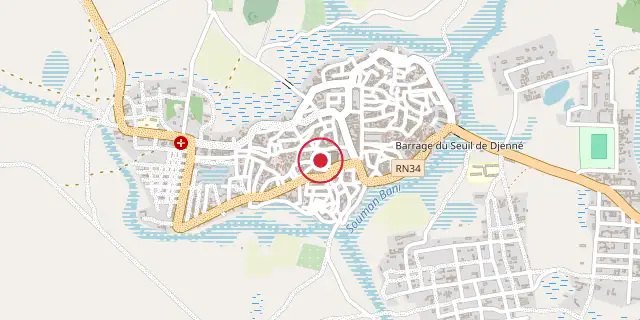
Coordinates: 13°54′18″N 4°33′22″W (13.9050, -4.5560) · Open in OpenStreetMap
Coordinates and connected clubs: the infobox of Wikipedia: Great Mosque of Djenné (CC BY-SA 4.0). Map: drawn by Codexery from OpenStreetMap tiles.
In the city of Djenné, Mali, the largest adobe brick building globally is the Great Mosque, situated on the Bani River's flood plain.[1] Sun-baked earth bricks, called ferey, form the mosque's walls, which are then covered with a plaster that creates a smooth, sculpted appearance.[2] To safeguard it from flood damage, the mosque sits on a platform that elevates it 3 meters above the marketplace.[3]
Geography and history
The earliest document mentioning the mosque is the Tarikh al-Sudan, which records that Sultan Kunburu became a Muslim and turned his palace into a mosque.[4][5] According to architectural historian Labelle Prussin, the mosque built by Koy Kounboro was later razed by his successor Malaha Tampo, who built a new mosque.[6] Prussin states that the Songhay ruler Askia Mohammed rebuilt the original mosque at the end of the 15th century.[6] After the Moroccan invasion, the Songhay mosque was destroyed and replaced, and in 1830 the Fulbe ruler Sheku Ahmadu removed its roof timbers and built a more austere structure.[6]
In 1828, French explorer René Caillié visited Djenné and wrote that the mosque was "rudely constructed, though very large" and that it was "abandoned to thousands of swallows".[4] French forces, led by Louis Archinard, took Djenné in April 1893; afterward, journalist Félix Dubois visited and recorded the original mosque's ruins.[7][8] Ismaila Traoré, who headed Djenné's mason guild, directed the 1907 rebuilding of the current mosque using forced labor.[9]
What the cited sources add
The same UNESCO source states that restoration works, funded by the Aga Khan Trust for Culture, proceeded with traditional masons.[10] As part of the Zamani Project, terrestrial laser-scanning was used in 2005 to create a 3D documentation of the mosque.[11]
References
- Wikipedia, "Great Mosque of Djenné" (CC BY-SA 4.0), which cites: Islamic Art: Mirror of the Invisible World PBS, 2011. (original not read by us) en.wikipedia.org
- Wikipedia, "Great Mosque of Djenné" (CC BY-SA 4.0), which cites: Maas, "Djenné: Living Tradition", Saudi Aramco World, 1990, p. 18–29 (we also read that source) en.wikipedia.org
- Wikipedia, "Great Mosque of Djenné" (CC BY-SA 4.0), which cites: ; Figure 7.2 is a plan of the mosque.; (original not read by us) en.wikipedia.org
- Wikipedia, "Great Mosque of Djenné" (CC BY-SA 4.0) en.wikipedia.org
- Wikipedia, "Great Mosque of Djenné" (CC BY-SA 4.0), which cites: "When the sultan became a Muslim, he had his palace pulled down and the site turned into a mosque dedicated to God Most High. This is the present congregational; "When Sultan Kunburu died – may God Most High have mercy on him – he was succeeded by the sultan who built the towers (abraj) of the congregational mosque. He i (original not read by us) en.wikipedia.org
- Wikipedia, "Great Mosque of Djenné" (CC BY-SA 4.0), which cites: Prussin, "Hatumere: Islamic design in West Africa", University of California Press, 1986, p. 182; Prussin, "Hatumere: Islamic design in West Africa", University of California Press, 1986, p. 182 (we also read that source) en.wikipedia.org
- Wikipedia, "Great Mosque of Djenné" (CC BY-SA 4.0), which cites: Engraving from photo in (original not read by us) en.wikipedia.org
- Wikipedia, "Great Mosque of Djenné" (CC BY-SA 4.0), which cites: Dubois 1896, p. [https://archive.org/stream/timbuctoomysteri00duborich#page/154/mode/1up 154]; Dubois 1896, p. [https://archive.org/stream/timbuctoomysteri00duborich#page/154/mode/1up 154]; Dubois 1896, p. [https://archive.org/stream/timbuctoomysteri00duborich#page/154/mode/1up 154] (original not read by us) en.wikipedia.org
- Wikipedia, "Great Mosque of Djenné" (CC BY-SA 4.0), which cites: ; (original not read by us) en.wikipedia.org
- "Restoration works continue despite violent storms at the Great Mosque of Djenné", UNESCO World Heritage News Archive, 2009. facts only, no text reused. whc.unesco.org
- Wikipedia, "Great Mosque of Djenné" (CC BY-SA 4.0), which cites: Rüther, "An African heritage database – The virtual preservation of Africa's past", International Society for Photogrammetry and Remote Sensing, 25-28 March 2002, p. 185–192; "Site - Djenne Mosque", Zamani Project, University of Cape Town; Rüther, "Documenting African sites: The Aluka Project", Journal of the Society of Architectural Historians, 2007, p. 437–443 (we also read that source) en.wikipedia.org
Each numbered sentence above was checked against the source it cites before publication. Sentences citing Wikipedia adapt text from the English Wikipedia article Great Mosque of Djenné (contributors), used under CC BY-SA 4.0; this entry is available under the same licence. Other sources were used for facts only; no text or images are copied from them.
More in Notable Buildings And Monuments
Sources
Compiled from Wikipedia and the sources listed below. Text from Wikipedia is available under CC BY-SA 4.0; this entry is adapted from it.
- Wikipedia: Great Mosque of Djenné (CC BY-SA 4.0).
Spotted an error? Know more?
Reader corrections go straight into our review queue. Suggest an edit · How this site is sourced