Dome of the Rock
World's oldest surviving Islamic architectural monument.
Last updated
Where it is
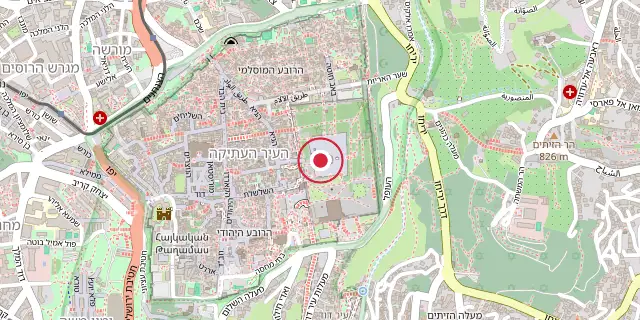
Coordinates: 31°46′41″N 35°14′06″E (31.7780, 35.2350) · Open in OpenStreetMap
Coordinates and connected clubs: the infobox of Wikipedia: Dome of the Rock (CC BY-SA 4.0). Map: drawn by Codexery from OpenStreetMap tiles.
Located in Jerusalem's Old City on the Temple Mount, the octagonal Dome of the Rock sits at the heart of the Al-Aqsa mosque compound.[1] As the oldest surviving Islamic architectural work globally, this structure also features the earliest known inscriptions that proclaim both Islam and the prophet Muhammad.[1]
Last updated 2026-10-01 from the source article.
Geography and history
It is believed in Christianity and Judaism to be the site where Abraham attempted to sacrifice his son.[2] The gold-plated roof was added in 1959–64 and again in the 1990s.[3] Jerusalem was captured by Crusaders in 1099, and the Dome of the Rock was given to the Augustinians, who turned it into a church.[4] Saladin recaptured Jerusalem on 2 October 1187 and reconsecrated the Dome of the Rock as a Muslim shrine.[5]
The Umayyad Caliphate, acting on orders from Abd al-Malik, began the initial construction during the Second Fitna in 691–692 CE.[2] Muslims hold the site sacred because they believe Muhammad's Night Journey commenced from the rock located at the structure's center.[2] The octagonal design might have taken inspiration from the Byzantine-era Church of the Seat of Mary, which was constructed between 451 and 458.[3] During the early Ottoman period, the exterior underwent a major transformation when vibrant Iznik-style tiles were added to its surface.[3]
Earthquakes caused severe damage to the building in both 808 and 846.[6]
What the cited sources add
The historian Shelomo Dov Goitein argued that the Dome of the Rock was intended to compete with the many fine buildings of worship of other religions.[7][8] Goitein also stated that the inscriptions decorating the interior clearly display a spirit of polemic against Christianity.[7][9] According to Goitein, the formula la sharika lahu ('God has no companion') is repeated five times in the inscriptions.[7][9] Raja ibn Haywa, Yazid ibn Sallam, and Yazid's son Baha served as the project's supervisor and engineers.[10][11]
An inscription identifies one of the Ottoman tile craftsmen as Abdallah of Tabriz.[12][13]
References
- Wikipedia, "Dome of the Rock" (CC BY-SA 4.0), which cites: Johns 2003, p. 416; George, "The Rise of Islamic Calligraphy", Saqi, 2010, p. 60 (original not read by us) en.wikipedia.org
- Wikipedia, "Dome of the Rock" (CC BY-SA 4.0), which cites: M. Anwarul Islam and Zaid F. Al-hamad, "The Dome of the Rock: Origin of its octagonal plan", Palestine Exploration Quarterly, 2007, p. 109–128; Rabbat, "The Meaning of the Umayyad Dome of the Rock", Muqarnas, 1989, p. 12–21 [13–14] (we also read that source) en.wikipedia.org
- Wikipedia, "Dome of the Rock" (CC BY-SA 4.0), which cites: Avner, "Muqarnas", Brill, 2010, p. 31–50 [43–44]; Avner, "Muqarnas", Brill, 2010, p. 31–50 [43–44]; Moore, "The Architecture of the Christian Holy Land: Reception from Late Antiquity through the Renaissance", Cambridge University Press, 2017-02-27; Necipoğlu 2008, p. 31; Hillenbrand 2000, p. 21; Blair, "The Art and Architecture of Islam 1250-1800", Yale University Press, 1995, p. 220 (we also read that source) en.wikipedia.org
- Wikipedia, "Dome of the Rock" (CC BY-SA 4.0), which cites: The Architecture of the Italian Renaissance, Jacob Burckhardt, Peter Murray, James C. Palmes, University of Chicago Press, 1986, p. 81 (original not read by us) en.wikipedia.org
- Wikipedia, "Dome of the Rock" (CC BY-SA 4.0), which cites: Strange, "Palestine Under the Moslems: A Description of Syria and the Holy Land from A.D. 650 to 1500", Alexander P. Watt for the Committee of the Palestine Exploration Fund, 1890 (original not read by us) en.wikipedia.org
- Wikipedia, "Dome of the Rock" (CC BY-SA 4.0), which cites: Amiran, "Earthquakes in Israel and adjacent areas: macroseismic observations since 100 B.C.E.", Israel Exploration Journal, 1994, p. 260–305 [267]; Nees, "Perspectives on Early Islamic Art in Jerusalem", BRILL, 2015-09-17 (original not read by us) en.wikipedia.org
- Shelomo Dov Goitein, "The Historical Background of the Erection of the Dome of the Rock", Journal of the American Oriental Society (1950), doi:10.2307/595539. OpenAlex metadata CC0; paper not read. doi.org
- Wikipedia, "Dome of the Rock" (CC BY-SA 4.0), which cites: Grabar 1986, p. 299; Grabar 1986, p. 299; Johns 2003, p. 416; Grabar 1986, p. 299; Hawting 2000, p. 60; Goitein, "The historical background of the erection of the Dome of the Rock", Journal of the American Oriental Society, 1950, p. 104–108; Ahmed, "The SAGE Handbook of Islamic Studies", SAGE Publications, 2010, p. 229–230 (we also read that source) en.wikipedia.org
- Wikipedia, "Dome of the Rock" (CC BY-SA 4.0), which cites: Goitein, "The historical background of the erection of the Dome of the Rock", Journal of the American Oriental Society, 1950, p. 104–108 (we also read that source) en.wikipedia.org
- Open Library record, ISBN 9789004185111 ("Muqarnas"). CC0 (metadata); book content not read. openlibrary.org
- Wikipedia, "Dome of the Rock" (CC BY-SA 4.0), which cites: Gil 1997, p. 92; Avner, "Muqarnas", Brill, 2010, p. 31–50 [43–44]; "Islamic Art and Architecture 650–1250", Yale University Press, 2001, p. 20 (we also read that source) en.wikipedia.org
- Open Library record, ISBN 9780300064650 ("The Art And Architecture Of Islam 12501800"). CC0 (metadata); book content not read. openlibrary.org
- Wikipedia, "Dome of the Rock" (CC BY-SA 4.0), which cites: Blair, "The Art and Architecture of Islam 1250-1800", Yale University Press, 1995, p. 220; Hillenbrand 2000, p. 21; Blair, "The Art and Architecture of Islam 1250-1800", Yale University Press, 1995, p. 220; Carswell 2006, p. 73; Necipoğlu, "From International Timurid to Ottoman: A Change of Taste in Sixteenth-Century Ceramic Tiles", Muqarnas, 1990, p. 137 (we also read that source) en.wikipedia.org
Each numbered sentence above was checked against the source it cites before publication. Sentences citing Wikipedia adapt text from the English Wikipedia article Dome of the Rock (contributors), used under CC BY-SA 4.0; this entry is available under the same licence. Other sources were used for facts only; no text or images are copied from them.
More in Notable Buildings And Monuments
Sources
Compiled from Wikipedia and the sources listed below. Text from Wikipedia is available under CC BY-SA 4.0; this entry is adapted from it.
- Wikipedia: Dome of the Rock (CC BY-SA 4.0).
Spotted an error? Know more?
Reader corrections go straight into our review queue. Suggest an edit · How this site is sourced