Frequently Asked Questions
The most-asked questions about notable asteroids.
What exactly is this encyclopedia about?
It is a fan-curated reference covering the most scientifically and culturally significant asteroids in our solar system, ranging from the dwarf planet Ceres to frequently discussed near-Earth objects like Bennu and Apophis. Think of it as a character guide for the rocky bodies that orbit the Sun outside the terrestrial planet zone.
Who are the 'main characters' I should know first?
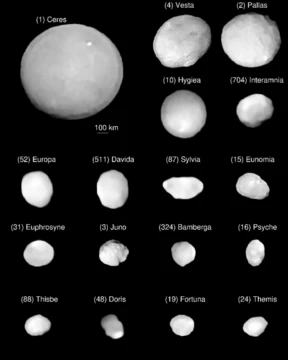
Ceres (the largest body in the main belt and the only asteroid classified as a dwarf planet), Vesta (the second-most massive and heavily cratered), Eros (the first asteroid ever landed upon by a spacecraft), and Bennu (the carbon-rich target of OSIRIS-REx). Apophis also gets enormous fan attention because of its 2029 close flyby of Earth.
Where should a total newcomer start reading?
Begin with the main-belt section, specifically the Ceres and Vesta entries, to build a sense of scale and geology. Then move to the near-Earth asteroid pages, where most of the public-facing drama—missions, near-misses, and sample returns—happens.
What qualifies an asteroid as 'notable' for inclusion here?
An asteroid makes the list if it is exceptionally large, has been a spacecraft target, poses a well-studied impact risk, or has sparked significant public or scientific discussion. Purely catalog numbers with no distinguishing story are left out.
How are the asteroids grouped or categorized?
Entries are organized by orbital region (main belt, near-Earth, Trojan, outer) and by spectral type (C-type carbonaceous, S-type stony, M-type metallic). This mirrors how planetary scientists themselves sort the population.
What are the biggest 'story arcs'—i.e., landmark missions?
NASA's Dawn orbited both Vesta and Ceres (2011–2018), JAXA's Hayabusa and Hayabusa2 sampled Itokawa and Ryugu, and OSIRIS-REx returned a Bennu sample to Earth in 2023. The 2022 DART kinetic-impact test on Dimorphos is another frequently cited milestone.
What is the single most iconic moment in asteroid history?
Many fans point to the 2029 Apophis close approach, which briefly triggered a non-zero impact probability and dominated headlines worldwide. Others favor the 2001 NEAR Shoemaker landing on Eros as the first time humanity physically touched an asteroid.
Are there 'villains' or dangerous asteroids to watch?
The Minor Planet Center tracks a list of Potentially Hazardous Asteroids (PHAs) that could approach Earth within 0.05 AU; Apophis, 99942 Apophis's cousin 2013 TX68, and a handful of others regularly top fan speculation threads. None currently pose a confirmed threat, but they remain the most discussed risk figures.
How do I follow new 'characters' entering the story?
Watch the Minor Planet Center's daily discovery announcements and the IAU's naming decisions for newly designated bodies. ESA and NASA mission press releases are the best source for upcoming flybys, sample-return targets, and deflection tests.
Is this encyclopedia affiliated with any space agency?
No; it is an independent, fan-written project and carries no official endorsement from NASA, ESA, JAXA, or the IAU. All data is drawn from publicly available scientific literature, and any errors are the authors' responsibility.