2044 Wirt
Binary Phocaea asteroid and Mars-crosser discovered by Carl Wirtanen.

2044 Wirt, first designated 1950 VE, is a binary asteroid belonging to the Phocaea family and also crosses the orbit of Mars. Its diameter is roughly 6.7 kilometers. The asteroid was spotted on November 8, 1950, by American astronomer Carl Wirtanen using the Lick Observatory on Mount Hamilton, California. Unusually, the object was later named after the discoverer himself.
The asteroid's orbit places it in the inner main belt, ranging from 1.6 to 3.2 AU from the Sun, completing a circuit every 3 years and 8 months (1,342 days). Its path has an eccentricity of 0.34 and an inclination of 24° relative to the ecliptic. The first recorded observation after discovery came from Lick Observatory on November 22, 1950.
Wirt is classified as a stony S-type asteroid. Between 2005 and 2010, multiple lightcurve studies—by astronomers including Donald Pray, Petr Pravec, Peter Kušnirák, Walter Cooney, Rui Goncalves, and Raoul Behrend, as well as the Palomar Transient Factory—yielded a well-defined rotation period between 3.689 and 3.690 hours, with brightness variations of 0.12 to 0.26 magnitude.
A minor-planet moon was detected during photometric observations in December 2005. The binary system has a diameter ratio of 0.25, and the satellite orbits the primary every 18.97 hours. The moon is estimated to be about 1.89 kilometers across.
Size and reflectivity data come from the Infrared Astronomical Satellite (IRAS), which measured a diameter of 6.66 kilometers and an albedo of 0.19. The Collaborative Asteroid Lightcurve Link assumes an albedo of 0.23, yielding a diameter of 6.65 kilometers at an absolute magnitude of 13.1.
The asteroid was named for Carl Wirtanen (1910–1990), an American astronomer who discovered minor planets and comets and contributed long-term astrometric work at Lick Observatory. He is known for surveys such as the Lick proper motion program and the Shane-Wirtanen survey. The naming citation was published by the Minor Planet Center on January 1, 1981 (M.P.C. 5688).
Quick Facts
- Minorplanet
- yes
- Background
- #FA8072
- Discovered
- 8 November 1950
- Discoverer
- C. A. Wirtanen
- Discovery Site
- Lick Obs.
- Mpc Name
- (2044) Wirt
- Named After
- Carl Wirtanen / (discoverer himself)
- Mp Category
- Mars-crosserPhocaea
- Epoch
- 4 September 2017 (JD 2458000.5)
- Uncertainty
- 0
- Observation Arc
- 66.44 yr (24,269 days)
- Aphelion
- 3.1989 AU
Facts from the source article.
Lore & Background
2044 Wirt was discovered on 8 November 1950 by American astronomer Carl Wirtanen at Lick Observatory on Mount Hamilton, California. It is a member of the main-belt's Phocaea family (701) and also a Mars-crossing asteroid, orbiting the Sun at a distance of 1.6–3.2 AU once every 3 years and 8 months. Its orbit has an eccentricity of 0.34 and an inclination of 24° with respect to the ecliptic. The asteroid's observation arc begins two weeks after its official discovery, with the first recorded observation at Lick Observatory on 22 November 1950.
Physically, Wirt has been characterized as a stony S-type asteroid. Between 2005 and 2010, several rotational lightcurves were obtained from photometric observations by astronomers Donald Pray, Petr Pravec, Peter Kušnirák, Walter Cooney, Rui Goncalves, and Raoul Behrend, as well as at the Palomar Transient Factory. These gave a well-defined rotation period between 3.689 and 3.690 hours with a brightness variation between 0.12 and 0.26 magnitude. During the photometric observations in December 2005, a minor-planet moon in orbit of Wirt was discovered, with a diameter ratio of 0.25 and an orbital period of 18.97 hours. The moon measures approximately 1.89 kilometers in diameter.
According to the survey by the Infrared Astronomical Satellite IRAS, the asteroid measures 6.66 kilometers in diameter with an albedo of 0.19, while the Collaborative Asteroid Lightcurve Link assumes an albedo of 0.23 and calculates a diameter of 6.65 kilometers with an absolute magnitude of 13.1. The asteroid was named after Carl Wirtanen, a discoverer of minor planets and comets and long-time contributor of astrometric observations at Lick Observatory. The official naming citation was published by the MPC on 1 January 1981.
Reader's Guide
2044 Wirt holds significance as a binary asteroid within the Phocaea family, a group of stony asteroids in the inner main-belt. Its status as a Mars-crosser adds dynamical interest, as its orbit crosses that of Mars. The discovery of its minor-planet moon in December 2005, with a diameter of 1.89 kilometers and an orbital period of 18.97 hours, makes it a valuable object for studying binary asteroid systems. The asteroid's well-defined rotation period of about 3.69 hours, determined from multiple lightcurve observations between 2005 and 2010, provides a solid basis for understanding its spin state. Its legacy is also tied to its naming after its discoverer, Carl Wirtanen, a rare honor that recognizes his contributions to astrometry and surveys at Lick Observatory, including the Lick proper motion program and the Shane-Wirtanen survey. The asteroid's diameter, estimated at approximately 6.7 kilometers from both IRAS and lightcurve data, and its stony S-type composition, contribute to the broader understanding of asteroid physical properties in the inner solar system.
Did You Know?
- 2044 Wirt is one of the rare cases where an asteroid was named after its discoverer.
- It has a minor-planet moon approximately 1.89 kilometers in diameter, discovered in December 2005.
- The asteroid's rotation period is between 3.689 and 3.690 hours.
- It is both a member of the Phocaea family and a Mars-crossing asteroid.
Frequently Asked Questions
Who discovered 2044 Wirt and where?
American astronomer Carl Wirtanen spotted the object on November 8, 1950, using the Lick Observatory atop Mount Hamilton in California. It entered the catalog under the provisional designation 1950 VE before receiving its permanent number.
What kind of asteroid is 2044 Wirt?
It is a roughly 6.7-kilometer-wide body that belongs to the Phocaea family while also crossing Mars's orbit. What makes it stand out among Phocaea members is that it is a binary system, with a companion moon about 1.89 kilometers across.
Why is 2044 Wirt named after its discoverer?
In an unusual twist for the asteroid-naming tradition, the object was given the name "Wirt" in honor of Carl Wirtanen himself. Most asteroids are named for mythological figures, cities, or other honorees, so a discoverer receiving the credit on his own find is a rarity.
What does 2044 Wirt's orbit look like?
The asteroid travels through the inner main belt, swinging between about 1.6 and 3.2 astronomical units from the Sun. Its path is noticeably stretched (eccentricity 0.34) and tilted roughly 24 degrees off the ecliptic, and one full lap takes about 1,342 days—just under four Earth years.
How does 2044 Wirt compare in size to other notable asteroids?
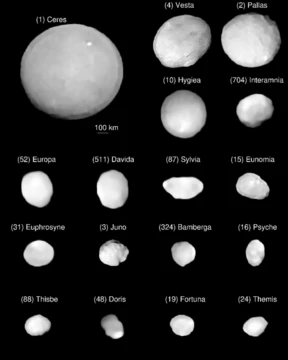
At approximately 6.7 kilometers in diameter, it sits well below the giants like Ceres or Vesta but is large enough to be a solid mid-sized belt object. Its 1.89-kilometer moon, while smaller, is still large enough to be a distinct secondary body rather than a mere chunk of debris.
More in Notable Asteroids, Part 2 1-24
Spotted an error? Know more?
Reader corrections go straight into our review queue. Suggest an edit · How this site is sourced