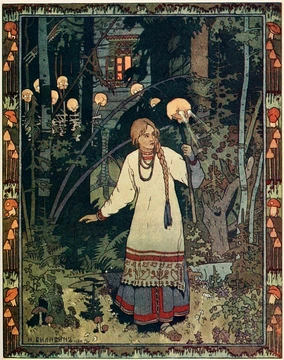
The Master Thief
A poor boy becomes a master thief to win a bride.
This Norwegian folktale appears in the collections of Asbjørnsen and Moe. A shorter version is tale 192 in the Brothers Grimm’s collection. Andrew Lang placed it in The Red Fairy Book, and George Webbe Dasent translated it for Popular Tales From the Norse. It is classified as Aarne–Thompson type 1525A, Tasks for a Thief.
Quick Facts
- Also known as
- Mestertyven; Die Meisterdieb
- Aarne–Thompson grouping
- 1525A
- Country
- Norway
- Published in
- Norske folkeeventyr
- Grimm's Fairy Tales
- The Red Fairy Book
Facts from the source article.
Plot
A poor cottager had no inheritance to leave his three sons, so he walked them to a crossroads. There, each son chose a different path. The youngest entered a vast forest. When a storm broke, he found shelter in a house. An old woman nearby warned him it was a robbers' den, but he stayed. When the robbers returned, he talked them into taking him on as a servant.
To test him, the robbers ordered him to steal an ox a man was taking to market. The boy placed a shoe with a silver buckle in the road. The man saw it and thought it would be valuable if he had the pair, but he kept walking. The boy retrieved the shoe, ran ahead, and placed it in the road again. When the man saw the same shoe a second time, he left his ox to search for the missing mate. The boy drove the ox away.
The man went home for his second ox. The robbers said if the boy stole that one too, they would let him join the band. The boy hung himself by the neck along the path. The man passed him. The boy ran ahead and hung himself again, then a third time. The man grew half-convinced it was witchcraft. When he went back to check if the first two bodies were still hanging, the boy drove off the second ox.
The man fetched his third and last ox. The robbers promised to make the boy their leader if he stole it. The boy made a sound like an ox bellowing in the woods. The man, thinking it was his stolen oxen, ran off to find them, leaving the third ox behind. The boy stole that one as well.
The robbers were unhappy with the boy as their leader, so they abandoned him. The boy drove all three oxen back to their owner, took all the treasure from the robbers' house, and returned to his father.
The boy wished to marry the daughter of a local squire. He sent his father to ask for her hand, instructing him to tell the squire that he was a Master Thief. The squire agreed to the marriage, but only if the boy proved his skill by stealing the roast from the spit on Sunday. The boy caught three hares and released them one after another near the squire's kitchen. The people inside, thinking it was the same hare each time, ran out to catch it. The boy slipped in and stole the roast.
Analysis
Folklorists have debated the origins of the tale type ATU 1525, known as "The Master Thief." Richard Dorson noted that Alexander H. Krappe traced it to Egypt, while W. A. Clouston argued for an Asian source. Stith Thompson also observed that European versions blended with Native American trickster tales, likely through French Canadian storytelling.
Variants
The tale of the Master Thief has been documented across the globe. Folklorist Stith Thompson noted its presence in collections from Europe, Asia, and beyond, with specific variants and subtypes of the ATU 1525 tale type appearing in both American and English compilations. Professor Andrejev identified tale type 1525A, also called The Master Thief, as one of the most popular in Ukrainian sources, where 28 variants exist, and in Russian material, which holds 19 versions. In Italy, a scholarly project by the Istituto centrale per i beni sonori ed audiovisivi, carried out in the late 1960s and early 1970s, uncovered variants and subtypes of the tale grouped under the name Mastro Ladro. Folklorist Joseph Jacobs crafted his own reconstruction of the story, published under the same title in his Europa's Fairy Book, following a formula he detailed in his commentaries. An earlier literary version, Cassandrino, The Master-Thief, appears in Straparola's collection The Facetious Nights. The Brothers Grimm included a version as tale 192, where a squire sets a boy four tasks: stealing horses from the stable, a sheet, the squire's wife's wedding ring, and the parson and clerk from the church. The boy is threatened with hanging if he fails, but he succeeds and then leaves the country. Nineteenth-century poet and novelist Clemens Brentano collected a variant called Witzenspitzel, later translated as Wittysplinter and published in The Diamond Fairy Book. An Irish variant, The Apprentice Thief, was published anonymously in The Royal Hibernian Tales. Irish folklorist Patrick Kennedy also listed Jack, The Cunning Thief as another variant of the Shifty Lad, and thus part of the Master Thief cycle. In one Irish variant, a king challenges young Jack, son of Billy Brogan, to steal three items without the king noticing. In the Irish tale How Jack won a Wife, the Master Thief character Jack completes a squire's challenges to prove his skill and marries the squire's daughter. Svend Grundtvig collected a Danish variant titled Hans Mestertyv. German scholar Johann Georg von Hahn compared six variants he gathered in Greece to the version in the Brothers Grimm collection.
More in Norwegian Fairy Tales
Spotted an error? Know more?
Reader corrections go straight into our review queue. Suggest an edit · How this site is sourced