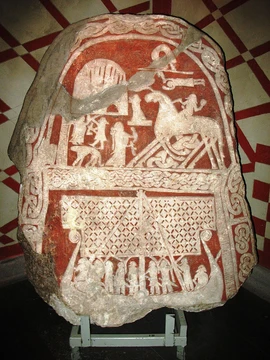
Ullr
Last updated
Ullr is a Norse god associated with snow, bows, hunting, and potentially the sun.[1] His name derives from a Proto-Germanic word meaning 'Glory'.[2] Place-name evidence suggests he was a major deity in pre-historic Sweden.[1]
Quick Facts
- Field
- Norse mythology
Facts from the source article.
Key facts and history
The stem *wulþ- appears in Germanic personal names meaning 'glory', not as the god's name.[3] The related form Ullinn was likely originally connected to Ullr.[4] Many scholars conclude Ullr was one of the older Norse gods whose importance waned before medieval texts were written.[5] The Old Norse deity name Ullr is a reflex of the reconstructed Proto-Germanic form *Wulþuz, which means 'Glory'.[2]
The Gothic noun wulþus ('glory, wealth') is a linguistic cognate of this theonym.[2] Important Norwegian and Swedish place names contain Ullr's name, whereas no such place names are found in Denmark or Iceland.[6] This distribution of place names suggests that Ullr's religious significance in Scandinavia was greater than what the sparse textual records imply.[6] In Sweden, place names referencing Ullr frequently appear near those of Njörðr, while in Norway they are often close to those of Freyr.[6]
What the cited sources add
A 1990 book titled "Gods and Myths of Northern Europe" was published by Penguin Books, Limited.[7] The Breckenridge Ullr Fest is listed among signature events that include International Snow Sculpture Championships and Oktoberfest.[8]
References
- Wikipedia, "Ullr" (CC BY-SA 4.0), which cites: In Modern Icelandic Ullr is usually referred to as Ullur . In the mainland Scandinavian languages the usual form is Ull, without the nominative case marker -r. ; Molin 2015, p. 149; Molin 2015, p. 149 (original not read by us) en.wikipedia.org
- Wikipedia, "Ullr" (CC BY-SA 4.0), which cites: de Vries 1977, p. 633; Orel 2003, p. 474; Kroonen 2013, p. 599; Orel 2003, p. 474; Kroonen 2013, p. 599 (original not read by us) en.wikipedia.org
- Wikipedia, "Ullr" (CC BY-SA 4.0), which cites: de Vries 1977, p. 633; Kroonen 2013, p. 599; "in phrases denoting the Deity", "wuldor", An Anglo-Saxon Dictionary: based on the manuscript collections by the late Joseph Bosworth, ed. and enlarged by T. No (original not read by us) en.wikipedia.org
- Wikipedia, "Ullr" (CC BY-SA 4.0), which cites: de Vries 1970b, p. 104 (original not read by us) en.wikipedia.org
- Wikipedia, "Ullr" (CC BY-SA 4.0), which cites: de Vries 1970b, p. 104; Olsen, Magnus., trans. Theodor Gleditsch. Farms and Fanes of Ancient Norway. Oslo: Instituttet for Sammenlignende Kulturforskning, 1928, pp. 140, 301.; de Vries 1970b, p. 104; Turville-Petre, Myth and Religion of the North, p. 184.; Philippson, Ernst Alfred. Die Genealogie der Götter in Germanischer Religion, Mythologie, und Theologie. Urbana: The University of Illinois Press, 1953. pp.&nbs; Turville-Petre, Myth and Religion of the North, p. 182. (original not read by us) en.wikipedia.org
- Wikipedia, "Ullr" (CC BY-SA 4.0), which cites: Simek, Rudolf. Dictionary of Northern Mythology, tr. Angela Hall, Cambridge / Rochester, New York: Brewer, 1993, , p. 339. (original not read by us) en.wikipedia.org
- Open Library record, ISBN 9780141941509 ("Gods and Myths of Northern Europe"). CC0 (metadata); book content not read. openlibrary.org
- "Breckenridge Ullr Fest", Breckenridge Resort Managers. facts only, no text reused. breckenridgeresortmanagers.com
Each numbered sentence above was checked against the source it cites before publication. Sentences citing Wikipedia adapt text from the English Wikipedia article Ullr (contributors), used under CC BY-SA 4.0; this entry is available under the same licence. Other sources were used for facts only; no text or images are copied from them.
Sources
Compiled from Wikipedia and the sources listed below. Text from Wikipedia is available under CC BY-SA 4.0; this entry is adapted from it.
- Wikipedia: Ullr (CC BY-SA 4.0).
Spotted an error? Know more?
Reader corrections go straight into our review queue. Suggest an edit · How this site is sourced