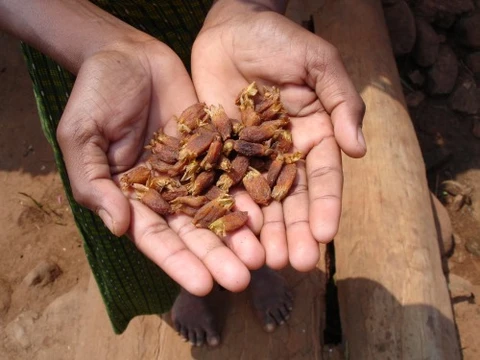
Boscia senegalensis
A resilient Sahelian shrub with edible, pesticidal, and water-clarifying uses.
Boscia senegalensis, known as hanza, is a perennial woody shrub in the caper family Capparaceae. Originating from West Africa, it is a traditional food plant whose fruit and seeds offer potential for improving nutrition, food security, and rural development. The plant also provides products for household, medicinal, and agricultural uses.
Quick Facts
- Species
- senegalensis
Facts from the source article.
Did You Know?
- Boscia senegalensis grows in altitudes from 60 to 1450 m, with rainfall of 100 to 500 mm annually.
- The plant contains natural coagulants that can clarify murky water.
Description
Boscia senegalensis is an evergreen dicot shrub that reaches 2 to 4 m in height. Its small, leathery leaves grow up to 12 cm long and 4 cm wide. The plant produces yellow spherical berries up to 1.5 cm in diameter, clustered in small bunches. Each fruit contains 1 to 4 greenish seeds. Common names include aizen, mukheit, hanza, bere, ngigili, mandiarha, anza, and taedent.
Cultivation
Boscia senegalensis survives severe drought and famine when other crops fail, and indigenous knowledge among the Hausa of Niger and Fulani herders underscores its importance. During the 1984–1985 famine, it was the most widely consumed famine food in Sudan and Darfur, relied on by over 94% of people in northern Darfur. Seeds can be stored up to 2 months at 15°C in cool storage. Techniques such as grafting, generating hybrids with related species, and in vitro tissue culture are being explored to improve harvests; direct seedling trials are also underway. Leaves, seeds, and fruits are traded in Sahel markets. Value-added opportunities include roasting seeds as a coffee substitute, fermenting fruit into beer, processing fruit and seeds into prepared food, and processing leaves for medicinal use. In Niger, a small-to-medium enterprise markets hanza seed products. A major constraint is the recalcitrant nature of the seeds, which lose viability rapidly and cannot be dried without killing the embryo, hindering large-scale propagation. Additional drawbacks include toxicity and the need for water and labour to leach out toxins.
Bitterness
The intense bitterness of hanza seeds comes from high levels of glucocapparin (MeGSL). Seeds must be debittered through water soaking for about a week, during which glucocapparin leaches out and converts to methylisothiocyanate (MeITC), a bitter water with pesticide and herbicide properties. This bitterness acts as a natural pesticide on the tree, deterring most predators until fruits are fully ripe, when birds may eat the sweet jelly mesocarp. Dried bitter seeds are not consumed by rodents or insects and can be stored for several years if kept dry, then debittered as needed.
Uses
Fruits become ready for consumption at the start of the rainy season, when little other food is available. They can be eaten raw or cooked; raw fruits have a sweet pulp that dries into a sugary solid. Juice can be boiled to a butter-like consistency and mixed with millet and milk for cakes, and in Sudan the fruit is fermented into beer. Seeds are a key famine food: fruits are dried, pounded to remove the seed coat, and soaked for several days with daily water changes to remove bitter toxins. Cooked seeds resemble chickpeas and can replace cereal in stews, soups, and porridges; they can also be dried, ground into flour for porridge, or roasted as a coffee substitute. Leaf extracts contain carbohydrate hydrolase enzymes useful for cereal flour production and reducing porridge bulk. Leaves are added to granaries to protect cereals from pathogens and have anti-parasitic, fungicidal, anti-inflammatory, and wound-healing properties; they can serve as emergency animal forage. Young roots can be ground and boiled into a thick sweet porridge. Wood is used for construction and fuel. Natural coagulants from bark, twigs, leaves, and fruits clarify water by causing clay and particulates to settle.
More in Non-timber Forest Products
Spotted an error? Know more?
Reader corrections go straight into our review queue. Suggest an edit · How this site is sourced