The Bible: In the Beginning...
A cinematic retelling of the first 22 chapters of Genesis.
John Huston directed and starred in this 1966 religious epic, which Dino De Laurentiis produced for 20th Century Fox. The film adapts the first 22 chapters of Genesis, from Creation to the binding of Isaac. Its large cast includes Ava Gardner, Peter O'Toole, George C. Scott, and Richard Harris. Christopher Fry wrote the screenplay, with contributions from Orson Welles and others. Toshiro Mayuzumi composed the score, and Giuseppe Rotunno shot the film in a 70mm format. Planned as the start of an Old Testament series, no sequels followed.
Quick Facts
- Director
- John Huston
- Producer
- Dino De Laurentiis
- Screenplay
- Christopher Fry
- Based on
- Book of Genesis
- Music
- Toshiro Mayuzumi
- Cinematography
- Giuseppe Rotunno
- Editing
- Ralph Kemplen
- Studio
- Dino de Laurentiis Cinematografica; Seven Arts Productions
Facts from the source article.
Did You Know?
- Ava Gardner remarked after the premiere, 'It's the only time in my life I actually enjoyed working—making that picture.'
- The film was released on Blu-ray Disc on 22 March 2011.
- Ulla Bergryd recalled that 'Paradise was, in fact, an old botanical garden on the outskirts of Rome.'
Plot
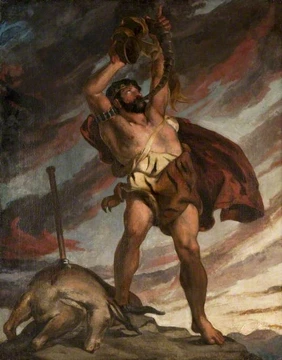
The film opens with the Creation, as God makes the heavens, earth, Adam, and Eve. They live in the Garden of Eden until a Serpent persuades Eve to eat from the tree of knowledge, and she convinces Adam to do the same. God punishes the Serpent and banishes the pair. Eve bears Cain and Abel; Cain, a farmer, and Abel, a shepherd, make sacrifices to God. God favors Abel's lamb, and Cain murders his brother out of jealousy. Adam and Eve mourn, but God gives them another son, Seth. Generations pass, and Cain's descendants grow evil. God decides to destroy creation with a flood and instructs Noah to build an Ark. Noah obeys, bringing pairs of animals aboard. After the door shuts, a storm floods the earth, killing all outside. The Ark lands on the mountains of Ararat, and God promises never to flood the earth again, symbolized by a rainbow. The second part shows Noah's descendants and the Tower of Babel, where King Nimrod defies God by building a colossal tower and firing an arrow toward the sky. God confuses the people's languages, scattering them. The remainder follows Abraham: God chooses him to father a great nation in Canaan. His wife Sarah is barren, so she offers her handmaiden Hagar, who bears Ishmael. God promises Abraham a son with Sarah, named Isaac, who will inherit Abraham's position, causing resentment between Hagar and Sarah.
Production
Seven Arts Productions contributed 30% of the budget. Ava Gardner was initially reluctant to play Sarah but accepted after John Huston talked her into it. Zoe Sallis, cast as Hagar, was originally known as Zoe Ishmail until Huston changed her name due to its similarity to Ishmael, her character's son. Ulla Bergryd, an anthropology student from Gothenburg, Sweden, was discovered by a talent scout in a museum and hired to play Eve. Huston considered Alec Guinness and Charlie Chaplin for Noah before playing the role himself. The film marked the debut of Italian actress Anna Orso as Shem's wife and introduced Franco Nero to American audiences; Nero, originally the still photographer, was cast as Abel for his handsome features and could not speak English, so Huston gave him recordings of Shakespeare to study. Moelwyn Merchant served as theological and historical consultant. Filming took place in Rome, Sardinia, Sicily, Itri, Abruzzo, and Mount Vesuvius. The Garden of Eden scenes were shot at a small zoological garden in Rome after the intended location was demolished.
Music
The score for The Bible: In the Beginning... earned Toshiro Mayuzumi both an Oscar and a Golden Globe nomination, making him the first Japanese-born composer nominated for a Best Original Score Academy Award. Director John Huston first tried to use existing music by Igor Stravinsky but couldn't secure the rights, and Stravinsky also turned down writing an original score. Producer Dino De Laurentiis suggested Goffredo Petrassi, but Huston refused. Ennio Morricone then wrote about 15 minutes of test cues that Huston approved, but a contract dispute with RCA Records forced his removal. Huston hired Mayuzumi, calling him a "modern Beethoven." Morricone later reused those cues in three of his own scores: The Return of Ringo, Garden of Delights, and The Secret of the Sahara.
Reception
The film received mixed reviews. Philip K. Scheuer of the Los Angeles Times called it magnificent, powerful, and thought-provoking. Variety praised its consummate skill, taste, and reverence. Bosley Crowther of The New York Times found the special effects extraordinary but lacking a galvanizing connection between stories. Richard L. Coe of The Washington Post described it as cautiously literary, impressive in some instances, absurd in others. The Monthly Film Bulletin called the episodes diffusely long and tediously slow, though noting Noah's Ark as the liveliest segment. Episcopal priest Malcolm Boyd criticized its fundamentalistic interpretation and called it tedious and boring. Leonard Maltin's guide gave it a BOMB rating, stating only Huston as Noah escapes heavy-handedness. Despite the reviews, the film grossed $34.9 million in North America, making it the highest-grossing film of 1966. It earned $15 million in domestic rentals. In Italy, it was the second most popular production of 1966 with 11,245,980 admissions, behind The Good, the Bad and the Ugly, and ranks 15th all-time.
More in Nimrod
Spotted an error? Know more?
Reader corrections go straight into our review queue. Suggest an edit · How this site is sourced