Outline of the February Revolution
The 1917 uprising that ended the Russian monarchy.
Last updated
The February Revolution was the first of two revolutions in Russia in 1917, unfolding in and around Petrograd. It began with mass protests over food shortages and rationing, escalating into violent clashes and the defection of the capital's garrison. The revolution forced the abdication of Nicholas II and ended Romanov dynastic rule.
Events
The Putilov strike of 18 February O.S. (3 March N.S.) had already begun at the Putilov Works. On 27 February O.S. (12 March N.S.), most of the Petrograd garrison joined the revolutionaries. Nicholas II abdicated on 2 March O.S. (15 March N.S.) while stranded at Pskov. Later events included the Kerensky offensive, the Kornilov affair, and the Moscow State Conference.
People
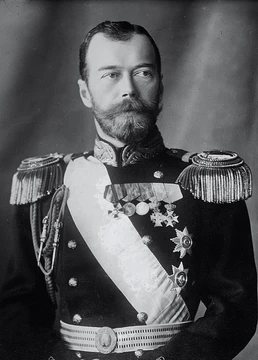
Nicholas II reigned as Emperor from 1894 until his abdication in 1917 and was executed in 1918. His wife Alexandra Feodorovna was deeply unpopular. Grand Duke Kirill Vladimirovich brought the Guards Equipage to the Tauride Palace in support of the Duma. Grand Duke Paul Alexandrovich drafted a manifesto for a constitutional monarchy.
Key ministers included Mikhail Belyayev (War), Nikolai Golitsyn (Council chairman), Ivan Grigorovich (Navy), Nikolai Pokrovsky (Foreign Affairs), and Alexander Protopopov (Interior). Military figures included Mikhail Alekseyev, who canvassed front commanders on abdication; Aleksei Brusilov, Supreme Commander from May to July 1917; and Lavr Kornilov, who commanded the Petrograd Military District and later became Supreme Commander. Others present at Pskov for the abdication included Yuri Danilov.
Places
Petrograd was the capital where the revolution centered. Kronstadt was a naval base where sailors mutinied.
The Tauride Palace housed the State Duma, the Provisional Committee, and the Petrograd Soviet. Vosstaniya Square (then Znamenskaya Square) saw clashes between crowds and police. Pskov was where Nicholas II signed his abdication.
Organizations
The Council of Ministers was the empire's highest executive authority until the monarchy fell. The Provisional Committee of the State Duma formed on 27 February O.S. (12 March N.S.) as the imperial government collapsed. The Petrograd Soviet, a council of workers' and soldiers' deputies, became a key revolutionary body.
The Russian Provisional Government took control on 2 March O.S. (15 March N.S.). The Russian Republic was proclaimed on 1 September O.S. (14 September N.S.). Other bodies included the Directorate, the Provisional Council of the Russian Republic, and the Russian Constituent Assembly.
Military organizations included the Imperial Russian Army and Navy. Regiments such as the Moscow Life Guards and Pavlovsky Life Guards had reserve battalions that joined the revolution. The Petrograd Soviet issued Order No. 1 placing garrison units under elected soldiers' committees.
Did You Know?
- The anthem written in 1917 for the Russian Republic was called Anthem of Free Russia.
- Banknotes issued by the Provisional Government were nicknamed Kerenka.
- The Milyukov note of April 1917 on Russia's war aims brought down the first cabinet.
More in Nicholas II of Russia
Sources
Compiled from Wikipedia and the sources listed below. Text from Wikipedia is available under CC BY-SA 4.0; this entry is adapted from it.
- Wikipedia: Outline of the February Revolution (CC BY-SA 4.0).
Spotted an error? Know more?
Reader corrections go straight into our review queue. Suggest an edit · How this site is sourced