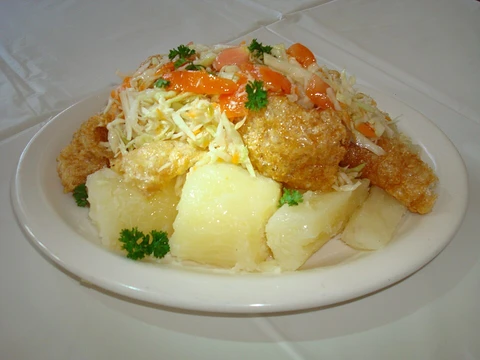
Arroz a la valenciana
A global rice dish rooted in Valencian tradition.
Last updated
Arroz a la valenciana (Valencian-style rice) refers to a broad category of rice dishes derived from the cooking traditions of the Valencian Community in eastern Spain. While paella is one specific recipe that emerged in the late 19th century, the generic method for preparing Valencian rice has spread globally since the colonial era. The dish is typically dry, colored with spices such as saffron, and includes vegetables, meats, and seafood.
History
Rice cultivation in Valencia likely predates the Moorish era, but Arab influence expanded its growth and culinary use. Medieval cookbooks from both Christian and Muslim traditions show rice seasoned with saffron, as seen in Mestre Robert's 16th-century arròs en Cassola al forn. Over time, Valencian rice culture developed diverse recipes incorporating vegetables and meats. During the colonial period, arroz a la valenciana spread to Spanish colonies in the Americas and the Philippines, where it adapted to local tastes.
The first written mention appears in an 18th-century manuscript by Franciscan friar Josep Orri, Avisos y instrucciones per lo principiant cuyiner. In 1780, Friar Gerónimo de San Pelayo published a cookbook in Mexico City on the dish. Antonia Carrillo's 1836 Mexican cookbook New and Simple Art of Cooking includes a recipe with green chiles and saffron. A cookbook from Havana in 1862 also features it.
José Castro and Serrano remarked that no province cooks rice like Valencia. At an 1889 religious event in Bergara, Spain, arroz a la valenciana was served. Ángel Muro's 1892 General Dictionary of cooking included a recipe honoring the 'country of rice'. By the 1890s, the term arroz a la paella became synonymous with arroz a la valenciana.
Arroz a la valenciana by country
In Bolivia, arroz a la valenciana is a common dish made with chicken, sometimes chorizo, and vegetables such as peas, onion, tomatoes, green beans, carrots, and local imilla potatoes. Its color comes from paprika, saffron, or red chilli pepper. In the Mariana Islands, part of the former Spanish East Indies, the Chamorro people call it balensiåna and season it with achiote. In Colombia, it is a typical coastal dish that often includes pork or chicken along with fish and seafood, mainly seasoned with saffron.
In the Philippines, arroz a la valenciana is commonly called arroz valenciana (Tagalog: aros balensiyana) and appears in Tagalog, Hiligaynon, and Negrense cuisines. It is considered a subtype of paelya, which itself derives from Valencian paella and pre-colonial biryani influences. Paelya uses more expensive ingredients, while arroz valenciana is simpler and sometimes called the 'paella of the poor'. It is traditionally served during Christmas noche buena, fiestas, and special occasions.
Vegetables vary but may include onions, tomatoes, bell pepper, green peas, carrots, and parsley. Meat is usually chicken and chorizo de Bilbao, but boiled eggs, pork, beef, duck, and seafood are also used. Coconut milk is often added, and coloring comes from achuete, turmeric, or safflower rather than saffron. Some versions include white wine, beer, or butter.
More in Nicaraguan cuisine
Sources
Compiled from Wikipedia and the sources listed below. Text from Wikipedia is available under CC BY-SA 4.0; this entry is adapted from it.
- Wikipedia: Arroz a la valenciana (CC BY-SA 4.0).
Spotted an error? Know more?
Reader corrections go straight into our review queue. Suggest an edit · How this site is sourced