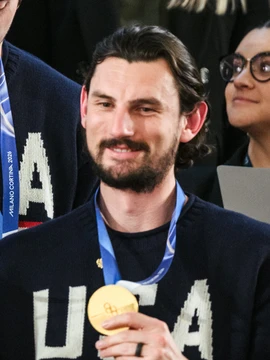
Tim Thomas (ice hockey, born 1974)
Two-time Vezina winner and Conn Smythe Trophy recipient at age 37.

Tim Thomas was an American professional ice hockey goaltender, born on April 15, 1974, in Flint, Michigan. He played most of his NHL career with the Boston Bruins, though he also spent significant time in minor leagues and Europe before breaking into the league at age 28. Thomas attended Davison High School and played four seasons of college hockey at the University of Vermont from 1993 to 1997. The Quebec Nordiques selected him 217th overall in the 1994 NHL Entry Draft. He didn’t become the Bruins’ starting goaltender until age 32.
Thomas won the Vezina Trophy twice, in 2009 and 2011, as the NHL’s top goaltender, and he represented Team USA at the 2010 Winter Olympics in Vancouver. In the 2011 Stanley Cup playoffs, he earned the Conn Smythe Trophy as the most valuable player. At age 37, he was the oldest player to win that award until Jordan Staal surpassed him in 2026. Thomas is one of four American-born players to win the Conn Smythe, alongside Brian Leetch, Jonathan Quick, and Patrick Kane.
In college, Thomas posted an 81–43–15 record with a 2.70 goals-against average and a .934 save percentage. He ranks third in NCAA Division I history with 3,950 career saves, led the nation in save percentage in 1996 (.924), and helped Vermont reach the NCAA tournament in his final two seasons, including a Frozen Four appearance in 1996—a program first. He was a two-time All-ECAC selection and a two-time NCAA East All-American. He remains Vermont’s all-time leader among goaltenders in games played (140), wins (81), and saves (3,950). At Vermont, he played alongside future NHL All-Star Martin St. Louis.
After college, Thomas played briefly for the Birmingham Bulls (ECHL) and Houston Aeros (IHL) in 1997–98 before moving mid-season to HIFK of the Finnish SM-Liiga. There, he posted a .947 save percentage in 18 games and helped the team win the Finnish championship. He signed with the Edmonton Oilers on June 4, 1998, but spent the next season with the AHL’s Hamilton Bulldogs (15 games) before returning to HIFK, where he recorded a .917 save percentage in 14 games as the team finished as league runners-up. In 1999–2000, he played for the Detroit Vipers (IHL), then spent the 2000–01 season with AIK IF in Sweden. He joined the Boston Bruins organization in 2001 but played his first full SM-Liiga season with Kärpät in 2001–02, posting a .925 save percentage in 32 games.
Quick Facts
- Birth Date
- 1974-04-15
- Birth Place
- Flint, Michigan, U.S.
- Height Ft
- 5
- Height In
- 11
- Weight Lb
- 201
- Position
- Goaltender
- Catches
- Left
- Played For
- HIFK / AIK / Kärpät / Boston Bruins / Jokerit / Florida Panthers / Dallas Stars
- Ntl Team
- USA
- Draft
- 217th overall
- Draft Year
- 1994
- Draft Team
- Quebec Nordiques
Facts from the source article.
Lore & Background
Thomas played four seasons of college hockey for the University of Vermont from 1993–1997, posting an 81–43–15 record with a 2.70 GAA and .934 save percentage. He ranks third in NCAA Division I record book in career saves (3,950) and led the nation in save percentage in 1996 (.924). He helped Vermont to NCAA tournament appearances in his final two seasons, including a berth in the 1996 NCAA Frozen Four. He was drafted 217th overall by the Quebec Nordiques in the 1994 NHL entry draft. After college, Thomas played for several years in the minor leagues and Europe, including stints in Finland's SM-Liiga with HIFK, Kärpät, and Jokerit, before making it to the NHL at age 28 with the Boston Bruins. He finally emerged as the Bruins' starting goaltender at age 32. During the 2004–05 NHL lockout, he played for Jokerit and posted a league-high .946 save percentage with 15 shutouts, winning the Lasse Oksanen trophy and the Kultainen kypärä award.
Reader's Guide
Thomas's significance lies in his late-blooming NHL career and his exceptional playoff performance. He won the Conn Smythe Trophy as the most valuable player in the 2011 Stanley Cup playoffs at age 37, making him the oldest player in NHL history to win the award until Jordan Staal in 2026. He is one of four American-born players to win the Conn Smythe Trophy, along with Brian Leetch, Jonathan Quick, and Patrick Kane. Thomas also won the Vezina Trophy twice (2009 and 2011) as the NHL's best goaltender. He was a member of Team USA in the 2010 Winter Olympics in Vancouver. His career path included extensive time in the minor leagues and Europe before establishing himself as an NHL starter, and he was known for adopting a yoga-based physical conditioning program in 2007 that increased his flexibility and strength. He led the NHL in 2008–09 with a 2.10 GAA and .933 save percentage, and recorded his 100th NHL win in a 6–0 shutout against the Anaheim Ducks on February 26, 2009.
Did You Know?
- He played college hockey at the University of Vermont alongside future NHL All-Star Martin St. Louis.
- During the 2004–05 NHL lockout, he set a SM-Liiga record with 15 shutouts in a single season.
NHL Career and Individual Distinctions
Selected with the first pick of the 2005 NHL Entry Draft by the Pittsburgh Penguins, Crosby immediately redefined expectations for a rookie. His debut campaign produced 102 points, making him the youngest player in league history to cross the century mark at 18 years and 253 days, and he finished as runner-up for the Calder Memorial Trophy. The following season proved even more extraordinary: a 120-point campaign earned him the Art Ross Trophy, the Hart Memorial Trophy, and the Lester B. Pearson Award simultaneously, cementing his status as the only teenager ever to capture a scoring title in a major North American professional sports league. Over the years, Crosby added two Maurice Richard Trophies for leading the league in goals (2010 with 51, and 2017), a second Art Ross in 2014 with 104 points, and three Ted Lindsay Awards recognizing peer admiration. He also collected the Mark Messier Leadership Award and was named among the 100 Greatest NHL Players in history in 2017, a testament to a career defined by sustained excellence rather than a single flash of brilliance.
Stanley Cup Pursuit and Overcoming Adversity
Assuming the Pittsburgh Penguins' captaincy at the start of the 2007-08 season, Crosby guided his team to the Stanley Cup Final, where they fell to the Detroit Red Wings in six games. The following year brought redemption: a seven-game series victory over the same Detroit squad made Crosby the youngest captain in NHL history to lift the Cup. His championship run extended further when Pittsburgh claimed titles in both 2016 and 2017, with Crosby earning the Conn Smythe Trophy as playoff MVP in consecutive years—a feat only the third player in league history to accomplish. Yet the path was far from smooth. In early 2011, a concussion forced him out for the remainder of that season and most of the 2011-12 campaign, a period that tested his resilience and the Penguins' depth. Despite such setbacks, Crosby's ability to return and deliver at the highest level during the playoffs underscored why his teammates and fans regarded him not merely as a scorer but as the emotional and competitive anchor of the franchise across nearly two decades.
International Dominance and the Triple Gold Club
Beyond the NHL, Crosby has been a cornerstone of Canadian hockey on the world stage. His international résumé began with a gold medal at the 2005 World Junior Championships, foreshadowing what would become an extraordinary collection of global titles. At the 2010 Vancouver Olympics, he scored the overtime winner against the United States in the gold medal game. Four years later, as Team Canada's captain, he secured a second consecutive Olympic gold. The 2015 World Championship in Prague completed his hat trick of major international golds, inducting him into the Triple Gold Club—and uniquely, he was the only member to have captained all three winning rosters. His leadership extended to the 2016 World Cup of Hockey, where he captained Canada to the title and was unanimously elected tournament MVP. More recently, he led Canada to victory in the inaugural 4 Nations Face-Off in 2025 and earned a silver medal at the 2026 Winter Olympics, demonstrating that his competitive fire remains undiminished well into his late thirties.
Halifax Roots and the Road to the Draft
Crosby's story begins in Halifax, Nova Scotia, where he was born on August 7, 1987, to Troy and Trina Crosby. His jersey number 87 and his landmark 2007 contract of $8.7 million per year both mirror his birthdate, a detail that has become part of his mythology. Growing up in nearby Cole Harbour, he started handling a puck in the family basement at age two and learned to skate by three. His father Troy had played goaltending in the QMJHL with the Verdun Junior Canadiens, helping them to the 1985 Memorial Cup, and though drafted 240th overall by Montreal, he never reached the NHL. Young Sidney idolized Steve Yzerman and rooted for the Canadiens. After excelling at Astral Drive Junior High as a straight-A student, he moved to Shattuck-Saint Mary's in Minnesota at 15 before joining the Rimouski Océanic in the QMJHL. There he earned numerous awards and led his club to the 2005 Memorial Cup final. In 2019, both Océanic and the QMJHL retired his number 87, and in 2025 the league renamed its Rookie of the Year award the Sidney Crosby Trophy.
More in NHL Trophy Winners, Part 2 1-24
Spotted an error? Know more?
Reader corrections go straight into our review queue. Suggest an edit · How this site is sourced