Frequently Asked Questions
The most-asked questions about ngc objects.
What exactly is the NGC catalogue?
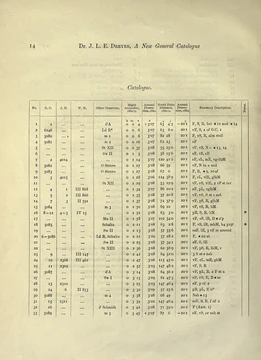
The New General Catalogue is a comprehensive list of deep-sky objects—galaxies, nebulae, and star clusters—compiled in 1888. It remains one of the most widely referenced star catalogues in both amateur and professional astronomy.
Who put the NGC catalogue together?
John Louis Emil Dreyer, an Irish astronomer at the Royal Greenwich Observatory, spent years collating earlier scattered lists into a single unified catalogue. He later became Astronomer Royal and was deeply involved in systematic sky cataloguing.
How many objects does the NGC contain?
The catalogue lists 7,840 entries, ranging from bright galaxies to faint nebulae and open or globular clusters. Only a fraction are visible to the naked eye; the majority require a telescope or long-exposure imaging.
What kinds of celestial objects are included?
The NGC covers three main categories: galaxies (the largest share), emission and reflection nebulae, and star clusters of both open and globular type. A small number of entries are unresolved point sources or double stars that were later reclassified.
How are NGC objects numbered and named?
Each entry receives a sequential number from NGC 1 through NGC 7840, ordered roughly by right ascension though not perfectly systematically. Observers and fans typically refer to a target by its number, for example NGC 7000 for the North America Nebula.
How does the NGC relate to the Messier and IC catalogues?
The NGC largely supersedes the older 110-object Messier catalogue and the 5,386-entry Index Catalogue, both of which Dreyer also worked on. Many Messier objects carry NGC numbers, and the three catalogues are routinely cross-referenced in star charts and observing lists.
What are some of the most famous NGC objects?
NGC 457 (Bode's Galaxy), NGC 7293 (the Helix Nebula), and NGC 6960 (the Western Veil) are among the most photographed targets. NGC 253 (the Sculptor Galaxy) and NGC 891 (the Silver Sliver) are also crowd favorites for visual and imaging observers.
Where should a beginner start if they want to observe NGC objects?
A solid entry point is the brighter galaxies and nebulae visible from mid-northern latitudes, such as NGC 4594 (the Sombrero Galaxy) or NGC 7000. Many astronomy clubs publish NGC top-50 or top-100 lists tailored to local sky conditions and season.
Is the NGC catalogue still considered accurate today?
Dreyer's original descriptions relied on 19th-century telescopic observations, so some identifications and spectral classifications have since been revised. Modern surveys like the Sloan Digital Sky Survey have re-identified many entries, yet the NGC numbers remain the standard naming convention.
Can I find NGC objects with a small backyard telescope?
Hundreds of NGC galaxies, nebulae, and clusters are reachable with a 6- or 8-inch reflector under reasonably dark skies. Brighter entries like NGC 2244 (the Rosette Nebula) or NGC 4486 (M87) reward even modest apertures on a clear night.