Chipseal
A cost-effective pavement surface treatment using asphalt and aggregate.
Last updated

Mcliquid · CC0
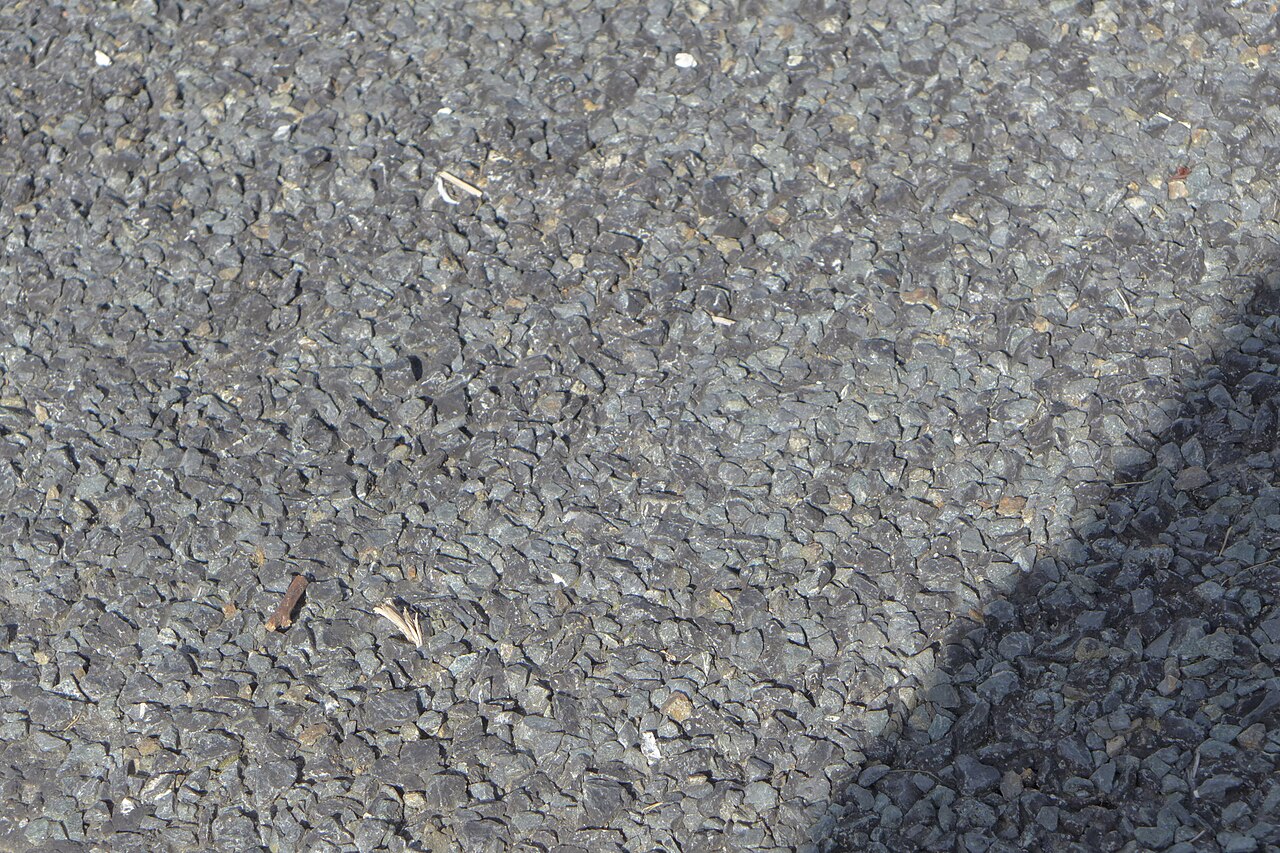
Chipseal is a pavement surface treatment that combines layers of asphalt with layers of fine aggregate.[1] The rough wearing surface of chipseal generates more roadway noise than typical asphalt or concrete surfaces.[2] Rural roads in the United States that experience less traffic are where chipseals are most often applied.[1]
Quick Facts
- Field
- Pavement surface treatment
- Common names
- Chip seal
- tar and chip
- sprayed seal
- surface dressing
- Typical use
- Rural roads with lower traffic volumes in the United States; major highways in Australia and New Zealand
Facts from the source article.
How it changed
Adding chipseal over gravel costs about 25% of resurfacing with asphalt.[3] A 4-mile project in Minnesota using chipseal cost $170,000 compared to $760,000 for asphalt.[3] Chipseal can be installed over gravel roads to eliminate the cost of grading and road roughness.[3] It also eliminates dust, mud, and the cost of adding gravel lost from grading.[3]
Dozens of vehicles suffered damage from that chipseal failure.[4] Waka Kotahi said all claims for that chipseal failure were processed through Fulton Hogan directly.[4] As vehicles travel faster, the noise levels produced by chipseal surfaces become louder.[2] The specific pattern of a tire's tread and how it contacts the road surface cause a wide range of noise levels.[2]
What the maker and period sources say
The ChipSeal program was initiated with assistance from the U.S. Air Force Research Laboratory to demonstrate hermetic equivalent performance for integrated circuits.[5] ChipSeal protected ICs survived 1000 hours of high humidity exposure without failure, while control modules had 10 to 30 percent failure rates.[5] The process was successfully scaled to 150 mm wafer size and demonstrated compatibility for 10 device types including analog, digital and memory ICs.[5] ChipSeal processing showed no negative effects in package reliability assessment.[5]
The technology is compatible with gallium arsenide and silicon-on-sapphire semiconductor types.[5] ChipSeal is applicable to high reliability commercial or defense products.[5]
References
- Wikipedia, "Chipseal" (CC BY-SA 4.0), which cites: Orsman, "Heinemann New Zealand Dictionary", Heinemann Educational Books (NZ) Ltd, 1979, p. 1131; Orsman, "The Dictionary of New Zealand English", Oxford University Press, 1997, p. 818; Gransberg, "Chip Seal Best Practices", Transportation Research Board, 2005, p. 13–20; "More than 100 motorists lodge damage claims after road seal peels off at Dome Valley", nzherald.co.nz, 25 February 2024 (we also read that source) en.wikipedia.org
- Wikipedia, "Chipseal" (CC BY-SA 4.0), which cites: Hogan, "Analysis of highway noise", Journal of Water, Air, & Soil Pollution, September 1973, p. 387–392 (original not read by us) en.wikipedia.org
- Wikipedia, "Chipseal" (CC BY-SA 4.0), which cites: Silver Creek umn.edu. (original not read by us) en.wikipedia.org
- "More than 100 motorists lodge damage claims after road seal peels off at Dome Valley", nzherald.co.nz, 25 February 2024. facts only, no text reused. nzherald.co.nz
- Internet Archive scan: "DTIC ADA400209: ChipSeal Inorganic Sealing Technology for Hermetic-Like Integrated Circuits. Volume 1" (2000-09-01). facts only; machine OCR of the scan. archive.org
Each numbered sentence above was checked against the source it cites before publication. Sentences citing Wikipedia adapt text from the English Wikipedia article Chipseal (contributors), used under CC BY-SA 4.0; this entry is available under the same licence. Other sources were used for facts only; no text or images are copied from them.
More in New Zealand inventions
Sources
Compiled from Wikipedia and the sources listed below. Text from Wikipedia is available under CC BY-SA 4.0; this entry is adapted from it.
- Wikipedia: Chipseal (CC BY-SA 4.0).
Spotted an error? Know more?
Reader corrections go straight into our review queue. Suggest an edit · How this site is sourced