Reflex sympathetic dystrophy
A rare chronic pain condition often triggered by injury.
Last updated
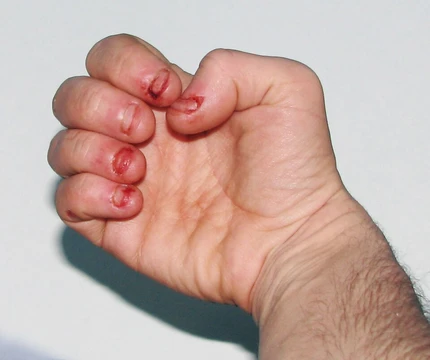
Reflex sympathetic dystrophy (RSD) is a historical term for complex regional pain syndrome type 1, a rare neuroinflammatory and dysautonomic disorder. It is notable for causing severe, chronic pain that is disproportionate to the initial injury and often spreads beyond the original site.
Pathophysiology
Inflammation and altered pain perception in the central nervous system are thought to be central to CRPS. Inflammatory molecules such as IL-1, IL-2, TNF-alpha and neuropeptides like substance P are released from peripheral nerves, possibly due to inappropriate cross-talk between sensory and motor fibers. This leads to neurogenic inflammation, nociceptive sensitisation causing allodynia, vasomotor dysfunction, and maladaptive neuroplasticity. The condition is considered an aberrant response to tissue injury.
Brain imaging shows increased activation in the S1 and S2 cortices, insula, associative-somatosensory cortices, frontal cortices, and anterior cingulate cortex upon painful stimulation. Contrary to earlier beliefs, sympathetic nervous system outflow appears reduced in the affected region, though sympatho-afferent coupling may occur. Wind-up and central nervous system sensitization are key processes in the induction and maintenance of CRPS.
Diagnosis
Diagnosis is primarily clinical, based on the Budapest Criteria adopted by the International Association for the Study of Pain. These criteria require continuing pain disproportionate to any inciting event, plus at least one symptom in three of four categories: sensory (hyperesthesia), vasomotor (temperature or skin color asymmetry), sudomotor/edema (edema or sweating changes), and motor/trophic (decreased range of motion, motor dysfunction, or trophic changes).
Additionally, at least one sign must be present in two or more categories at evaluation: sensory (hyperalgesia or allodynia), vasomotor (temperature asymmetry >1°C or skin color changes), sudomotor/edema (edema or sweating asymmetry), and motor/trophic (decreased range of motion, motor dysfunction, or trophic changes). No other diagnosis should better explain the signs and symptoms. No specific test exists; thermography, sweat testing, X-rays, electrodiagnostics, and sympathetic blocks may support the picture. Early recognition and prompt treatment improve outcomes.
Treatment
Treatment involves multiple modalities. Physical and occupational therapy have low-quality evidence; interventions include transcutaneous electrical nerve stimulation, progressive weight bearing, graded tactile desensitization, massage, and contrast bath therapy. A two-week multidisciplinary rehabilitation program reduced subjective pain and body perception scores in a retrospective cohort. Mirror box therapy appears beneficial in early CRPS, though long-term effects are unproven.
Graded motor imagery, comprising laterality reconstruction, motor imagery, and mirror therapy, may be useful for CRPS-1. Transcutaneous electrical nerve stimulation can help pain and edema but not functional ability. Tentative evidence supports bisphosphonates, calcitonin, and ketamine. Nerve blocks with guanethidine appear harmful; evidence for sympathetic nerve blocks is insufficient.
Intramuscular botulinum injections may help localized symptoms. Ketamine shows promise but no benefit on function or depression.
Research
The National Institute of Neurological Disorders and Stroke supports research on CRPS through grants to major medical institutions. Investigators are studying new treatments and aggressive intervention after trauma to reduce the risk of developing the disorder.
Using microneurography, researchers record neural activity in single nerve fibers of affected patients to discover the mechanism of spontaneous pain. Mirror visual feedback research is conducted at the Royal National Hospital for Rheumatic Disease in Bath. The Netherlands has the most comprehensive research program, part of the TREND initiative, with German and Australian teams also pursuing better understanding and treatments.
Did You Know?
- A minority (7%) of individuals with CRPS in a single limb go on to develop it in another.
- The prior concept of CRPS having three stages is no longer in wide use.
More in Neurocutaneous Conditions
Sources
Compiled from Wikipedia and the sources listed below. Text from Wikipedia is available under CC BY-SA 4.0; this entry is adapted from it.
- Wikipedia: Complex regional pain syndrome (CC BY-SA 4.0).
- Word definitions: the , each quoted from its Wikipedia article.
Spotted an error? Know more?
Reader corrections go straight into our review queue. Suggest an edit · How this site is sourced