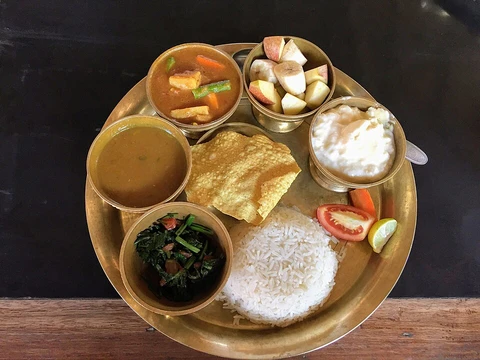
Sattu
A dry-roasted flour used in Nepali, Indian, and Tibetan cuisines.
Sattu is a coarsely ground parched barley meal, with the word derived from the Sanskrit sáktu.[1] Eastern India and the Terai region of Nepal are where sattu originated, according to Harkesh Singh Kehal's work.[2]
Quick Facts
- Also known as
- Satui
- Main region
- Nepal, India, Tibet
- Primary ingredients
- Dry-roasted pulses and cereals (e.g., chickpeas, maize, barley, Bengal gram)
- Notable cultural association
- Satuaan observance in Bhojpuri region (month of Chait, March–April)
Facts from the source article.
Key facts and history
Upādhyāya states that sattu has long been a fundamental component of daily meals and is linked to both seasonal events and religious customs in rural Bhojpuri life.[3] During the Satuaan observance in Chait (March–April), sattu is eaten with a chutney made from raw mangoes, a practice particularly noted in Bhojpuri culture.[4] Sattu-filled littis are made and presented to Lord Shiva at the Lota-Bhanta Mela in Banaras.[4] To prepare sattu, grains or grams—most often barley or Bengal gram—are dry-roasted in an iron vessel with sand.[5]
During hot weather, sattu is traditionally drunk as a cooling beverage after being mixed with cold water.[5]
What the cited sources add
The book "Bhojpuri Kahawaten", published by Vani Prakashan in 2006, states that in the Bhojpuri region sattu is consumed as an independent food and used as a filling for parathas and sattu-filled litti, known locally as makuni, phutehari or bhabhari.[6][7]
References
- Wikipedia, "Sattu" (CC BY-SA 4.0), which cites: "Definition of sáktu", A Comparative Dictionary of Indo-Aryan Languages, Digital South Asia Library, University of Chicago Library, 2026; www.wisdomlib.org, "Saktu, Shaktu, Śaktu: 21 definitions", www.wisdomlib.org, 2016-03-18 (original not read by us) en.wikipedia.org
- Wikipedia, "Sattu" (CC BY-SA 4.0), which cites: Harkesh Singh Kehal. Alop Ho Riha Punjabi Virsa. Pub. Lokgeet Parkashan. . (original not read by us) en.wikipedia.org
- Wikipedia, "Sattu" (CC BY-SA 4.0), which cites: Upādhyāya, "Bhojapurī lokagītoṃ kā sāṃskr̥tika adhyayana", Bhāratīya Loka-Saṃskr̥ti Śodha-Saṃsthāna, 1984 (original not read by us) en.wikipedia.org
- Wikipedia, "Sattu" (CC BY-SA 4.0), which cites: Planalp, "Heat Stress and Culture in North India", U.S. Army Medical Research and Development Command, 1971; "Litti Chokha: बक्सर में भगवान श्रीराम ने खाया था लिट्टी-चोखा, जानिए क्या है पंचकोशी यात्रा की पौराणिक कथा - Litti Chokha Shriram had eaten Litti Chokha in Buxar know what is the legend of Panchkoshi Yatra", Jagran; "लोटा-भंटा मेला : मेला जहां वरुणा में स्नान के बाद लगता है भोले को बाटी- चोखा का भोग - Lota Bhanta Mela A symbol of faith fair where after bathing in Varuna bati chokha bhog to shiva in Varanasi Jagran Special", Jagran (origina en.wikipedia.org
- Wikipedia, "Sattu" (CC BY-SA 4.0), which cites: "Why you should drink sattu in summer", The Indian Express (original not read by us) en.wikipedia.org
- Wikipedia, "Sattu" (CC BY-SA 4.0), which cites: Ojhā, "भोजपुरी कहावतें: एक सांस्कृतिक अध्ययन", Vaṇī Prakāśana, 2006 (we also read that source) en.wikipedia.org
- Open Library record, ISBN 9788181435620 ("Bhojpuri Kahawaten"). CC0 (metadata); book content not read. openlibrary.org
Each numbered sentence above was checked against the source it cites before publication. Sentences citing Wikipedia adapt text from the English Wikipedia article Sattu (contributors), used under CC BY-SA 4.0; this entry is available under the same licence. Other sources were used for facts only; no text or images are copied from them.
More in Nepalese Cuisine
Spotted an error? Know more?
Reader corrections go straight into our review queue. Suggest an edit · How this site is sourced