Frequently Asked Questions
The most-asked questions about nebulae.
What exactly is a nebula?
A nebula is a vast, diffuse cloud of gas (mostly hydrogen and helium) mixed with fine dust suspended in interstellar space. They can stretch across hundreds or thousands of light-years and serve as both the cradles where new stars ignite and the final resting places of dying ones.
What are the main categories of nebulae I should know about?
The big families are emission nebulae (glowing from ionized gas), reflection nebulae (scattering nearby starlight), dark nebulae (dust clouds that block background light), planetary nebulae (shells ejected by dying sun-like stars), and supernova remnants (the debris of massive stellar explosions). Each tells a different chapter of the stellar life cycle.
Who are the 'main characters'—the most iconic nebulae fans talk about?
The Orion Nebula (M42) is the flagship, visible to the naked eye and endlessly imaged. The Crab Nebula, the Ring Nebula, the Helix Nebula, and the Eagle Nebula's Pillars of Creation round out the most frequently referenced names in any discussion.
Where should a total newcomer start exploring?
Begin with the Orion Nebula, since it's the brightest and easiest to spot in winter skies, giving you an immediate visual anchor. From there, branch into planetary nebulae like the Ring or Helix to see how a single star's death creates a structured shell, then move to supernova remnants for the high-energy end of the spectrum.
How do nebulae actually form?
They arise from stellar winds that strip material off a star, from the explosive ejection of a massive star's outer layers in a supernova, or from the residual gas and dust left over after a burst of star formation. In every case, the raw ingredients are hydrogen, helium, trace metals, and silicate or carbon dust grains.
Just how big are we talking?
A typical emission nebula spans tens to hundreds of light-years, while supernova remnants can reach over a hundred light-years in diameter. The Orion Nebula alone stretches roughly 24 light-years and contains enough material to form millions of suns.
Why do nebulae show up in so many different colors?
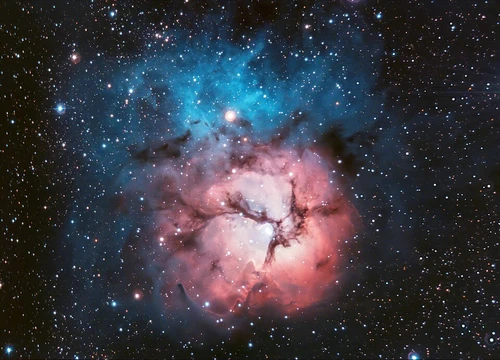
The color you see is dictated by which atoms are excited and which wavelengths they emit: hydrogen produces red, doubly ionized oxygen gives blue-green, and sulfur adds a deeper red. Reflection nebulae simply mirror the blue-white hue of their nearby star, while dark nebulae appear as silhouettes because they absorb rather than emit light.
What's the 'story arc' connecting nebulae to stars?
It's a closed loop: gravitational collapse inside a nebula ignites a new star, and when that star exhausts its fuel it either puffs its envelope into a planetary nebula or detonates as a supernova, seeding the surrounding cloud with heavy elements. Each generation of stars enriches the next nebula's chemistry, so the cycle literally builds complexity over billions of years.
What are the most celebrated 'moments' in nebula observation history?
Hubble's 1995 Pillars of Creation image became arguably the most recognized astronomy photograph ever, and the 2022 James Webb Space Telescope first deep field revealed thousands of faint nebulae in a single frame. The 1731 identification of the Crab Nebula as the remnant of the 1054 supernova was an early landmark in linking historical records to modern objects.
Do I need a professional telescope to see one?
The Orion Nebula is a steady naked-eye object in dark skies, and a modest pair of binoculars will resolve its core. For color and structure in planetary or supernova-remnant nebulae, a small aperture telescope with a long-exposure camera or even a good smartphone adapter will reveal far more than the unaided eye can capture.