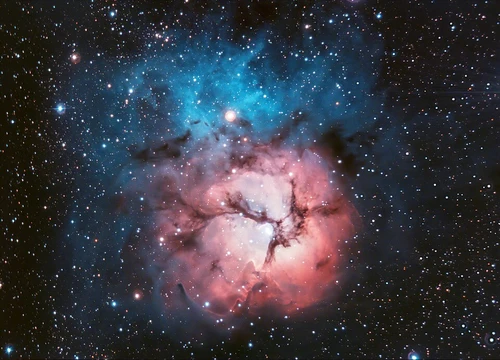
Interstellar cloud
Last updated
Organic molecules such as formaldehyde, methanol, and vinyl alcohol were observed in spectra where they were not expected.[1] The ratios of these elements may help develop theories on their production, including cosmic ray spallation.[2] These high-velocity clouds are detected primarily in the 21 cm line of neutral hydrogen.[3] A molecule's relative percentage in the cloud is proportional to the height of its peak in a spectrum.[4]
Due to the low temperature and density of interstellar clouds, scientists prior to 2001 anticipated that reactions within them would proceed very slowly, yielding minimal products.[1] Only at the much higher temperatures and pressures found on Earth and in Earth-based laboratories are scientists familiar with the chemical reactions needed to create such substances.[1] The finding that these reactions in interstellar clouds occur more rapidly than anticipated, probably through gas-phase reactions, was indicated by the discovery.[1] Studying the presence and proportions of metals in space is facilitated by interstellar clouds as a medium.[2]
What the research sources say
The National Radio Astronomy Observatory reported that astronomers discovered vinyl alcohol in an interstellar cloud near the center of the Milky Way using the 12 Meter Telescope at Kitt Peak.[5] Barry Turner stated that the discovery provides a tool for understanding the formation of complex organic compounds in interstellar space.[5] Turner and A. J. Apponi detected the vinyl alcohol in Sagittarius B, a molecular cloud 26,000 light-years from Earth.[5] The astronomers detected the specific radio signature of vinyl alcohol during May and June of 2001.[5]
Turner noted that since the 1970s, scientists have speculated that molecules could form on microscopic dust grains in interstellar clouds.[5] Turner and others speculate that energy from young stars could evaporate icy grain surfaces, liberating molecules into interstellar space.[5]
References
- Wikipedia, "Interstellar cloud" (CC BY-SA 4.0), which cites: Charles Blue, "Scientists Toast the Discovery of Vinyl Alcohol in Interstellar Space", National Radio Astronomy Observatory, October 2001 (we also read that source) en.wikipedia.org
- Wikipedia, "Interstellar cloud" (CC BY-SA 4.0), which cites: Knauth, "Newly Synthesized Lithium in the Interstellar Medium", Nature, 2000, p. 656–658 (original not read by us) en.wikipedia.org
- Wikipedia, "Interstellar cloud" (CC BY-SA 4.0), which cites: "Dark Matter- More Than Meets the Eye", NASA (we also read that source) en.wikipedia.org
- Wikipedia, "Interstellar cloud" (CC BY-SA 4.0), which cites: Project Leader Dr. Lochner, "Spectra and What Scientists Can Learn From Them", Goddard Space Flight Center, NASA, November 2009 (original not read by us) en.wikipedia.org
- Charles Blue, "Scientists Toast the Discovery of Vinyl Alcohol in Interstellar Space", National Radio Astronomy Observatory, October 2001. facts only, no text reused. nrao.edu
Each numbered sentence above was checked against the source it cites before publication. Sentences citing Wikipedia adapt text from the English Wikipedia article Interstellar cloud (contributors), used under CC BY-SA 4.0; this entry is available under the same licence. Other sources were used for facts only; no text or images are copied from them.
More in Nebulae
Sources
Compiled from Wikipedia and the sources listed below. Text from Wikipedia is available under CC BY-SA 4.0; this entry is adapted from it.
- Wikipedia: Interstellar cloud (CC BY-SA 4.0).
- Word definitions: the Codexery glossary, each quoted from its Wikipedia article.
Spotted an error? Know more?
Reader corrections go straight into our review queue. Suggest an edit · How this site is sourced