Etak
Pioneer of commercial automotive navigation and digital mapping.
Last updated
Etak, Inc., an independent American company, sold car navigation hardware, digital maps, and mapping software. Founded in 1983, it was an early commercial trailblazer in these fields. After Tele Atlas bought it in 2000, the Etak name was soon retired.
Quick Facts
- Founded
- 1983
- Headquarters
- Sunnyvale, later Menlo Park, California
- Founding investor
- Nolan Bushnell
- Seed funding
- $500,000
- First product
- Navigator (introduced 1985)
- Acquired by
- News Corporation (1989)
- Sony Corporation (1996)
- Tele Atlas (2000)
Facts from the source article.
Founding of the company
Nolan Bushnell, founder of Atari and Chuck E. Cheese's Pizza Time Theater, provided Etak's initial start-up funding. In 1983, co-founder Stan Honey, then doing military-related research at SRI International, sailed with Bushnell to victory in a Transpac race.
Impressed by Honey's navigational electronics, Bushnell asked for other ideas; Honey suggested a car navigation system. Bushnell gave $500,000 in seed money, and Etak was born. The name came from a Polynesian term for navigation.
Etak Navigator
Etak's first product, the Navigator, was introduced in 1985. It was an Intel 8088-based system with 256K RAM, 32K EPROM, 2K SRAM, and a cassette tape drive storing digital maps and part of the operating system. For the Los Angeles area, three to four tapes were needed; the driver changed tapes when reaching a map edge.
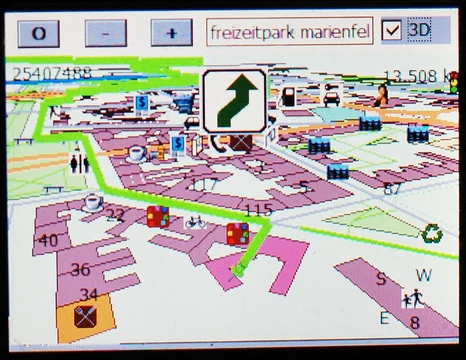
The system used a green vector display rather than color raster graphics. It featured address geocoding and worked via a digital compass and two wheel sensors on non-driven wheels. Map-matching augmented dead reckoning: the user entered the car's initial location and performed a short calibration drive, after which the system self-corrected by checking location and direction against street map data, critical since GPS was absent.
The move to digital mapping
The Navigator sold a few thousand units in a few years and appeared in Michael Jackson's car and the 1991 film "Nothing But Trouble". Etak lacked resources for mass production of improved models. In 1985, it entered an exclusive agreement with General Motors requiring GM to pay a minimum amount regardless of whether Delco Electronics fielded a product. Etak stopped making hardware and focused on digital mapping with Etak Maps and EtakGuide.
It licensed its car navigation technology to Clarion in Japan and Bosch (Blaupunkt) in Germany (as the TravelPilot), and continued engineering support for licensees and vertical market fleet applications. Etak began mapping Japanese cities in 1987, but the Japanese government later required a license; by the time it came through, a Japanese competitor had moved in. Rupert Murdoch's News Corporation acquired Etak for a reported $25 million, persuaded that digital maps would be a major advertising medium.
Expansion and consolidation
In 1995, News Corp expanded Etak's field operations unit to create accurate maps of major US cities. A second building at 1605 Adams Drive in Menlo Park was leased to house a map library, Sun SPARC digitizing stations, and field operations. Field offices opened in Detroit, New York, Los Angeles, Seattle, Washington, D.C., Miami, Chicago, Houston, Atlanta, and Orlando. A highways project began in 1996.
Under Sony's ownership, urban core projects started in 1997 in multiple cities due to an agreement with GM's Delphi unit. The Miami field office was shuttered, with personnel moved to Minneapolis, St. Louis, and Phoenix. In March 1998, several offices closed; on June 4, 1998, all remaining field offices closed, ending independent mapping efforts under the Etak banner.
More in Navigation System Companies
Sources
Compiled from Wikipedia and the sources listed below. Text from Wikipedia is available under CC BY-SA 4.0; this entry is adapted from it.
- Wikipedia: Etak (CC BY-SA 4.0).
Spotted an error? Know more?
Reader corrections go straight into our review queue. Suggest an edit · How this site is sourced