Rizal Park
Historic urban park and site of José Rizal's execution.
Last updated
Where it is
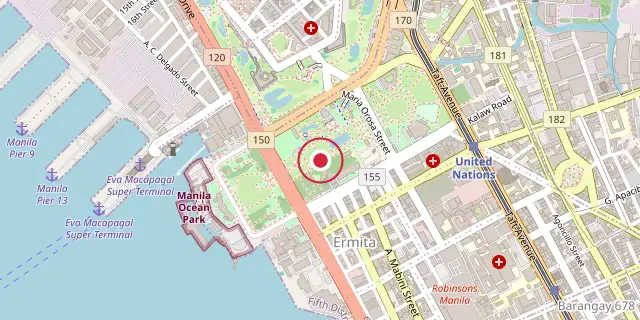
Coordinates: 14°34′55″N 120°58′41″E (14.5820, 120.9780) · Open in OpenStreetMap
Coordinates and connected clubs: the infobox of Wikipedia: Rizal Park (CC BY-SA 4.0). Map: drawn by Codexery from OpenStreetMap tiles.
Located in the Ermita district of Manila, the historic urban park known as Rizal Park or Luneta sits on Manila Bay's eastern shore.[1][2] That monument, which contains Rizal's remains, serves as the park's symbolic focal point.[2]
Geography and history
The park's history began in 1820 when the Paseo de Luneta was completed on a marshy patch of land south of Manila's walls.[3] The Spanish cleared the settlement after the British used it as cover during their 1762–1764 occupation.[3] The site later became known as Bagumbayan Field, featuring a Spanish military hospital and a crescent-shaped fortification called the Luneta.[4] The Rizal Monument was built during the American colonial period and inaugurated on December 30, 1913.[5]
The area was originally the settlement of Barrio Nuevo (Bagumbayan), which existed as early as 1601.[3] Between 1823 and 1897, under Spanish rule, the site gained notoriety as a place where public executions occurred.[6] José Rizal was put to death at this location on December 30, 1896, an event that helped build momentum for the Philippine Revolution.[2] Proclamation No. 234, signed by President Ramon Magsaysay on December 19, 1955, designated the site as a national park covering about 16.24 hectares.[7]
President Ferdinand Marcos issued Proclamation No. 299 in 1967, changing the name from Luneta National Park to Rizal Park.[8]
What the cited sources add
According to a 2015 inventory, there are 3,497 trees of 112 species in the park.[9] The park's musical dancing fountain was built by German-Filipino William Schaare in the 1960s.[10] On February 16, 1986, a political gathering called the Tagumpay ng Bayan rally took place at the Luneta.[11] To differentiate it from other parks with the same name, the National Parks Development Committee started using the brand "Rizal Park, Luneta" in December 2021.[12]
To enhance tourist safety, 30 high-definition CCTV cameras were put in place at the park during 2012.[13]
References
- Wikipedia, "Rizal Park" (CC BY-SA 4.0), which cites: Chua, "Rizal Park Luneta and the fresh air of freedom", The Manila Times, January 1, 2022, p. A6; "New Rizal Park logo unveiled as nation commemorates martyrdom of Dr. Jose Rizal", BusinessMirror, January 4, 2022; "Rizal Park", National Parks Development Committee (we also read that source) en.wikipedia.org
- Wikipedia, "Rizal Park" (CC BY-SA 4.0), which cites: Cruz, Elfren S., "The road to EDSA", The Philippine Star, February 23, 2017 (we also read that source) en.wikipedia.org
- Wikipedia, "Rizal Park" (CC BY-SA 4.0), which cites: Joaquin, "Manila My Manila", The City of Manila, 1990 (original not read by us) en.wikipedia.org
- Wikipedia, "Rizal Park" (CC BY-SA 4.0), which cites: (1911–12). "The Century Magazine", p.237-249. The Century Co., NY, 1912.; "History – Spanish Period" . Rizal Park. Retrieved on October 7, 2011. (original not read by us) en.wikipedia.org
- Wikipedia, "Rizal Park" (CC BY-SA 4.0), which cites: Division of Insular Affairs, War Department (1901). "Public Laws and Resolutions Passed by the United States Philippine Commission", p.689. Washington: Governme; "Vatican City can fit in Rizal Park", January 2012 (original not read by us) en.wikipedia.org
- Wikipedia, "Rizal Park" (CC BY-SA 4.0), which cites: "History – Spanish Period" . Rizal Park. Retrieved on October 7, 2011.; Jernegan, Prescott Ford (1995). "A Short History of the Philippines", p.252. New York: D. Appleton and Company. (original not read by us) en.wikipedia.org
- Wikipedia, "Rizal Park" (CC BY-SA 4.0), which cites: "Creating The Jose Rizal National Centennial Commission", Official Gazette of the Republic of the Philippines, August 10, 1954; "The Centenary of the Rizal Monument", Official Gazette of the Republic of the Philippines; "Reserving for National Park Purposes to Be Known as the "Luneta National Park" a Certain Parcel of the Private Domain of the Government Situated in the District of Ermita, City of Manila", December 19, 1955 (original not read by us) en.wikipedia.org
- Wikipedia, "Rizal Park" (CC BY-SA 4.0), which cites: "Naming the National Park in the District of Ermita, City of Manila, as Rizal Park.", Official Gazette of the Republic of the Philippines, October 24, 1967 (original not read by us) en.wikipedia.org
- Wikipedia, "Rizal Park" (CC BY-SA 4.0), which cites: Teves, "NPDC to revive Rizal Park with more indigenous trees", Philippine News Agency, August 16, 2019 (original not read by us) en.wikipedia.org
- Wikipedia, "Rizal Park" (CC BY-SA 4.0), which cites: Mejia-Acosta, Iris (May 25, 2011). "Luneta Celebrates Rizal's 150th Birthday with a Fresh Look". Pinay Ads. (original not read by us) en.wikipedia.org
- Cruz, Elfren S., "The road to EDSA", The Philippine Star, February 23, 2017. facts only, no text reused. philstar.com
- Wikipedia, "Rizal Park" (CC BY-SA 4.0), which cites: Chua, "Rizal Park Luneta and the fresh air of freedom", The Manila Times, January 1, 2022, p. A6; "New Rizal Park logo unveiled as nation commemorates martyrdom of Dr. Jose Rizal", BusinessMirror, January 4, 2022 (we also read that source) en.wikipedia.org
- Wikipedia, "Rizal Park" (CC BY-SA 4.0), which cites: "CCTV cameras seen to make Manila's Luneta Park safer", Yahoo! Philippines; Mejia-Acosta, Iris (May 25, 2011). "Luneta Celebrates Rizal's 150th Birthday with a Fresh Look". Pinay Ads. (original not read by us) en.wikipedia.org
Each numbered sentence above was checked against the source it cites before publication. Sentences citing Wikipedia adapt text from the English Wikipedia article Rizal Park (contributors), used under CC BY-SA 4.0; this entry is available under the same licence. Other sources were used for facts only; no text or images are copied from them.
More in National parks of the Philippines
Sources
Compiled from Wikipedia and the sources listed below. Text from Wikipedia is available under CC BY-SA 4.0; this entry is adapted from it.
- Wikipedia: Rizal Park (CC BY-SA 4.0).
Spotted an error? Know more?
Reader corrections go straight into our review queue. Suggest an edit · How this site is sourced