Nki National Park
Remote national park in southeastern Cameroon.
Last updated
Where it is
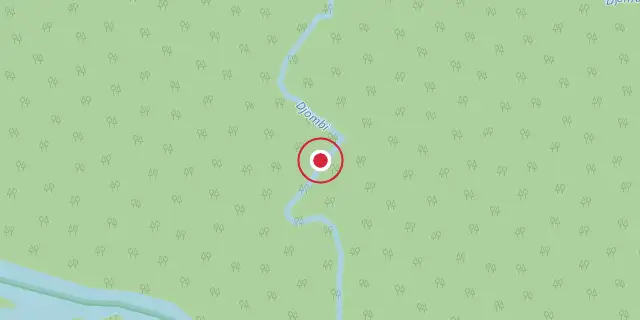
Coordinates: 2°25′01″N 14°25′01″E (2.4170, 14.4170) · Open in OpenStreetMap
Coordinates and connected clubs: the infobox of Wikipedia: Nki National Park (CC BY-SA 4.0). Map: drawn by Codexery from OpenStreetMap tiles.
Nki National Park is a protected area in southeastern Cameroon's East Province, known for its remote location and described as "the last true wilderness". It encompasses a large and varied ecosystem with over 265 bird species and a high density of forest elephants, though poaching has been a major problem since an economic depression in the 1980s.
History
The World Wildlife Fund has worked to conserve the park since the 1980s, including removing logging businesses. This effort drew criticism, particularly from the remote village of Ndongo, which before the WWF's involvement was a bustling logging town of 300 residents with good roads and plentiful work. After the WWF pressured logging companies to operate more environmentally, the companies left in 1988, leaving broken machinery and severely damaging Ndongo's economy. Leonard Usongo, manager of WWF projects in southeast Cameroon, stated that protecting forests requires acknowledging communities' problems and poverty.
Logging is no longer a major threat, as developing infrastructure for it would require significant investment, especially in the southern portion of Nki. According to WWF scientific advisor Paul Robinson Ngnegueu, poaching is the biggest threat, stemming from the late 1980s economic depression. Indigenous people followed poachers for financial opportunities, selling products through intermediaries.
Cameroonian authorities applied repressive measures against indigenous populations, such as in January 1997 when Bakas were forced from their homes near Mambele, turning them against the WWF. Poachers travel up the Dja River for central Nki, where elephant ivory is abundant; strong currents deter them for half the year. In 1995, the park was named an Essential Protection Zone, its first official status. It was formally established as a national park on 17 October 2005, though the Bakas have continually asked to reduce its boundaries and for higher usage rights.
Geography and climate
The park lies in a remote area of southeastern Cameroon, which has helped maintain most of its pristine forest and beauty, and it has never been completely explored. Its terrain is largely hilly, with elevations from 350 to 650 m, and it falls within the Sangha ecoregion. Several large rivers cross Nki, including the Dja River, where Nki Falls is located. The park covers 3093 km², straddling two administrative divisions in the East province: Ngoyla in Haut Nyon and Moloundou in Boumba et Ngoko Division.
Seventy-three bais, or forest clearings, have been discovered; in April 2006, a WWF team found the largest bai in the region, Ikwa Bai, slightly larger than Dzanga Sangha Bai. The bai has a small creek running through its center atop a bed of rocks and sand, with a large mineral pit next to the stream, and hosts chimpanzees, elephants, buffaloes, and gorillas. The climate is tropical, with temperatures ranging from 23.1 to 25°C and an average of 24°C. Relative humidity varies between 60 and 90%, and annual rainfall is 1500 mm.
Demographics
The area around the park has a human population of 22,882, mostly ethnic Bantus and Baka Pygmies, including the Djem, Bangando, Bakwele and Zime tribes. Non-indigenous employees of logging companies and traders also make up a sizeable portion. Population density is about five people per square kilometer, concentrated along the main Yokadouma-Moloundou road. Villages around the park are mostly homogeneous, with few non-natives, most of whom work as civil servants or traders.
Biodiversity
The main forest type is semi-evergreen with an open canopy dominated by 50–60 m Triplochiton, mixed with large patches of closed evergreens, and some seasonally flooded Uapaca trees along the Dja River. Nki encompasses a biodiverse group of plants and animals. Species found include sitatunga, chimpanzees, forest antelope (largely duikers), bushbucks, giant forest hogs, bush pigs, leopard, Nile crocodiles, bongos, and hundreds of fish species.
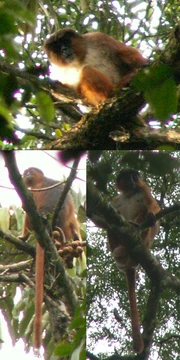
The forests of Cameroon have some of the highest population density of forest elephants of any nation; for Boumba Bek and Nki combined, elephant density is roughly 2.5 per square kilometer, with the population rising from 1,547 in 1998 to 3,000 in 2006. Gorillas are abundant, with an estimated 6,000 adults in Nki. Diurnal primates include the threatened crested monkey, De Brazza monkey, and the black colobus, which reportedly only live east of the Dja River. A 20-day BirdLife International study discovered 265 bird species, including the widespread yellow-bellied form of forest robin.
A pair of Dja River scrub warblers was found in a 1-hectare Rhynchospora marsh. Three species of forest nightjar have been observed: Bate's and brown nightjars are common, while a rarer unidentified third species, likely Prigogine's nightjar, has been heard twice. Two small owls, Sjostedt's and African barred owlets, coexist in Nki due to similar habitat requirements.
Ranked in
More in National Parks of Cameroon
Sources
Compiled from Wikipedia and the sources listed below. Text from Wikipedia is available under CC BY-SA 4.0; this entry is adapted from it.
- Wikipedia: Nki National Park (CC BY-SA 4.0).
- Word definitions: the Codexery glossary, each quoted from its Wikipedia article.
Spotted an error? Know more?
Reader corrections go straight into our review queue. Suggest an edit · How this site is sourced