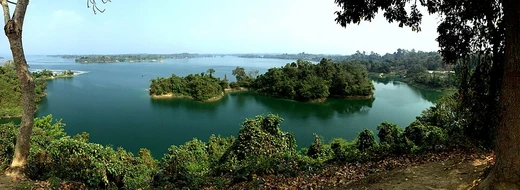
Hail Haor Wildlife Sanctuary
Key wetland sanctuary for waterfowl in Sylhet Basin.
Hail Haor Wildlife Sanctuary is a major wildlife sanctuary in Bangladesh, located in Moulvibazar District in the northeast region. It is one of the most important wetlands in the Sylhet Basin for resident and migratory waterfowls. The sanctuary also serves as a vital water source for surrounding inhabitants during summer when other sources dry up.
Quick Facts
- Location
- Moulvibazar District, Sylhet Division, Bangladesh
- Nearest city
- Moulvibazar
- Area
- 8,906.00 hectares
- Established
- 1983
Facts from the source article.
Did You Know?
- The area has a tropical monsoon climate with mean annual precipitation of 4000 mm, most falling from June to September.
- Temperatures in the Srimangal area normally range between 9 °C in winter and 32.8 °C in summer.
Description
The sanctuary lies between hills to the south, west and east, and the Manu and Kushiara river plains to the north. Hills are covered with tea gardens and natural forest blocks. During monsoon the wetland expands to about 14000 ha, shrinking to 3000 ha in summer, restricted to 130 beels and narrow canals. About 172000 people in 62 villages live around it. Receding monsoon water exposes land converted to rice fields. A project called 'Management of Aquatic ecosystems through Community Husbandry' was implemented from 1998 to 2008 by the Bangladesh Government and USAID, involving local groups in wetland conservation.
Biodiversity
Flora and fauna are mainly wetland-adapted. Much of the lake area is overgrown with Indian lotus and water hyacinth. Common hydrophytes include Typha elephantina, Trapa bispinosa, Hygrorhiza aristata, and species of Utricularia, Ceratophyllum, Vallisneria, Hydrilla, Najas, Potamogeton, Nymphoides, Pistia, Lemna and Azolla. Adjacent trees and shrubs include Bambusa spp., Musa spp., Mangifera indica, Erythrina spp. and Crataeva nurvula. The sanctuary hosts 40,000 to 50,000 waterfowl in winter, including lesser whistling duck, fulvous whistling duck, cotton pygmy goose, garganey, northern pintail, northern shoveler, common teal, common pochard, tufted duck, gadwall, spotbill duck, bar-headed goose, greylag goose, ruddy shelduck, comb duck, mallard, red-crested pochard, Baer's pochard, grebe, little cormorant, Indian pond heron, cattle egret, little egret, intermediate egret, great egret, water cock, moorhen, purple swamphen, common coot, pheasant-tailed jacana, bronze-winged jacana, herons, kingfishers, egrets and terns. Raptors include osprey, Eurasian marsh harrier and pied harrier. Threatened birds include Baer’s pochard, greater spotted eagle and Pallas’s fish eagle. It is an Important Bird Area (IBA) designated by BirdLife International. Other wildlife includes amphibians, reptiles and turtles. Fish species include Catla catla, Labeo rohita, L. calbasu, L. gonius, Cirrhina mrigala, Barbus spp., Wallago attu, Mystus tengra, Mystus aor, Oampokpabda, Gadusia chapra, Clupea spp., Notoptenis notopterus, Clarius batrachus, Heteropneustes fossilis, Channa spp., Anabas testudineus and Colis afasciota. Freshwater shrimps of genus Macrobrachium are common.
Threats
Wetlands face threats from siltation, drainage for agriculture and industry, and conversion into small fishing blocks via artificial embankments and roads, leading to declines in fish and waterfowl populations. Loss of tree diversity and population results from encroachment for cultivation, weed invasion, cattle grazing, collection of minor forest products and fuel wood, fire hazard, and expansion of roads and infrastructure. Large numbers of people, mostly migrants, live along the wetland and depend on fishing and cultivation for livelihood.
Frequently Asked Questions
Where is Hail Haor Wildlife Sanctuary?
Hail Haor Wildlife Sanctuary is located in Moulvibazar District, Sylhet Division, Bangladesh.
When was Hail Haor Wildlife Sanctuary founded?
Hail Haor Wildlife Sanctuary was founded in 1983.
More in National Parks of Bangladesh
Spotted an error? Know more?
Reader corrections go straight into our review queue. Suggest an edit · How this site is sourced