Belle Meade Plantation
Historic thoroughbred horse farm and Greek Revival mansion near the Natchez Trace.
Last updated

via Wikipedia: Belle Meade Plantation · see source
Where it is
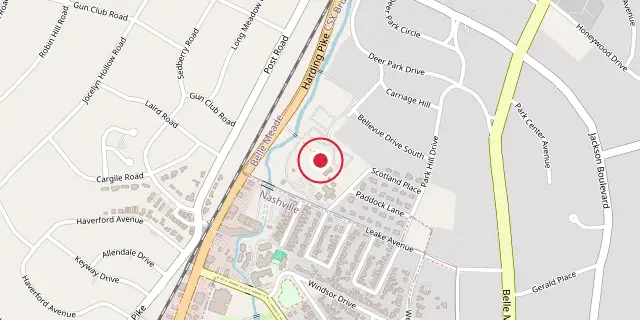
Coordinates: 36°06′22″N 86°51′54″W (36.1060, -86.8650) · Open in OpenStreetMap
Coordinates and connected clubs: the infobox of Wikipedia: Belle Meade Plantation (CC BY-SA 4.0). Map: drawn by Codexery from OpenStreetMap tiles.
Belle Meade Plantation, now called Belle Meade Historic Site and Winery, began as a farm in 1807 near Nashville, Tennessee. For nearly a century, five generations of the Harding-Jackson family owned and ran the property. Named for its "beautiful meadow," the farm peaked at 5,400 acres and relied on a workforce of 136 people, including enslaved individuals.
At its heart stood a Greek Revival mansion built in 1853. In the late 1800s, Belle Meade became famous nationwide for breeding thoroughbred racehorses, especially the celebrated stallion Iroquois. Today, the site operates as a museum, attraction, nonprofit winery, and restaurant, with various outbuildings preserved on just 30 remaining acres.
History
In 1807, Virginian John Harding bought Dunham's Station log cabin and 250 acre on the Natchez Trace, an ancient Native American path connecting their settlements in present-day Tennessee and Mississippi. He began to develop a farm, naming it "Belle Meade" — French/Old English for "beautiful meadow". Harding operated various businesses, such as a blacksmith shop, cotton gin, and grist and saw mills. By 1816, Harding was boarding horses for neighbors such as Andrew Jackson and breeding thoroughbreds, as well as racing them.
Middle Tennessee became known for raising purebred livestock, including cattle, sheep and horses. In 1823 Harding registered his own racing silks with the Nashville Jockey Club (an association of thoroughbred owners). He trained horses on the track at his farm at McSpadden's Bend, which he bought for his son William. William Giles Harding first worked the McSpadden Bend property along the Cumberland River.
He inherited Belle Meade in 1839. During the following decades he acquired additional property to total 5400 acre; by the time of the Civil War, he held 136 enslaved African Americans. In 1853 he incorporated his father's house into a much larger mansion. William Giles Harding would marry Elizabeth McGavock of Carnton; they had two daughters who survived to adulthood named Selene and Mary.
With the onset of the Civil War in 1861, Harding had to suspend his racing and breeding operations. As a staunch supporter of the Confederate States of America, he donated $20,000 of his own money, and raised $500,000 total to the costs of the Confederate States Army. In return he was made a Brigadier General and placed in charge of the Nashville Munitions Factory. After Union forces took control of Nashville in April 1862, Harding was arrested.
He was sent to Fort Mackinac, Michigan, for six months, then released under house arrest at Belle Meade after paying a $20,000 bond and signing an oath of allegiance. In the aftermath, the plantation recovered, but with greatly reduced capacity. Roughly half of the enslaved persons returned as paid employees after the war and lived in their own homes nearby. After a financial downturn in 1893 and later the death of the owner and his heir, the estate was dismantled and sold in parcels in 1906.
Much of the vast area of the original plantation became incorporated in 1938 as the City of Belle Meade that became an upscale residential area that included Nashville's Cheekwood Botanical Gardens, Percy Warner Park, and The Belle Meade Country Club. Since 1953, the mansion has been administered in trust by the Association for the Preservation of Tennessee Antiquities, a private non-profit corporation. In the 1970s, it was listed on the National Register of Historic Places.
Since the 1990s, the management has made an effort to reconcile the past by featuring stories of African Americans who worked there before and after emancipation.
Mansion and grounds
John Harding bought a cabin and 250 acres near the Natchez Trace; enslaved people began to clear and develop the land. They also built their own slave quarters, which are documented as two-family cabins. In the 1820s Harding commissioned the first red brick Federal-style house on a small hill near Richland Creek. The entrance façade featured a two-story, five-bay block constructed on a limestone foundation and flanked with symmetrical one-story wings.
Chimneys flanked the central block as well as the two hyphens (wings). His son William Giles Harding took over operating Belle Meade in 1839. He began to acquire more land for breeding and raising high-quality livestock, first emphasizing thoroughbred horses and adding cattle, sheep, and other breeds. He ultimately owned 5400 acres.
In 1853, he had the house altered and enlarged in a Greek-Revival style. Stucco was applied to cover the red bricks, and a two-story veranda was created on the central block, featuring six solid limestone pillars quarried at Belle Meade and styled in the Doric order. A solid limestone pediment entablature is set above the columns. A two-story kitchen extension was attached to the house via a two-level breezeway.
This was customary to keep the heat of the kitchen away from the main house. The breezeway was enclosed in the 20th century by successive families living at Belle Meade. Through the 1880s and 1890s a Dairy, Carriage House, and Stable were also added. William G. Harding had a mausoleum built in 1839 for the interment of family members.
Interior
The 14 ft high central Entrance Hall runs the full length of the house from west to east, following the prevailing wind direction for natural cooling. The walls display thoroughbred horse paintings by 19th-century painters Edward Troye, Harry Hall, Henry Stull, Herbert Kittredge, and Henri De Lattre that depict some of the most famous horses. On the north end of the hall, double parlors feature wood of the tulip poplar, Tennessee's state tree. The library and dining rooms are found to the south.
These rooms feature portraits of the Harding family and chandeliers that were once lit with methane gas. The central hall configuration is found on the second and third floors as well, accessed by the winding cantilevered, Second Empire-style staircase carved from cherry. The second floor contains two connected bedrooms to the north and a guest bedroom and master bedroom to the south. William Hicks Jackson, son-in-law of William Giles Harding, modernized the interior of the house in 1883, adding three full bathrooms, complete with hot and cold running water.
In 1907, just after being sold, the home was outfitted with an additional bathroom complete with a surrounding needlepoint shower which was believed to help circulation and those suffering from arthritis. The third level is known as a garret and has two single rooms flanking the central hall with 8 ft high ceilings. The Mansion also has a cellar, which was uncommon at the time. It contained a steam engine and a boiler to power the hot and cold running water for the home.
Grounds
Today, Belle Meade's grounds cover 30 acre and have 10 outbuildings scattered throughout the estate, including the original 1790s log cabin purchased by John Harding in 1807 with the property. Harding added the Smokehouse in 1826, and through various expansions, became the largest in the South. As much as 20000 lb of pork was recorded as smoked here annually. Other buildings that were added later by William G. Harding and his Harding-Jackson descendants include: an 1870s Children's Playhouse that was used by the Harding children, the 1884 Dairy that supplied fresh milk, cream, cheese, and produced up to 240 lb of butter each week, the 1892 Carriage and Stable House showcases the Harding and Jackson families' carriage collection and includes one of the most impressive carriage collections to be found.
A Visitors' Center was constructed on the grounds in 1990 to serve as a central point for guests to arrive, sell tickets and serve as a Gift Shop. In 2009, Belle Meade opened Nashville's first Winery; it features Tennessee red and white wines made from the native southern grape, the muscadine, and blackberry fruit. Additionally, the onsite restaurant, the Belle Meade Meat and Three, offers smoked meats, fresh cooked vegetables, biscuits, cornbread and homemade desserts.
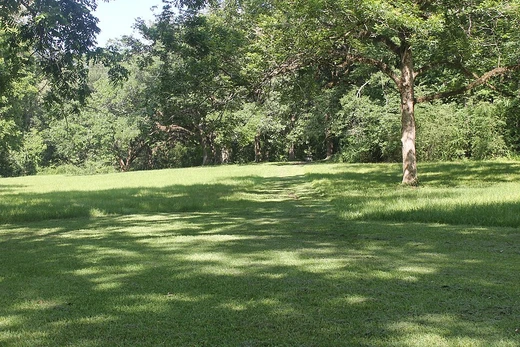
The landscape and drainage was designed by Ossian Cole Simonds in the 1910s. His design emphasized the landscape's topography and created the first pocket parks in Nashville.
More in Natchez Trace
Sources
Compiled from Wikipedia and the sources listed below. Text from Wikipedia is available under CC BY-SA 4.0; this entry is adapted from it.
- Wikipedia: Belle Meade Plantation (CC BY-SA 4.0).
Spotted an error? Know more?
Reader corrections go straight into our review queue. Suggest an edit · How this site is sourced