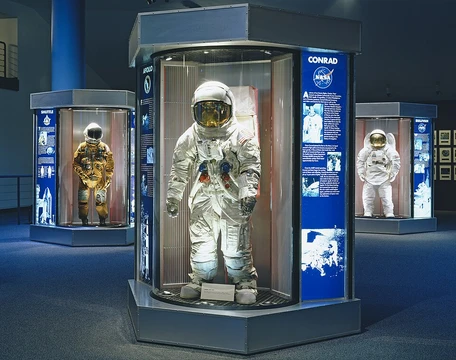
NASA Astronaut Group 5
NASA's 1966 astronaut group, the Original Nineteen.
Last updated
NASA Astronaut Group 5, called the Original Nineteen, was chosen in April 1966. Half of its members flew to the Moon, including three of the six Lunar Module Pilots who landed there. The other half flew Skylab and the Space Shuttle, forming the core of early Shuttle commanders. It is the only group to include a pre-qualified astronaut, X-15 pilot Joe Engle.
Quick Facts
- Number
- 19
Facts from the source article.
Background
Confidence in American progress was shattered again on April 12, 1961, when Yuri Gagarin became the first man to orbit Earth. By 1966, NASA looked beyond Apollo. On February 3, 1966, Alan Shepard created the Advanced Programs Office at the Manned Spacecraft Center.
NASA announced plans on March 3 for the Apollo Applications Program, which envisioned 45 crewed missions using 19 Saturn V and 26 Saturn IB rockets, including three orbital workshops and four Apollo Telescope Mounts. The first AAP launch was expected as early as April 1968. With 33 astronauts on hand, Deke Slayton determined that another two dozen were needed for AAP, and NASA announced a recruitment drive on September 10, 1965.
Selection
Candidates had to be U.S. citizens, born on or after December 1, 1929, no taller than 6 feet, and hold a bachelor's degree in physical or biological sciences or engineering. They needed to be graduates of a test pilot school or have 1,000 hours of jet flying experience, and pass a class I flight physical with 20–20 uncorrected vision. The age limit was raised to 36 from 34 compared to the 1963 group. Active-duty military applied through their services; civilians and reservists applied directly via a Civil Service Form 57, mailed to Pilot-Astronaut, P.O. Box 2201, Houston, Texas, postmarked by December 1, 1965.
About 5,000 applications arrived; only 351 met the criteria. From these, 159 applicants (100 military, 59 civilian) were considered further.
Six women applied, but none met the criteria, likely because women could not fly military jets. Double amputee Lieutenant Frank K. Ellis applied but was passed over. Michael Collins later noted relief at no female finalists but concern at no African-American ones.
Group members
Don L. Lind received a B.S. in physics from the University of Utah in 1953, served in the Navy, and earned a Ph.D. in high energy nuclear physics from UC Berkeley in 1964. He worked at NASA's Goddard Space Flight Center, was backup pilot for Skylab 3, Skylab 4, and the unflown Skylab Rescue mission, and flew as mission specialist on STS-51-B in April 1985.
Jack R. Lousma earned a B.S. in aeronautical engineering from the University of Michigan in 1959, served in the Marine Corps, and earned an M.S. from the U.S. Naval Postgraduate School in 1965. He served on support crews for Apollo 9, 10, and 13, flew as command module pilot of Skylab 3 from July to September 1973, was backup docking module pilot for Apollo-Soyuz, and commanded STS-3 in March 1982. T. Kenneth Mattingly II, from Chicago, flew on Apollo 16, STS-4, and STS-51-C.
Operations
On October 3, 1966, Shepard split the group across six office branches. The Apollo Applications Branch, led by Alan Bean with Bill Anders as deputy, got Engle, Lousma, Pogue, and Weitz. Pete Conrad’s CSM Block II Branch, with Richard Gordon as deputy, received Brand, Evans, Mattingly, Swigert, and Worden. Neil Armstrong’s LM/LLRV/LLRF Branch took Bull, Carr, Haise, Irwin, and Mitchell.
Givens landed in John Young’s Pressure Suits/PLSS Branch; Lind and McCandless joined Owen Garriott’s Experiments Branch; Duke and Roosa went to Frank Borman and C.C. Williams’s Boosters/Flight Safety Panels Branch. Slayton asked each man his preference between CSM and LM specialties, then made the final call.
Nine became CSM specialists: Brand, Evans, Givens, Mattingly, Pogue, Roosa, Swigert, Weitz, and Worden. Ten became LM specialists: Bull, Carr, Duke, Engle, Haise, Irwin, Lind, Lousma, McCandless, and Mitchell. Apollo added a support crew to handle flight plans, checklists, and simulator emergency procedures.
Did You Know?
- John Young coined the nickname Original Nineteen as a parody of the Mercury Seven.
- Seven group members were from the USAF, six from the Navy, and two from the Marine Corps.
More in NASA Astronaut Corps
Sources
Compiled from Wikipedia and the sources listed below. Text from Wikipedia is available under CC BY-SA 4.0; this entry is adapted from it.
- Wikipedia: NASA Astronaut Group 5 (CC BY-SA 4.0).
Spotted an error? Know more?
Reader corrections go straight into our review queue. Suggest an edit · How this site is sourced