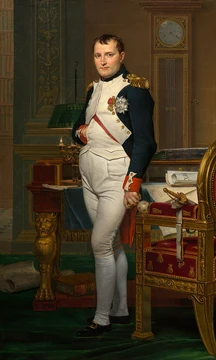
La Madeleine, Paris
A Parisian church built as a temple to Napoleon's army.
Last updated

via Wikipedia: La Madeleine, Paris · see source
Where it is
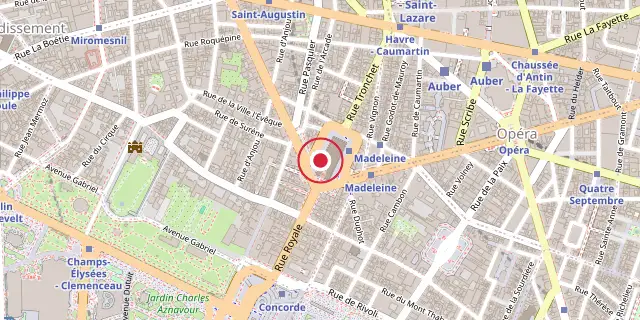
Coordinates: 48°52′12″N 2°19′26″E (48.8700, 2.3240) · Open in OpenStreetMap
Coordinates and connected clubs: the infobox of Wikipedia: La Madeleine, Paris (CC BY-SA 4.0). Map: drawn by Codexery from OpenStreetMap tiles.
La Madeleine is a Catholic parish church on Place de la Madeleine in the eighth arrondissement of Paris. Originally planned by Louis XV as a church, it was redesigned under Napoleon Bonaparte to become a monument to the glory of his armies before being completed as a church in 1842. The building is surrounded on all four sides by Corinthian columns and contains notable frescoes and sculptures.
History
The neighbourhood, then at the edge of Paris, was annexed to the city in 1722. An earlier church of Saint-Marie-Madeleine had stood on avenue Malesherbes since the 13th century but was considered too small. Louis XV authorised a new, larger church with a view along Rue Royale toward the new Place Louis XV, now Place de la Concorde. In 1763 the King laid the first stone for a design by Pierre Contant d'Ivry and Guillaume-Martin Couture.
D'Ivry's initial plan proposed a large dome atop a Latin cross form, similar to Les Invalides. After d'Ivry died in 1777, Couture abandoned that plan, demolished much of the early work, and adopted a simpler classical design modelled after an ancient Greek or Roman temple. Construction halted in 1789 with only the foundations and grand classical portico completed. Under the Revolutionary government, proposals for the building included a library, a public ballroom, and a marketplace.
While on a military campaign in Poland, he personally chose the design of Pierre-Alexandre Vignon over the Academy's recommendation. Vignon's plan took the form of a classical temple with Corinthian columns on all four sides, preserving the columns already raised.
Exterior
The church’s architect, Vignon, followed the Neo-Classical style by modeling it after a peripteral Greek temple, meaning classical columns line all four sides, not just the front. Ancient examples of this form include the Temple of Olympian Zeus in Athens and the smaller Maison Carrée in Nîmes. La Madeleine is unusual among large Neo-Classical buildings because it copies the entire exterior of an ancient temple, not just the entrance portico. Fifty-two Corinthian columns, each 20 meters tall, encircle the structure.
The Latin inscription on the frieze above the entrance reads D⸱O⸱M⸱SVB⸱INVOC⸱S⸱M⸱MAGDALENAE, which translates to “To God all-powerful and Very Great, under the invocation of Saint Mary Magdalen.” The pediment features a Last Judgement sculpture by Philippe Joseph Henri Lemaire, who also contributed to the Arc de Triomphe. In the scene, Christ sits in the center with two angels; to his right, the Archangel Michael stands with figures representing the Vices, while the Virtues appear on the left.
Mary Magdalene kneels among those denied entry, showing her repentance. The large bronze doors on the south portal, created by Henri de Triqueti, depict the Ten Commandments. These doors are exceptionally large—bigger than those of Saint Peter’s Basilica in Rome—but were made thinner and lighter, with no gilding, only the natural bronze color.
Parts
The plan of the church was inspired more by classical Roman architecture, particularly the baths, than by traditional church architecture. Inside, the church designed by Huvé is composed of a single long space without a transept, divided into three wide arched bays each with a dome and circular skylights. All walls, arches, and ceiling are covered with decoration of coloured marble in intricate geometric forms, frequently gilded. The cul-de-four over the choir is decorated with a painting by Jules-Claude Ziegler depicting major events in Christian history with an emphasis on France; at the top are Christ with Apostles and Mary Magdalene, and in the foreground Napoleon Bonaparte and Pope Pius VII signing the Concordat of 1801.
Below this painting and above the altar is a wide ceramic mosaic in Neo-Byzantine style, conceived between 1888 and 1893 by Father LeRebours, painted by Charles-Joseph Lameire, and transformed into ceramic by the Sevres Porcelain workshops. The mosaic's central figure is the Christ of the Resurrection, accompanied by disciples and missionaries who lived in Gaul, including Mary Magdalene, Saint Martha, Saint Lazare, Saint Genevieve, Saint Trophyme, Saint Front of Perigeaux (given the features of Lameire), and Saint Ursin (given the features of architect Charles Garnier).
Music
La Madeleine has deep musical roots. Frédéric Chopin’s funeral was held there, and Camille Saint-Saëns, Théodore Dubois, and Gabriel Fauré each served as its principal organist. The main pipe organ, above the south entrance in a decorated case with angels and spires, was built by Aristide Cavaillé-Coll in 1845.
Charles Mutin restored it in 1927, extending the manuals. Later tonal changes came in 1957, 1971, and 1988. A smaller, matching organ stands in the choir.
Did You Know?
- The bronze doors of La Madeleine are larger than those of Saint Peter's Basilica in Rome, but were made thinner and lighter with no gilding.
- In 1837, a proposal was brought forward to convert the church into the first railroad station in Paris, but it was abandoned as expensive and impractical.
- Frédéric Chopin's funeral at La Madeleine was delayed almost two weeks until 30 October 1849 because the church had never permitted female singers in its choir; they relented on condition the women sang behind a black velvet curtain.
- During the Paris Commune of 1871, the curé of the church, Abbé Deguerry, was executed alongside the Archbishop of Paris and four other hostages on 24 May.
More in Napoleon
Sources
Compiled from Wikipedia and the sources listed below. Text from Wikipedia is available under CC BY-SA 4.0; this entry is adapted from it.
- Wikipedia: La Madeleine, Paris (CC BY-SA 4.0).
Spotted an error? Know more?
Reader corrections go straight into our review queue. Suggest an edit · How this site is sourced