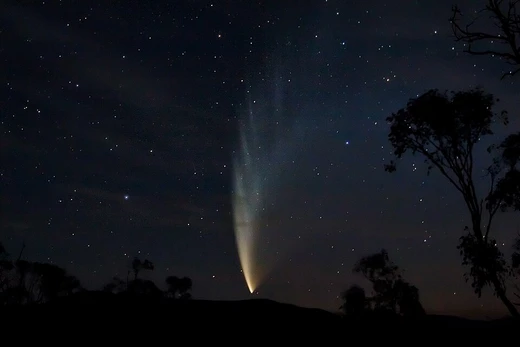
C/1990 K1 (Levy)
Non-periodic comet discovered by David H. Levy in 1990.
Last updated
C/1990 K1 (Levy) is a non-periodic comet discovered by David H. Levy on 20 May 1990. It eventually grew bright enough to be seen without optical aid and holds the distinction of being the first comet observed by the Hubble Space Telescope.
Observational history
Levy spotted the comet during his usual search routine, aiming a 40-cm reflector toward the star Alpheratz. At discovery, it shone at magnitude 9.6 with a tail roughly 2 arcminutes long, marking his sixth comet find. It was then 2.59 AU from the Sun and 3.07 AU from Earth. Confirmation came the next day, with other observers reporting magnitudes between 10 and 11.
The first naked-eye sighting occurred on 23 July, when the comet reached magnitude 6.0; within a week, its tail stretched just over a degree. Brightening continued through August: John Bortle recorded magnitudes of 5.7 on the 3rd and 4.1 on the 28th, while S. Garro in France logged 3.6 on the 23rd. The tail became visible to the naked eye, though most detailed observations required optical aid, and by month’s end it extended about 3.5 degrees. The comet made its closest approach to Earth on 26 August 1990, at 0.43 AU (64 million km).
During September, it faded slowly as it moved away from Earth but toward perihelion; by 20 September its magnitude hovered around 5. On 27 September, the Hubble Space Telescope captured it—the first comet it had ever observed. In October, only the Southern Hemisphere could see it, at magnitude 6, and perihelion occurred on 24 October. Solar elongation shrank to 24 degrees in November, limiting observations.
Alan Hale recovered the comet on 10 December at magnitude 7, after which it began moving north. Over the next two months, tail lengths of 0.5 to 1.5 degrees were reported as the comet slowly dimmed. The final detection came on 1 April 1992, via CCD images from the Oak Ridge Observatory’s 155-cm reflector.
Scientific results
Because Comet Levy was well placed for study both before and after perihelion and remained fairly bright, scientists measured production rates of OH, NH, CN, C₂, and C₃ at various solar distances. Most species produced more material before perihelion, with hydroxyl showing the strongest asymmetry—its output peaked about a month before the others. On shorter timescales, the comet varied in both optical and ultraviolet light.
Frequently Asked Questions
What makes C/1990 K1 (Levy) historically significant?
It holds the record as the first comet ever imaged by the Hubble Space Telescope. As a non-periodic visitor, it also made the news for becoming bright enough for unaided-eye observation during its 1990 apparition.
How close did C/1990 K1 (Levy) come to Earth?
The comet reached its closest approach on 26 August 1990, passing just 0.43 AU from our planet. Its perihelion, or closest point to the Sun, followed on 24 October 1990.
What is C/1990 K1 (Levy)'s orbital classification?
It is classified as a non-periodic (long-period) comet, meaning it does not return on a short, predictable cycle like short-period comets do. Its last confirmed detection was on 1 April 1992, after which it faded from view.
Ranked in
More in Named Comets
Sources
Compiled from Wikipedia and the sources listed below. Text from Wikipedia is available under CC BY-SA 4.0; this entry is adapted from it.
- Wikipedia: C/1990 K1 (Levy) (CC BY-SA 4.0).
- Word definitions: the , each quoted from its Wikipedia article.
Spotted an error? Know more?
Reader corrections go straight into our review queue. Suggest an edit · How this site is sourced