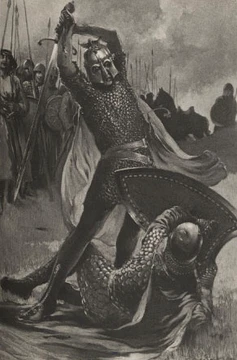
Yamato Takeru
Semi-legendary Japanese prince and folk hero, wielder of the Kusanagi sword.
Last updated
His widow venerated his memory at a shrine, and his relics including the sacred sword Kusanagi were later moved to the current location of Atsuta Shrine.[1][2]
Key facts and history
After his death, his possessions were gathered together along with the sword Kusanagi.[1] His widow venerated his memory in a shrine at her home.[1] Common points include the use of two magic swords, where the first validates the hero's authority.[3] Other parallels include the leadership role of a war band and death to an enemy after giving up the sword to a female figure.[3]
Littleton proposed that both legends descend from a common northeast Iranian ancestor.[3] After some time, the relics—including the sacred sword—were relocated to where Atsuta Shrine now stands.[2] C. Scott Littleton, an anthropologist, has called the Yamato Takeru legend "Arthurian" because it shares structural features with the King Arthur story.[4]
What the cited sources add
The same source notes that his widow venerated his memory at a shrine in her home.[1] Ponsonby-Fane also records that the relics including the sacred sword were later moved to the current location of Atsuta Shrine.[2] Littleton's comparative analysis identifies structural similarities between Yamato Takeru and King Arthur legends, including the use of two magic swords.[4][3] Littleton further proposed a common northeast Iranian ancestor for both legends.[3]
References
- Wikipedia, "Yamato Takeru" (CC BY-SA 4.0), which cites: Ponsonby-Fane, Richard. (1953) Studies in Shinto and Shrines, p. 433. (original not read by us) en.wikipedia.org
- Wikipedia, "Yamato Takeru" (CC BY-SA 4.0), which cites: Ponsonby-Fane, p. 434. (original not read by us) en.wikipedia.org
- Wikipedia, "Yamato Takeru" (CC BY-SA 4.0), which cites: Littleton, C. S. (1995), p. 262.; Littleton, C. S. (1995). (original not read by us) en.wikipedia.org
- Wikipedia, "Yamato Takeru" (CC BY-SA 4.0), which cites: Littleton, C.S. (1983). (original not read by us) en.wikipedia.org
Each numbered sentence above was checked against the source it cites before publication. Sentences citing Wikipedia adapt text from the English Wikipedia article Yamato Takeru (contributors), used under CC BY-SA 4.0; this entry is available under the same licence. Other sources were used for facts only; no text or images are copied from them.
More in Mythological swordfighters
Sources
Compiled from Wikipedia and the sources listed below. Text from Wikipedia is available under CC BY-SA 4.0; this entry is adapted from it.
- Wikipedia: Yamato Takeru (CC BY-SA 4.0).
Spotted an error? Know more?
Reader corrections go straight into our review queue. Suggest an edit · How this site is sourced