Krakus
Legendary founder of Kraków and builder of Wawel Castle.
Krakus, also known as Krak or Grakch, is a legendary Polish duke and pre-Christian king of the Vistulans, a Lechitic tribe. He is traditionally regarded as the founder of Kraków and credited with building Wawel Castle. The earliest known mention of Krakus appears in the 1190 work Chronica seu originale regum et principum Poloniae by Wincenty Kadłubek.
Quick Facts
- Reign
- Between 8th and 10th century?
- Predecessor
- None (Kingdom established)
- Successor
- His younger son; (Wincenty Kadłubek and The Chronicle of Greater Poland), Krakus II and Lech II (Jan Długosz)
- Place of death
- Kraków (supposedly)
- Burial place
- Krakus' Mound, Kraków (supposedly)
- Issue
- Wanda; Two sons (various names)
- Religion
- Slavic paganism
- Dynasty
- Dynasty of Krakus
Facts from the source article.
Did You Know?
- Historian Michael Morys-Twarowski suggests the name Kraków is a possessive form meaning "Krak's gord", indicating a real person.
- Morys-Twarowski also theorizes that the holophagus may represent cultural memory of Avar raids, whose members could have been poisoned while trying to take Krakus's residence on Wawel Hill.
- A similar legend of Krok and Libussa appears in early Czech history by Cosmas of Prague.
Name
Historian Jacek Banaszkiewicz traces Krak's name to a pre-Slavic word "krakula", meaning "judge's staff" or "scepter", which also denoted judicial authority among pagan Balts. Other historians, Cetwiński and Derwich, propose an etymology linking Krak to "oak", a sacred tree associated with genealogy. The city name Kraków is thought to derive from a word meaning "crow" or "raven".
Family
According to Wincenty Kadłubek, Krakus had two sons (unnamed) and a daughter, Wanda. The Chronicle of Greater Poland states his younger son was also named Krakus, while Jan Długosz claims the older son bore the father's name and the younger was called Lech. Kadłubek and the Chronicle report that the younger son secretly killed his older brother during their father's lifetime and later succeeded to the throne; Długosz depicts the older son outliving Krakus before being murdered.
Legendary biography
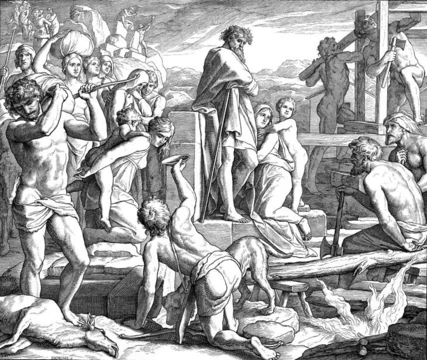
Krakus is said to have spent time in Carantania before returning to the area inhabited by Lechites, whom he united and who then chose him as their ruler, called a king by Kadłubek. During his reign, a monster called the "holophagus" threatened his subjects by collecting cattle and eating people who refused. The monster was eventually poisoned, either by Krakus's two sons or, in later tradition, by a shoemaker named Skuba.
Burial
Krakus Mound, still extant, was long believed to contain Krakus's remains. Archaeological research from 1934 to 1938 found no grave within it, though the mound, over 50 m in diameter, appears to have been erected between the 8th and 10th centuries. It has been suggested that the mound, along with Wanda's Mound, held the ruler's remains on its surface, possibly as ashes in an urn, and that the mausoleum was later destroyed.
More in Mythological Founders of Populated Places
Spotted an error? Know more?
Reader corrections go straight into our review queue. Suggest an edit · How this site is sourced