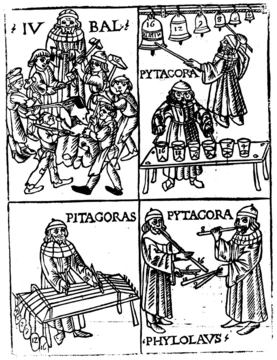
Musical composition
The art of creating original musical works.

Musical composition is the act of making a piece of music, the resulting work itself, or the way that piece is put together. The people who do this are called composers, though those who focus on songs are often known as songwriters, and a lyricist writes the words for a song. In classical music, the composer usually decides which instruments in a large ensemble—like an orchestra—will handle the melody, accompaniment, bassline, and other parts. In musical theatre and pop music, a songwriter might hire an arranger to handle that task. Some pop or traditional songwriters never write anything down; they create the song in their head and then play, sing, or record it from memory. In jazz and popular music, influential sound recordings carry the same weight that written scores do in classical music.
A composition can also be created using words, images, or computer programs that tell the performer how to produce sounds. Examples include 20th-century avant-garde music with graphic notation, text-based works like Karlheinz Stockhausen's *Aus den sieben Tagen*, and computer programs that pick sounds for a piece. Music that relies heavily on randomness and chance is called aleatoric music, linked to 20th-century composers such as John Cage, Morton Feldman, and Witold Lutosławski. A more familiar example of chance-based music is the sound of wind chimes jingling in a breeze. The study of composition has mostly focused on Western classical music, but the term also covers popular songs, traditional instrumental pieces, and improvised works like those of free jazz performers or African percussionists such as Ewe drummers.
According to Jean-Benjamin de Laborde (1780), composition involves two things: arranging sounds in a pleasing succession (melody) and combining simultaneous sounds in a pleasant way (harmony). Since sound recording was invented, a piece or song can exist as a recording. Music can be performed from memory, by reading written notation, or both. For example, a principal cellist in an orchestra might read most parts but memorize a solo to watch the conductor. Compositions include a wide range of musical elements that vary across genres and cultures. Popular music after about 1960 uses electric and electronic instruments like the electric guitar and bass, while contemporary classical music uses them less often. Baroque music (1600–1750) used only acoustic instruments like strings, brass, woodwinds, timpani, harpsichord, and pipe organ. A 2000s pop band might use an electric guitar with effects, a digital synthesizer, and electronic drums.
The term "piece" is a general, non-technical word used mainly for instrumental compositions from the 17th century onward. It is rarely used for individual movements in sonatas or symphonies, and composers have often used compound forms like *Klavierstück*. In vocal music, "piece" is most common for operatic ensembles. Composition techniques can parallel visual art's formal elements. A piece might be through-composed (each part is different, with no repetition), or it might use forms like strophic, rondo, or verse-chorus. Some pieces are built around a specific scale, while others are improvised during performance. The scale, mode, and tonic note are important in tonal composition. Middle Eastern music often uses a specific mode (maqam) within improvisation, and Indian classical music does the same in both Hindustani and Carnatic systems.
In the 20th and 21st centuries, new methods have emerged. EEG headsets can interpret musicians' brainwaves to create music, as used in Project Mindtunes (with disabled musicians and DJ Fresh) and by artists Lisa Park and Masaki B.
- field
- Music
- known_for
- Creation of original musical works, including vocal, instrumental, and electronic pieces
Lore & Background
Musical composition can involve written notation, but in some cases, a pop or traditional songwriter may compose a song in their mind and then play, sing, or record it from memory. In jazz and popular music, notable sound recordings by influential performers are given the weight that written or printed scores play in classical music. Composition can also be done with words, images, or computer programs that explain or notate how the singer or musician should create musical sounds, ranging from graphic notation to text compositions and aleatoric music that uses randomness and chance.
Reader's Guide
Musical composition encompasses a vast range of practices across genres and cultures. In classical music, orchestration is typically done by the composer, but in musical theatre and pop music, songwriters may hire an arranger. The study of composition has traditionally focused on Western classical music, but it also includes popular songs, traditional instrumental pieces, and improvised works like those of free jazz performers and African percussionists. Composition involves the manipulation of harmony, melody, form, rhythm, and timbre. Since the invention of sound recording, a piece may exist as a recording. Composers may write for any combination of instruments, voices, or electronic sources, and the task of adapting a composition for different ensembles is called arranging or orchestration. Interpretation by performers varies widely, as notation does not specify all elements of performance.
Did You Know?
- Composers of primarily songs are usually called songwriters, and the person who writes lyrics is the lyricist.
- Music that makes heavy use of randomness and chance is called aleatoric music, associated with composers such as John Cage, Morton Feldman, and Witold Lutosławski.
- In the 2000s, composition is considered to consist of the manipulation of harmony, melody, form, rhythm, and timbre.
- EEG headsets have been used to create music by interpreting the brainwaves of musicians, as in Project Mindtunes.
Historical Roots and the Human-Machine Spectrum
Algorithmic composition is far from a purely digital-age invention. Long before computers existed, formal rule sets governed how Western composers handled voice-leading in counterpoint, and those procedures can often be distilled into what we would now call algorithmic determinacy. This centuries-old lineage shows that the impulse to systematize musical creation predates any specific technology. The modern landscape, however, spans a wide spectrum of human involvement. At one extreme, an algorithm can run entirely without ongoing human intervention, for instance by introducing chance procedures that make compositional decisions autonomously. At the other extreme, techniques such as live coding and interactive interfaces keep the composer firmly in the driver's seat, making the process fully human-centric even though the underlying logic is algorithmic. This continuum means that algorithmic composition is not a single practice but a family of approaches ranging from total automation to tightly guided, real-time human control.
Taxonomies and the Six-Type Framework
Classifying compositional algorithms is not straightforward because they can be sorted along several independent axes. One common division asks whether the computer is composing the music or merely assisting a human composer; the former applies when the algorithm makes its own choices during creation. Another axis concerns output: some algorithms produce notational information such as sheet music or MIDI data for other instruments to perform, while others generate sound synthesis directly, and still others do both. A particularly useful structural model identifies six partly overlapping categories: mathematical models, knowledge-based systems, grammars, evolutionary methods, systems that learn, and hybrid systems that blend elements from multiple categories. This multi-dimensional taxonomy reflects the reality that a single algorithmic project might simultaneously draw on stochastic mathematics, rule-based grammatical constraints, and iterative optimization, making rigid single-label classification inadequate for capturing the full complexity of how these systems actually operate in practice.
Translational and Mathematical Approaches
Two particularly creative branches of algorithmic composition draw on sources that have no immediate musical relevance. Translational models take information from a non-musical medium and convert it into sound. A JPEG image of a horizontal line might map to a constant pitch, while an upward-slanted line becomes an ascending scale. Text-to-music translation can extract sentiment through machine-learning methods and render positive or negative emotional content as major or minor chord qualities. Mathematical models operate differently: stochastic processes such as Markov chains and Gaussian distributions let the composer weight random possibilities rather than dictate every note. Since the 1970s, fractals have served as another mathematical source, generating structure from chaotic natural phenomena. Even the On-Line Encyclopedia of Integer Sequences offers a way to play integer sequences as twelve-tone music by computing each integer modulo eighty-eight on a standard keyboard, so that the natural numbers produce half a chromatic scale. The all-interval series has similarly been adapted for computer-aided composition, showing that pure number theory can yield musically coherent material.
Evolutionary, Optimization, and Knowledge-Based Methods
A distinct family of algorithmic approaches treats composition as a search or optimization problem. In optimization-based methods, the goal is to find the right combination of notes that minimizes an objective function encoding the rules of a particular style; this function can be hand-crafted or learned through machine-learning techniques such as Markov models. Researchers have applied integer programming, variable neighbourhood search, and other combinatorial tools to this task. Evolutionary methods take a biological metaphor: genetic algorithms drive mutation and natural selection across generations of candidate compositions, with a critic component supervising quality and pruning weaker solutions. The evo-devo approach extends this by combining evolutionary pressure with developmental processes, starting from a very simple musical structure and iteratively transforming it into something more complex. Knowledge-based systems work from a different angle, isolating the aesthetic code of a genre and encoding it as a set of rules or tests that a new composition must satisfy, effectively generating works in a recognizable stylistic idiom without requiring a human to write each note by hand.
Frequently Asked Questions
What does 'musical composition' actually mean in plain terms?
It's the umbrella term for an original piece of music—vocal, instrumental, or electronic—or the structured blueprint that gives a piece its shape. It can also describe the creative process of writing that music from the ground up.
Who are the people behind musical compositions?
They're called composers, and the title applies to anyone who crafts an original musical work, whether that's a symphony, a pop ballad, or a synthesized electronic track. The role spans every genre and era, not just one tradition.
Is musical composition only about Western classical music?
Not at all. While academic study of composition has historically leaned heavily on Western classical methods, the concept itself stretches across popular music, traditional folk traditions, and even spontaneously improvised performances.
What kinds of works qualify as a musical composition?
Any original, structured piece of music counts—sung lines, orchestral arrangements, solo instrument works, or electronic soundscapes. The defining factor is that it's a deliberate creative work rather than a mere replay of someone else's material.
How is composition different from just performing a song?
Composition is the act of designing the piece itself—its melody, harmony, rhythm, and form—while performance is the act of interpreting and delivering an already-existing work in a given moment. One builds the blueprint; the other brings it to life.
More in Music Theory 1-17
Spotted an error? Know more?
This is a living reference — every entry is fact-audited, and reader corrections feed straight into our audit queue. Suggest an edit · See this site's audit record