
Also sprach Zarathustra
Tone poem by Richard Strauss inspired by Nietzsche's philosophical novel.

Nietzsche, Friedrich Wilhelm, 1844-1900 author · Public domain
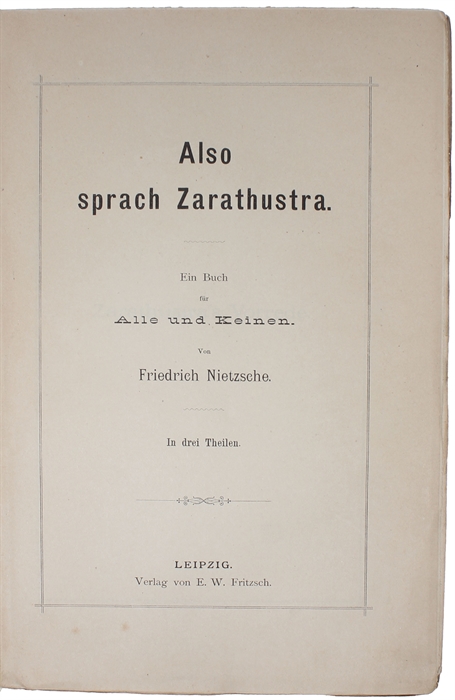
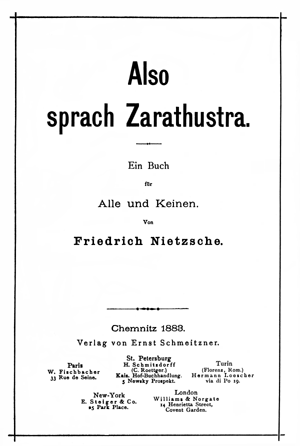
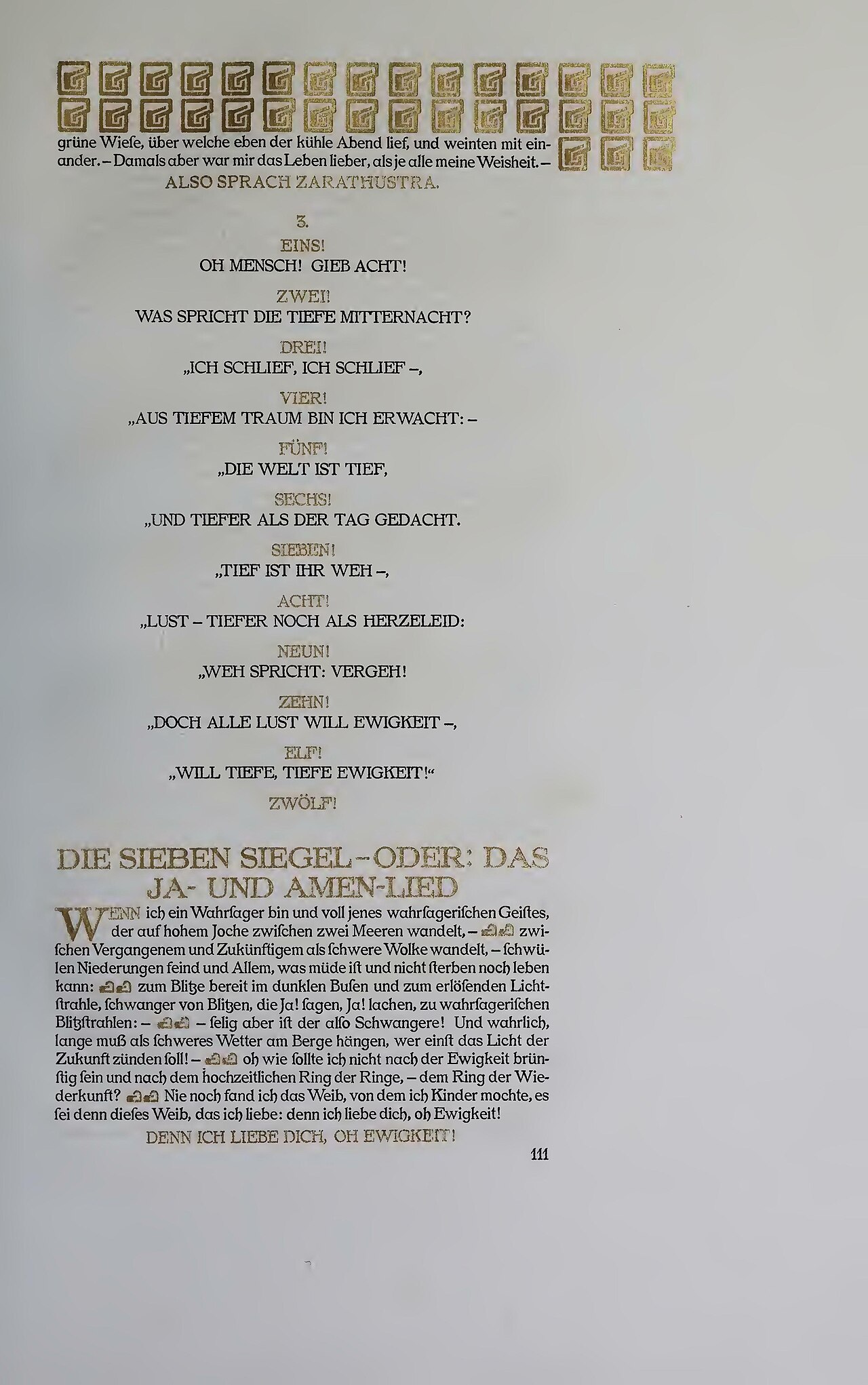
Also sprach Zarathustra, Op. 30, is a tone poem by German composer Richard Strauss, written in 1896 and inspired by Friedrich Nietzsche’s philosophical novel of the same name. Strauss himself conducted the first performance on 27 November 1896 in Frankfurt. A typical performance lasts about 33 minutes. The work’s opening fanfare, titled “Sonnenaufgang” (Sunrise) in the composer’s programme notes, gained widespread fame after its repeated use in Stanley Kubrick’s 1968 film *2001: A Space Odyssey*. Later, Eumir Deodato’s jazz-funk adaptation won the 1974 Grammy Award for Best Pop Instrumental Performance.
The piece is scored for a large orchestra including piccolo, three flutes, three oboes, English horn, clarinet in E, two clarinets in B, bass clarinet, three bassoons, contrabassoon, six horns, four trumpets, three trombones, two tubas, timpani, bass drum, cymbals, triangle, glockenspiel, a bell on low E, organ, two harps, and strings. It is divided into nine sections with only three definite pauses, each named after chapters from Nietzsche’s novel. The opening “Sunrise” begins with a sustained low C from double basses, contrabassoon, and organ, leading into a brass fanfare built on the notes C–G–C, a motif drawn from the natural overtone series. This “dawn” motif recurs throughout.
The work contrasts the keys of B major (representing humanity) and C major (representing the universe). A notable fugue in “Of Science and Learning” uses all twelve notes of the chromatic scale, and the double basses must play a contra B, the lowest note on a piano. The final section, “Song of the Night Wanderer,” begins with twelve strikes of midnight and ends unresolved: high flutes, piccolos, and violins play a B major chord while lower strings pluck a C, leaving the tonic ambiguous. The first recording was made in 1924, and Strauss himself conducted a 1944 high-fidelity recording with the Vienna Philharmonic. Fritz Reiner made the first stereophonic recording in 1954 with the Chicago Symphony Orchestra.
- composer
- Richard Strauss
- typical_duration
- approximately 33 minutes
- instrumentation
- piccolo, 3 flutes, 3 oboes, English horn, clarinet in E♭, 2 clarinets in B♭, bass clarinet, 3 bassoons, contrabassoon, 6 horns, 4 trumpets, 3 trombones, 2 tubas, timpani, bass drum, cymbals, triangle,
- sections
- 9 sections, including 'Sonnenaufgang', 'Von den Hinterweltlern', 'Von der großen Sehnsucht', 'Von den Freuden und Leidenschaften', 'Das Grablied', 'Von der Wissenschaft', 'Der Genesende', 'Das Tanzlie
Lore & Background
The piece is divided into nine sections played with only three definite pauses, named after selected chapters of Nietzsche's novel. It starts with a sustained double low C on double basses, contrabassoon and church organ, transforming into the brass fanfare introducing the 'dawn' motif (C–G–C). This motif is based on the first five notes of the natural overtone series, though the major third in the chord is immediately changed to a minor third, the first note not part of that series. The work contrasts the keys of B major (representing humanity) and C major (representing the universe), a tonal conflict that remains unresolved at the end. The coda features twelve strikes of midnight, concluding with high flutes, piccolos and violins playing a B major chord while lower strings pluck a C, leaving the piece half-resolved. One section contains an unusual fugue in the double-basses and cellos that uses all twelve notes of the chromatic scale, and a later passage requires the basses to play a contra B, the lowest B on a piano, possible only on a five-string bass or one with a low-B extension. The initial fanfare, titled "Sunrise" in the composer's programme notes, became widely known after its repeated use in Stanley Kubrick's 1968 film *2001: A Space Odyssey*.
Reader's Guide
The piece is a tone poem inspired by Friedrich Nietzsche’s philosophical novel, structured into nine sections that trace key moments in the protagonist Zarathustra’s journey. It opens with a sustained low C from the double basses, contrabassoon, and organ, which leads into the famous brass fanfare introducing a three-note “dawn” motif built on intervals of a fifth and octave (C–G–C), derived from the natural overtone series. A central compositional theme is the contrast between B major, representing humanity, and C major, representing the universe; the work ends unresolved, with high woodwinds and strings playing a B major chord while lower strings pluck a C, leaving the “world riddle” unsolved. The piece features a fugue in the “Of Science and Learning” section that uses all twelve notes of the chromatic scale, and a passage requiring double basses to play a contra B, a rare demand in orchestral literature. Strauss conducted the first performance in Frankfurt in 1896, and the French premiere in 1899 was also led by the composer. The initial fanfare gained widespread recognition after its use as the main theme in Stanley Kubrick’s 1968 film *2001: A Space Odyssey*, and a jazz-funk adaptation by Eumir Deodato won a Grammy in 1974. The work remains a staple of orchestral repertoire, symbolizing cosmic grandeur and philosophical depth.
Did You Know?
- The piece ends with high flutes, piccolos and violins playing a B major chord while lower strings pluck a C, leaving the tonality unresolved.
A Pillar of the Tone Poem Tradition
Strauss built his reputation as a composer largely through the tone poem, a genre in which he became one of the defining voices of the late Romantic and early Modern era. Also sprach Zarathustra occupies a distinguished position within this body of work. It arrived after Don Juan, which was the first of his tone poems to achieve wide acclaim, and it stands alongside a constellation of equally celebrated pieces: Death and Transfiguration, Till Eulenspiegel's Merry Pranks, Don Quixote, Ein Heldenleben, Symphonia Domestica, and An Alpine Symphony. Together these works form a sequence that traces the evolution of his orchestral imagination, from the bold narrative sweep of Don Juan to the introspective and programmatic breadth of his later scores. As a composer known for his tone poems and operas, Strauss placed these orchestral narratives at the center of his artistic identity, and the grouping of Also sprach Zarathustra among them underscores its role as one of the works that cemented his standing in the concert hall.
The Composer Behind the Score
Also sprach Zarathustra is inseparable from the figure of its creator: Richard Georg Strauss, born in Munich in 1864 into a household where music was the daily language. His father Franz was the principal horn player at the Court Opera and a professor at the Königliche Musikschule, and the young Richard began composing at the age of six after starting piano lessons at four. By the time he graduated from the Ludwigsgymnasium in 1882, he had already absorbed the styles of Schumann and Mendelssohn through his father's guidance, while Wagner's operas, first heard in 1874, were beginning to reshape his musical vocabulary in ways his conservative father initially resisted. This layered education, combining classical discipline with the sweeping dramatic ambition of Wagner, produced a composer who could operate at the highest level of both the concert hall and the opera stage. As a leading figure bridging the late Romantic and early Modern eras, Strauss carried that dual sensibility into every tone poem he wrote, and Zarathustra reflects the full weight of that training.
Conductor, Celebrity, and the Life Beyond the Podium
Strauss was not merely a composer who occasionally led an orchestra; he was a prominent conductor in Western Europe and the Americas whose interpretations of Liszt, Mozart, and Wagner earned him quasi-celebrity status. His conducting path began in 1883 as assistant to Hans von Bülow with the Meiningen Court Orchestra, and it carried him through the Bavarian State Opera, the Deutsches Nationaltheater und Staatskapelle Weimar from 1889 to 1894, a 1894 debut at the Bayreuth Festival, the Berlin State Opera, and the Vienna State Opera. In 1920 he co-founded the Salzburg Festival, extending his influence over the European musical landscape for decades. This dual identity, as the man writing the scores and the man bringing them to life, meant that works like Also sprach Zarathustra were not only composed but actively shaped, rehearsed, and championed by their author. The quasi-celebrity he enjoyed as his compositions became standards of orchestral repertoire made him one of the most recognizable musical figures of his century.
A Standard of the Orchestral Repertoire
The fact that Also sprach Zarathustra endures as a touchstone of the orchestral canon is no accident. Strauss's compositions, including this tone poem, became standards of orchestral and operatic repertoire, a status that elevated him to quasi-celebrity across Western Europe and the Americas. His tone poems, Don Juan, Death and Transfiguration, Till Eulenspiegel's Merry Pranks, Don Quixote, Ein Heldenleben, Symphonia Domestica, An Alpine Symphony, and Zarathustra among them, formed a body of work so central to the concert tradition that orchestras worldwide built their seasons around them. Beyond the tone poems, his broader output, which included two symphonies, lieder such as the Four Last Songs, the Violin Concerto in D minor, the Horn Concertos, the Oboe Concerto, and Metamorphosen, further cemented his place in the repertoire. The piece's position within this constellation of orchestral masterworks, all composed by a single figure who also conducted with distinction, speaks to the extraordinary breadth of his contribution to Western classical music.
Gallery

Frequently Asked Questions
What is Also sprach Zarathustra?
It is a one-movement tone poem (Op. 30) composed by Richard Strauss, lasting roughly 33 minutes. The work draws its narrative and thematic material from Friedrich Nietzsche's philosophical novel of the same name.
What is the famous 'sunrise' opening?
The first section, titled 'Sonnenaufgang,' builds a soaring chromatic theme over sustained brass chords to depict the sun rising above the sea. This passage became globally recognizable after its use in Stanley Kubrick's 2001: A Space Odyssey.
How is the piece structured?
Strauss divided the tone poem into nine distinct sections, each illustrating a different episode or character from Nietzsche's text. These range from 'Von den Hinterweltlern' (On the Out-of-the-Way People) to 'Das Tanzlied' (The Dance Song) and the closing 'Nachtlied' (Night-Song).
What orchestra is required to perform it?
The scoring calls for a large Romantic orchestra: piccolo, three flutes, three oboes, English horn, a clarinet in E♭, two B♭ clarinets, bass clarinet, three bassoons, contrabassoon, six horns, four trumpets, three trombones, two tubas, timpani, bass drum, cymbals, and triangle. This breadth allows Strauss to paint vivid, contrasting coloristic scenes across the nine sections.
Why is Also sprach Zarathustra considered important in the repertoire?
It stands as one of the most frequently performed and recorded tone poems of the late-Romantic era, celebrated for its dramatic orchestral writing and philosophical depth. Its cultural footprint extends far beyond the concert hall, most notably through its association with space exploration imagery in popular film.
More in Music Theory & Composition 1-20
Spotted an error? Know more?
This is a living reference — every entry is fact-audited, and reader corrections feed straight into our audit queue. Suggest an edit · See this site's audit record