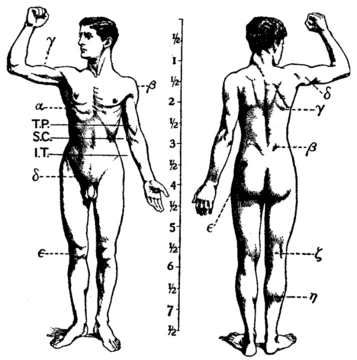
Human back
The large posterior area of the human body.

The human back, or dorsum, is the large rear surface of the body, extending from the top of the buttocks up to the back of the neck. It sits opposite the chest and abdomen, with the vertebral column running down its center and forming a shallow groove. The back’s width is defined by the shoulders at the top and the pelvis at the bottom. Back pain is a frequent medical issue and is usually not serious.
The backbone is the back’s central structure, specifically the section from the top of the thoracic vertebrae to the bottom of the lumbar vertebrae. This column houses the spinal cord in its spinal canal and typically has curves that shape the back. The ribcage attaches to the spine at the upper back, starting at the T1 vertebra, and extends more than halfway down, leaving a less protected area between the lower ribs and the hips. The upper back’s width is set by the scapulae, the broad, flat shoulder bones.
Back muscles fall into three groups: superficial, intermediate, and deep. The superficial group, also called the appendicular group, moves the limbs and includes the trapezius, latissimus dorsi, rhomboid major, rhomboid minor, and levator scapulae. These muscles are supplied by the anterior rami of spinal nerves, reflecting their origin outside the back. The intermediate group, or respiratory group, may aid breathing and consists of the serratus posterior superior and serratus posterior inferior. It is also innervated by anterior rami. The deep group, or intrinsic group, originates in the back and has four subdivisions: spinotransversales (splenius capitis and splenius cervicis), erector spinae (iliocostalis, longissimus, and spinalis), transversospinales (semispinalis, multifidus, and rotatores), and segmental muscles (levatores costarum, interspinales, and intertransversarii). The deep group is supplied by the posterior rami of spinal nerves.
Near the back, the lungs lie within the ribcage and extend to its rear, allowing them to be listened to through the back. The kidneys sit below the muscles just under the end of the ribcage, loosely attached to the peritoneum. A blow to the lower back can injure them.
The skin on the back is thicker and has fewer nerve endings than elsewhere on the torso. It usually has less hair than a man’s chest, with some exceptions. The upper-middle back is the one area a typical person cannot normally reach to touch. This skin is innervated by the dorsal cutaneous branches and the lateral abdominal cutaneous branches of the intercostal nerves.
The back’s complex structure supports the head and trunk, provides trunk strength, and allows flexibility and movement. The upper back, with ribs firmly attached to each thoracic vertebra, has very limited movement and the most structural support. The lower back, or lumbar vertebrae, allows bending backward (extension) and forward (flexion) but does not permit twisting.
The back contains interconnecting nerves, bones, muscles, ligaments, and tendons, all potential sources of pain. Back pain is the second most common pain in adults, after headaches. Muscle strain is by far the most frequent cause; back muscles usually heal within a few weeks, though the pain can be severe. Other common causes include disc problems like degenerative disc disease or a lumbar disc herniation, fractures such as spondylolisthesis or osteoporotic fractures, and osteoarthritis.
The curve of a woman’s back often appears in paintings, as many cultures allow the back to be shown nude—implying full nudity without displaying it. Exposing the lower back has been done for centuries. Clothing like halter tops and backless dresses is designed to reveal the back. Many women’s shirts, even conservative ones, expose the lower back because the lower waist is a pivot point that lengthens and arches when sitting or bending, and women’s fashion often favors waist-length tops that leave the back bare during movement. The back also serves as the largest canvas for body art on the human body. Its size and relative lack of hair make it ideal for tattoos, especially lower back tattoos among young women. Some people have tattoos covering the entire back, while others have smaller ones at places like the shoulder blade or lower back. The part of the back that cannot be reached to scratch is sometimes called acnestis. An itch there can be irritating, leading to the use of backscratchers. Many English idioms refer to the back.
- location
- Posterior area of the human body
- key_structure
- Vertebral column (thoracic to lumbar vertebrae)
- muscle_groups
- Superficial, intermediate, deep
- common_condition
- Back pain (second most common pain in adults)
- cultural_significance
- Frequent subject in art and body art
Lore & Background
The central feature of the human back is the vertebral column, specifically the length from the top of the thoracic vertebrae to the bottom of the lumbar vertebrae, which houses the spinal cord in its spinal canal. The ribcage extends from the spine at the top of the back, more than halfway down the length of the back, leaving an area with less protection between the bottom of the ribcage and the hips. The width of the back at the top is defined by the scapula, the broad, flat bones of the shoulders. The muscles of the back can be divided into three distinct groups: a superficial group (trapezius, latissimus dorsi, rhomboid major, rhomboid minor, levator scapulae), an intermediate group (serratus posterior superior and serratus posterior inferior), and a deep group (spinotransversales, erector spinae, transversospinales, segmental muscles). The deep group is innervated by the posterior rami of spinal nerves. The skin of the human back is thicker and has fewer nerve endings than the skin on any other part of the torso. The upper-middle back is the one area of the body which a typical human under normal conditions might be unable to physically touch. The curvature of the female back is a frequent theme in paintings, and the back serves as the largest canvas for body art on the human body.
Reader's Guide
The human back is anatomically and culturally significant. Structurally, it provides support for the head and trunk, strength in the trunk, and flexibility and movement. The upper back has limited movement due to ribs attached firmly to the thoracic spine, while the lower back allows for extension and flexion but not twisting. Back pain is the second most common type of pain in adults, most often caused by muscle strain, which can heal within weeks. Other sources include disc problems, fractures, and osteoarthritis. Culturally, the back has been depicted in art for centuries, often shown nude to imply full nudity without displaying it. Clothing such as haltertops and backless dresses expose the back. The lower back is frequently revealed in women's fashion due to body movement and waist-length tops. The back is also a prominent site for tattoos, including full-back designs and lower back tattoos. The part of the back that cannot be reached to scratch is called acnestis, leading to the use of backscratchers. English idioms highlight the back as an area of vulnerability, such as 'watch one's back' or 'stab one in the back.' Historically, flagellation across the back with a whip was a common punishment and means of forcing slaves to work, and self-flagellation has been used as a form of religious mortification.
Did You Know?
- The skin of the human back is thicker and has fewer nerve endings than the skin on any other part of the torso.
- The upper-middle back is the one area of the body which a typical human under normal conditions might be unable to physically touch.
- Back pain is the second most common type of pain in adults, the most common being headaches.
- The part of the back that typically cannot be reached to be scratched is sometimes named acnestis.
Frequently Asked Questions
What is the Human back in the musculoskeletal system?
The Human back, or dorsum, is the broad posterior surface of the body that stretches from the top of the buttocks up to the back of the neck. It sits directly opposite the chest and abdomen and serves as the canvas over which the vertebral column runs.
What are the main structural components of the Human back?
The vertebral column—specifically the thoracic and lumbar vertebrae—forms the central spine of the back, creating a recessed midline. Surrounding it are three layers of muscle groups: superficial, intermediate, and deep.
What is the most common medical issue associated with the Human back?
Back pain ranks as the second most frequently reported pain condition among adults. In the vast majority of cases, its origin is benign rather than the result of a serious underlying disorder.
Where exactly is the Human back located on the body?
It occupies the entire posterior region, rising from the upper buttocks to the posterior neck. The vertebral column traces its full length, producing a central area of recession along the midline.
Why does the Human back hold cultural significance?
Because of its broad, sculptural surface and the interplay of muscle and bone, the back has become a frequent subject in visual art and body art traditions. Its shape and the way it frames the spine make it a natural focal point for artists.
More in Musculoskeletal System 1-24
Spotted an error? Know more?
This is a living reference — every entry is fact-audited, and reader corrections feed straight into our audit queue. Suggest an edit · See this site's audit record