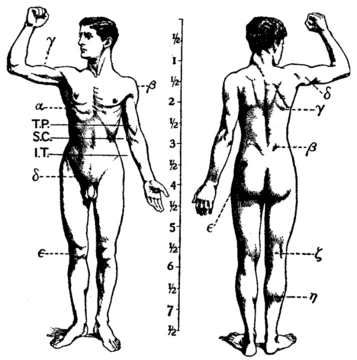
Gluteus maximus
Largest human muscle, key to erect posture and running.

The gluteus maximus is the primary muscle that extends the hip in humans, and it is the largest of the three gluteal muscles, as well as the single largest muscle in the entire human body. Its thick, quadrilateral mass creates the rounded prominence of the buttocks and largely defines the shape of each side of the hips. The other gluteal muscles are the medius and minimus, sometimes informally called the glutes. This muscle’s considerable size is a key feature of the human muscular system, directly linked to the ability to keep the trunk upright while standing. Other primates have much flatter hips and cannot maintain an erect posture.
The muscle is composed of parallel muscle fascicles grouped into larger bundles separated by fibrous septa. It originates from several nearby structures: the posterior gluteal line of the outer upper ilium (a pelvic bone), extending above to the iliac crest and slightly below; from the lower part of the sacrum and the side of the coccyx (tailbone); from the aponeurosis of the erector spinae (lumbodorsal fascia), the sacrotuberous ligament, and the fascia covering the gluteus medius (gluteal aponeurosis). Its fibers run obliquely downward and outward. The muscle ends in two main areas: the upper and larger portion, along with the superficial fibers of the lower portion, form a thick tendinous lamina that crosses the greater trochanter and inserts into the iliotibial band of the fascia lata; the deeper fibers of the lower portion insert into the gluteal tuberosity of the linea aspera, between the vastus lateralis and adductor magnus. If present, the third trochanter also serves as an attachment point.
Three bursae are usually found on the deep surface of this muscle: a large one separating it from the greater trochanter (bursa trochanterica m. glutaei maximi); a second, often missing, on the ischial tuberosity (bursae glutaeofemorales); and a third between the skin and the tendon, sometimes extending to the vastus lateralis (bursa trochanterica subcutanea).
Functionally, the gluteus maximus straightens the leg at the hip; when the leg is flexed, it extends it to align with the body. The anus also aligns during hip flexion, tightening the muscle and tilting the pelvis forward. Taking its fixed point from below, it supports the pelvis and trunk on the head of the femur, which is especially noticeable when standing on one leg. Its most powerful action is restoring the body to an erect position after stooping by drawing the pelvis backward, assisted by the biceps femoris (long head), semitendinosus, semimembranosus, and adductor magnus. The lower part of the muscle also acts as an adductor and external rotator of the limb, while the upper fibers act as abductors of the hip joints. The gluteus maximus is a tensor of the fascia lata, and through its connection with the iliotibial band, it steadies the femur on the tibial articular surfaces during standing when the extensor muscles are relaxed. Thus, it performs extension, valgisation, and external rotation of the knee.
In society and culture, the glutes are often seen as a symbol of health, strength, and aesthetic appeal, frequently depicted in artwork from at least Ancient Greece to the present day to celebrate physicality and dynamic movement. In training, the gluteus maximus is involved in sports from running to weight-lifting, with exercises focusing on it including hip thrusts, glute bridges, quadruped hip extensions, kettlebell swings, squats and variations (split squats, unilateral squats with the raised foot backward or forward, and wide-stance lunges), deadlifts, reverse hyperextensions, four-way hip extensions, and glute-ham raises.
Clinically, functional assessment can help evaluate injuries to the gluteus maximus and surrounding muscles. The 30-second chair-to-stand test measures how many times a person can stand up from a seated position in thirty seconds, assessing strength, flexibility, pain, and endurance for rehabilitation progress. The piriformis test, requiring a trained professional, measures gluteus maximus flexibility based on the angle of external and internal rotation relative to normal range of motion without injury or impingement.
In other animals, the gluteus maximus is larger and thicker in humans than in other primates. It is about 1.6 times larger relative to body mass compared to chimpanzees, comprising roughly 18.3% of total hip musculature mass versus 11.7% in chimpanzees. This large size is a defining feature of the human muscular system, tied to maintaining an erect trunk, whereas other primates have much flatter hips and cannot sustain standing erectly. In other primates, the correlate to the human gluteus maximus is the ischiofemoralis, a small muscle corresponding to the human gluteus maximus.
- Type
- Skeletal muscle
- Location
- Buttocks, originating from ilium, sacrum, coccyx, and associated ligaments
- Function
- Hip extension, adduction, external rotation, and trunk stabilization
- Key Feature
- Largest muscle in the human body
- Comparative Size
- Approximately 1.6 times larger relative to body mass than in chimpanzees
Lore & Background
The gluteus maximus arises from the posterior gluteal line of the outer upper ilium, the iliac crest, the lower part of the sacrum, the side of the coccyx, the aponeurosis of the erector spinae, the sacrotuberous ligament, and the fascia covering the gluteus medius. Its fibers are directed obliquely inferiorly and laterally, ending in two main areas: the upper and larger portion inserts into the iliotibial band of the fascia lata, while the deeper fibers of the lower portion insert into the gluteal tuberosity of the linea aspera. Three bursae are usually found in relation with its deep surface, including one separating it from the greater trochanter.
Reader's Guide
The gluteus maximus is significant for its role in human bipedalism and dynamic movement. Its large size is one of the most characteristic features of the human muscular system, connected with maintaining the trunk in the erect posture. Other primates have much flatter hips and cannot sustain standing erectly. The muscle plays multiple important functional roles, particularly in running rather than walking, helping to control trunk flexion, decelerate the swing leg, and contribute to hip extension. During level walking, the muscle shows minimal activity, suggesting its enlargement was not primarily adapted for walking but for running capability and trunk stabilization during dynamic activities. In cultural terms, the glutes are often considered a symbol of health and strength, and aesthetically appealing, with evidence of such depictions extending from at least Ancient Greece to the modern day.
Did You Know?
- The gluteus maximus is the single largest muscle in the human body.
- It is approximately 1.6 times larger relative to body mass in humans compared to chimpanzees.
- During level walking, the muscle shows minimal activity, suggesting its enlargement was not primarily adapted for walking.
- The muscle is made up of muscle fascicles lying parallel with one another, collected into larger bundles separated by fibrous septa.
Frequently Asked Questions
Who is Gluteus maximus?
Gluteus maximus is the largest and most superficial of the three gluteal muscles, forming the bulk of each buttock. It is a thick, roughly quadrilateral mass of skeletal muscle that defines the rounded outer contour of the hips.
What does Gluteus maximus actually do?
It powers hip extension, adduction, and external rotation while also bracing the trunk against unwanted movement. In everyday terms, it is the muscle you rely on to stand up from a seated position, sprint, or climb a flight of stairs.
How big is Gluteus maximus compared to other muscles?
It is the single largest muscle in the entire human body by mass. Relative to body weight, it is roughly 1.6 times larger than the equivalent muscle in chimpanzees, a difference closely tied to our fully bipedal way of life.
Why is Gluteus maximus so important for human posture?
Its substantial size and orientation are directly linked to our ability to hold the trunk in a fully upright, erect position. Without it, sustained bipedal activities like running or prolonged standing would be far more mechanically demanding.
Where does Gluteus maximus attach in the body?
It originates across the ilium, sacrum, coccyx, and their associated ligaments before inserting into the thigh via the iliotibial tract and the gluteal tendon. This broad, multi-point attachment base is what gives the muscle such a large functional surface area.
More in Musculoskeletal System 1-24
Spotted an error? Know more?
This is a living reference — every entry is fact-audited, and reader corrections feed straight into our audit queue. Suggest an edit · See this site's audit record