Frequently Asked Questions
The most-asked questions about murex snails.
What exactly is a murex snail?
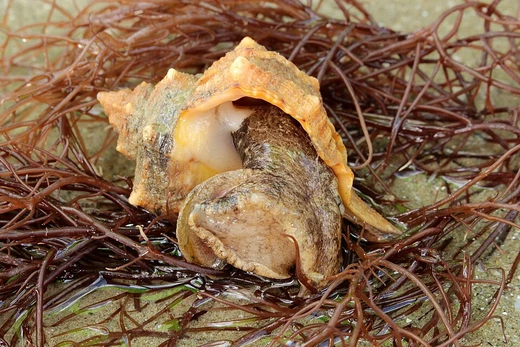
Murex snails are a large family of marine gastropod mollusks (Muricidae) recognized by their heavily sculptured, often spiny shells. They are carnivorous predators that cling to rocky substrates in shallow coastal waters around the world.
Where do murex snails live?
They inhabit rocky shores, tide pools, and reef edges in tropical and subtropical seas, with the greatest species richness in the Indo-Pacific and the Caribbean. You will typically find them on exposed rock in the intertidal zone or just below the waterline.
What makes murex shells so distinctive?
Their shells feature dramatic spines, flares, and ridges that evolved as defense against predators like crabs and larger fish. Coloration ranges from deep purples and pinks to browns and creams, and the sculpturing is so varied that no two species look alike at a glance.
What is the connection between murex snails and ancient purple dye?
For over two millennia, Phoenician, Greek, and Roman craftsmen harvested certain murex species and extracted a precious violet-red pigment from a gland in their mantle tissue. This Tyrian purple was extraordinarily expensive to produce and became a lasting symbol of royalty and religious authority.
Are murex snails dangerous to handle?
They are not venomous to humans, but their sharp spines can cause painful scratches, and some species carry a radular venom that produces a stinging sensation if the animal is squeezed or its foot is pressed. Wearing gloves is the standard precaution for shell collectors and divers.
How do murex snails feed?
They are active predators that use a chitinous radula combined with a venom gland to paralyze small prey such as other snails, worms, and crustaceans. Once the prey is immobilized, the snail rasps the flesh and consumes it, often within minutes.
How many species of murex snail are there?
The family Muricidae contains roughly 1,500 to 2,000 described species, making it one of the most diverse groups of marine snails. New species continue to be described regularly, particularly from deep-water surveys and Indo-Pacific expeditions.
How do murex snails reproduce?
Most species are separately sexed and release eggs and sperm into the surrounding water for external fertilization. The resulting planktonic larvae drift for several weeks before settling on a suitable rocky surface and metamorphosing into a miniature adult.
How are murex snails different from other sea snails?
Unlike smooth-shelled abalones or the flat-footed limpets, murex snails combine a high-spired, heavily ornamented shell with a powerful muscular foot and a chemically armed radula. That combination of spines, vivid color, and active predatory behavior sets them apart in most rocky intertidal communities.
Where should a newcomer start learning about murex snails?
A good entry point is visiting a natural-history museum mollusk collection or using a local tide-pool field guide to appreciate the shell diversity in person. From there, open databases such as WoRMS or MolluscaBase let you explore species descriptions, geographic ranges, and taxonomy in depth.