Hazard Stevens
Last updated

via Wikipedia: Hazard Stevens · see source
Hazard Stevens, a Union officer, earned the Medal of Honor for leading the capture of Fort Huger during the Civil War. He also made the first recorded ascent of Mount Rainier in 1870 with Philemon Beecher Van Trump. Stevens worked as a politician, writer, and lawyer after the war.
Early life and the Civil War
Hazard Stevens was born on June 9, 1842, in Newport, Rhode Island, to Isaac I. Stevens and Margaret Hazard Stevens. When his father became the first governor of the Washington Territory in 1854, the family relocated to Olympia. During the Civil War, both Stevens and his father served as volunteers in the Union army with the 79th New York Volunteer Infantry. Stevens held the rank of major and assistant adjutant general.
He was wounded at the Battle of Chantilly on September 1, 1862, where his father, then a general, was killed. For leading a party that captured Fort Huger in Virginia on April 19, 1863, Stevens was awarded the Medal of Honor on June 13, 1894. He left the Union Army volunteers on September 19, 1865. President Andrew Johnson nominated him for the brevet rank of brigadier general of volunteers on January 13, 1866, effective April 2, 1865, and the Senate confirmed this on March 12, 1866.
After the war and the ascent of Mount Rainier
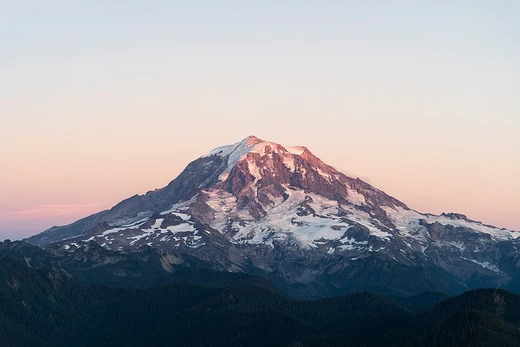
After the war, Stevens returned to Washington to care for his widowed mother, initially working for the Oregon Steam Navigation Company and then as a federal revenue collector in 1868. He then met P. B. Van Trump, who was working as the private secretary to Marshall F. Moore, the seventh governor of the territory. Both men were interested in climbing Mount Rainier and on August 17, 1870 they completed the first documented ascent of the mountain. The Stevens Van Trump Historic Monument along the Skyline Trail in Mount Rainier National Park was erected to commemorate the historic first ascent of the mountain.
Nearby Stevens Peak, Stevens Canyon, and Stevens Ridge are named after him. Stevens joined the bar in 1871, representing the Northern Pacific Railroad Company in their prosecution of lumber theft cases. In 1874, Stevens investigated British claims on the San Juan Islands at the request of President Ulysses S. Grant.
Later life
In 1874, Stevens moved to Dorchester, Massachusetts near Boston. He then entered the Massachusetts state legislature as a reformer in 1885. He successfully lobbied for the preservation of Boston's Old State House. He was unsuccessful in a run for the United States Congress.
In 1887 Stevens was admitted to the Rhode Island Society of the Cincinnati by right of his descent from Lieutenant Colonel Daniel Lyman. Stevens climbed Mount Rainier a second time in 1905 on a trip organized by The Mazamas, an Oregon mountaineering club. Stevens returned to Washington in 1914. He established the Cloverfields Dairy Farm in Olympia, Washington in 1916.
Now on the National Historic Register, the former farm is the site of the present Olympia High School. Later in life, Stevens wrote The Life of Isaac Ingalls Stevens, a noted biography of his father in addition to many papers on the Civil War. In 1918, while in frail health, he presided over the ceremonial placement of a memorial marker to Bureau of Indian Affairs agent Andrew Bolon in Klickitat County, Washington and, the following day, suffered a stroke of paralysis. He died unmarried shortly thereafter and is interred at Island Cemetery in Newport, Rhode Island.
More in Mount Rainier
Sources
Compiled from Wikipedia and the sources listed below. Text from Wikipedia is available under CC BY-SA 4.0; this entry is adapted from it.
- Wikipedia: Hazard Stevens (CC BY-SA 4.0).
Spotted an error? Know more?
Reader corrections go straight into our review queue. Suggest an edit · How this site is sourced