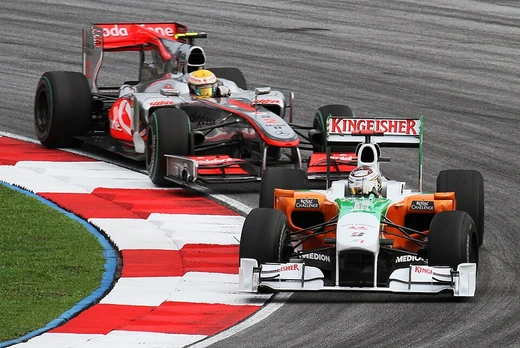
Formula racing
Open-wheel single-seater motorsport governed by standardized regulations.

Formula racing—called open-wheel racing in North America—covers a range of single-seater motorsport where the wheels are exposed. The term "formula" refers to a specific set of technical rules for a car type, a concept the FIA first introduced for its post–World War II single-seater events. Among the most famous categories are Formula One, Formula E, Formula Two, Formula Three, regional Formula Three, and Formula Four. The phrase is also commonly applied to other open-wheel series like the IndyCar Series and Super Formula Championship.
Lower tiers such as Formula Three and Formula Two are known as junior, lower, or feeder formulae, sitting below top-level series like Formula One on the career ladder of single-seater racing. Two main types of formula exist: open formula, where teams can pick their own chassis or engine, and control or "spec" formula, which mandates a single supplier for both chassis and engine. Formula Three is an open formula, while Formula BMW is a control formula. Formula Ford is an exception, with an open chassis rule but a single-brand engine requirement.
Not every formula series is a high-cost professional affair, even though Formula One is the world's most expensive motorsport. Some formulas target juniors and amateurs; Formula 1000 and Formula Vee rank among the cheapest forms of circuit racing. Most modern formula categories permit racing slicks and extensive use of wings and ground effects to boost cornering speeds. However, popular amateur classes like Formula Ford and Formula Vee do without these, resulting in much slower cornering and a greater reliance on drafting. The term "wings and slicks racing" sometimes separates the faster categories from the slower ones.
**World championships**
**Formula One** After World War II, the FIA's Commission Sportive Internationale set the standardized rules for Formula One in 1946 while reviving Grand Prix racing. The first race under those early regulations was a non-championship Grand Prix in Turin in September 1946. The first officially recognized Formula One season took place in 1947, and the World Championship for Drivers began in 1950.
**Formula E** Formula E is the top tier for single-seat, electrically powered racing cars, launching its first season in 2014–15. Conceived in 2012, the FIA intended it as a research and development platform for electric vehicles and a way to boost interest in EVs and sustainability. The series mainly runs on temporary city circuits in places like New York, Hong Kong, Zürich, Berlin, Rome, and Paris, with events called "ePrix." To control costs while allowing technological progress, it uses a spec chassis and battery that all entrants must use, but teams can design their own motors, inverter, and rear suspension. The series has grown in popularity in recent years.
**International championships**
**Formula 2** The FIA Formula 2 Championship debuted in 2017, created by Bernie Ecclestone and Flavio Briatore after the GP2 Series was rebranded. Designed to be affordable and serve as a training ground for Formula One, F2 requires all teams to use the same chassis, engine, and tire supplier.
**Formula 3** In 2019, the GP3 Series was replaced by international Formula 3, mirroring the GP2-to-Formula 2 rebranding of 2017. The first drivers' champion was Robert Shwartzman with Prema Racing, which also won the teams' title that year. Until 2024, the FIA Formula 3 World Cup was held at the end of the season during the Macau Grand Prix, but it was later discontinued for various reasons. Since then, Formula Regional cars have raced at the Macau Grand Prix instead of Formula 3 cars.
**Regional championships**
**Formula Regional** Formula Regional is the last category that does not run as part of Formula One event weekends. It was created to replace the various F3 championships worldwide after the FIA decided the "Formula 3" name would be used exclusively for the series that runs on F1 weekends (formerly GP3). Each championship covers a specific region: Asia, Americas, Europe, India, Japan, Middle East, and Oceania (New Zealand).
**National championships**
**Formula 4** FIA Formula 4, or FIA F4, is an open-wheel category for junior drivers. There is no global championship; instead, individual nations or regions can host their own series under a universal set of rules and specifications. The FIA created it as an entry-level category to bridge the gap between karting and Formula 3, and it is part of the FIA Global Pathway.
**North America**
**IndyCar Series** The IndyCar Series is the top formula racing category in North America. The sport's roots go back to 1905. The current series was founded in 1996 by then-Indianapolis Motor Speedway CEO Tony George as the "Indy Racing League" (IRL). In 2008, it merged with the rival Champ Car World Series (formerly CART) to form the IndyCar Series. A typical season includes races on natural terrain road courses, temporary street circuits, small ovals (short tracks), and larger high-speed ovals (superspeedways), including the historic Indianapolis 500.
**Indy NXT** Indy NXT, previously called Indy Lights, is the top feeder series for the IndyCar Series, similar to how Formula 2 feeds Formula One.
- governing_body
- Fédération Internationale de l'Automobile (FIA)
- top_series
- Formula One
- electric_equivalent
- Formula E (inaugural season 2014–15)
- primary_forms
- Open formula and control (spec) formula
Lore & Background
Lower categories such as Formula Two and Formula Three are known as junior, lower, or feeder formulae, as they sit beneath top-tier championships like Formula One on the career ladder of single-seater racing. These series are governed by a "formula"—a set of regulations for car design, a concept first introduced by the FIA for post-World War II single-seater events. There are two main types of racing formula: open formula, which permits teams to choose their own chassis or engines, and control or "spec" formula, which mandates a single supplier for both. For instance, Formula Three is an open formula, while Formula BMW is a control formula; Formula Ford is a hybrid, with an open chassis rule but a single-brand engine requirement. Not all formula series are expensive professional events; some, like Formula 1000 and Formula Vee, are among the most affordable forms of circuit racing and are intended for juniors and amateurs. Most contemporary formula categories use racing slicks and extensive wings and ground effects to boost cornering speeds, but popular amateur classes such as Formula Ford and Formula Vee do not, resulting in slower cornering and a greater reliance on drafting. The term "wings and slicks racing" sometimes distinguishes the faster categories. Formula One, the most costly motorsport globally, revived Grand Prix racing after World War II with standardized regulations defined in 1946, holding its first official season in 1947 and inaugurating the World Championship for Drivers in 1950. Formula E, the top class for electric single-seaters, began in 2014–15 as an FIA research platform for electric vehicles, racing on temporary city circuits called ePrix, using a spec chassis and battery while allowing teams to develop their own motors and inverters. The FIA Formula 2 Championship replaced the GP2 Series as a feeder for F1, mandating identical chassis, engine, and tyres for all teams. International Formula 3 replaced GP3 in 2019, and its World Cup at the Macau Grand Prix was discontinued before 2024, with Formula Regional cars now racing there instead. Formula Regional championships are organized by region—such as Asia, Europe, and the Americas—and serve as a step below international F3. Formula 4 is an entry-level category bridging karting and Formula 3, with national or regional championships following universal FIA rules as part of the FIA Global
Reader's Guide
Formula racing's significance lies in its structured hierarchy, from entry-level categories like Formula Four and Formula Vee to the pinnacle of Formula One, the most expensive form of motorsport. The FIA Global Pathway formalizes this progression, with regional championships like Formula Regional and national series like Formula Four bridging karting and higher levels. Notable variations include open formulas allowing choice of chassis or engines, and control formulas with single suppliers. The IndyCar Series and Super Formula Championship are prominent non-FIA formula series. Formula E, introduced in 2014–15, serves as an R&D platform for electric vehicles. The legacy of formula racing includes its role in developing driver talent and advancing automotive technology, with categories like Formula Ford and Formula Vee emphasizing drafting due to the absence of wings and slicks.
Did You Know?
- Formula E, the electric formula series, was conceived in 2012 and held its inaugural season in 2014–15.
Frequently Asked Questions
What is the top tier of Formula racing?
Formula One sits at the apex of the open-wheel hierarchy and is the most widely followed single-seater series globally. Beneath it, Formula Two, Formula Three, and regional Formula Four act as development ladders for aspiring drivers.
Is there an electric version of Formula racing?
Yes—Formula E is the all-electric single-seater series, debuting with its inaugural season in 2014–15. It keeps the open-wheel, single-seater format but swaps combustion engines for battery-electric powertrains.
More in Motor Sports 1-24
Spotted an error? Know more?
This is a living reference — every entry is fact-audited, and reader corrections feed straight into our audit queue. Suggest an edit · See this site's audit record