Frequently Asked Questions
The most-asked questions about moons of uranus and neptune.
What is the Moons of Uranus and Neptune fan encyclopedia actually about?
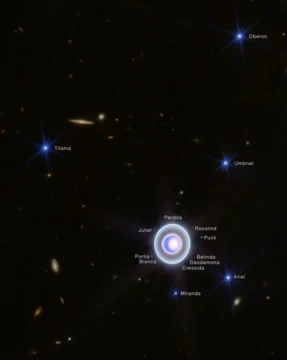
It is a community-built reference that treats every confirmed satellite of Uranus (28) and Neptune (14) as a distinct 'character,' cataloging its discovery story, physical traits, orbital quirks, and fan theories. Think of it as a wiki where each moon gets a profile page, a relationship map, and a timeline.
Who are the headliners fans argue about the most?
Titania and Miranda on the Uranus side and Triton on the Neptune side dominate every forum thread, largely because their surfaces and orbital mechanics are the most visually dramatic and scientifically puzzling. Smaller satellites like Puck, Nereid, and Proteus have dedicated fan clubs but rarely crack the top of a discussion.
Where should a total newcomer begin?
Start with the 'Uranus System Overview' and 'Neptune System Overview' pages, which lay out the naming conventions and orbital families before you jump into individual moon profiles. From there, most readers gravitate toward Miranda or Triton first, since those entries link out to nearly every other satellite.
How many 'characters' are in the roster right now?
Uranus has 28 confirmed moons and Neptune has 14, though the Uranian count jumped by a dozen in the 2023 discovery batch. The irregular, distant satellites at the outer edge of both systems are still being hunted, so the roster is not final.
Who plays the role of the enigmatic outsider?
Triton is the closest thing to a tragic anti-hero: a captured Kuiper Belt object locked in a retrograde orbit around Neptune, slowly spiraling inward toward a tidal-disruption ending. Fans love the 'it was never meant to be here' narrative that its origin implies.
What makes Miranda such a fan favorite?
Its surface is a jumbled collage of at least three geological epochs, crowned by the Verona Facula scar, which looks like a massive impact basin stitched over with younger terrain. That visual chaos gives it the most 'backstory' of any moon in either system.
What's the naming logic behind the cast?
Uranus's moons are drawn from Shakespeare and Alexander Pope (Titania, Oberon, Ariel, Puck, Cordelia, etc.), while Neptune's moons come from water-related figures in Roman and Greek mythology (Triton, Nereid, Proteus, Naiad). The split reflects the planets' mythological associations with the sky and the sea.
What's the biggest 'plot twist' in the lore?
Triton's retrograde orbit proved it was not formed in Neptune's disk but was gravitationally captured from the Kuiper Belt, upending the assumption that every moon is a native child of its planet. That single fact recontextualizes an entire system's origin story.
Do the two moon 'families' ever cross over?
No moon orbits both planets, but the irregular satellites at the outer edges of Uranus and Neptune share a similar capture origin, so fans treat them as distant thematic cousins. Comparative threads that put, say, Uranus's Sycorax next to Neptune's Neso are a regular feature of the wiki.
What recent development has fans been most excited about?
The 2023 announcement of twelve tiny new Uranian moons (S/2023 U1 through S/2023 U12) more than doubled the Uranian roster overnight and reignited interest in the small, dark, irregular satellites that had been the least-studied 'background characters' in the system.