Frequently Asked Questions
The most-asked questions about moons of saturn.
What are Saturn's moons in general terms?
Saturn's moons are the natural satellites that orbit the sixth planet from the Sun, spanning from pebble-sized fragments to a world as large as Titan. Together they make up one of the most varied and dynamically active satellite families in the solar system.
How many moons does Saturn actually have?
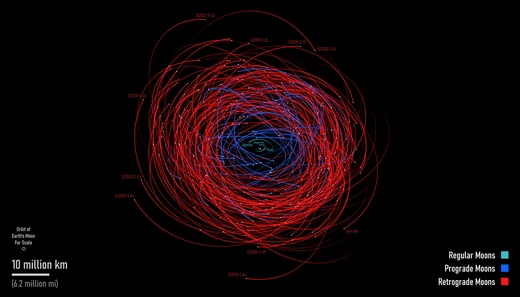
Saturn currently has more than 140 confirmed natural satellites, the most of any planet in our solar system. The vast majority are small, irregularly shaped bodies, with only a handful large enough to be considered true geological worlds.
Which is the largest moon in Saturn's system?
Titan, roughly 5,150 km across, is the biggest moon orbiting Saturn and the second-largest satellite in the entire solar system. It is the only known moon that possesses a thick, dense atmosphere and stable liquid on its surface.
What makes Titan stand out from every other moon?
Titan has a nitrogen-rich atmosphere, a methane-water cycle with rain, rivers, and vast hydrocarbon seas, and a surface chemistry unlike anything else we have observed. It is the only place outside Earth where liquid is known to flow across a surface today.
Why is Enceladus such a fan favorite?
Enceladus is a small icy moon that erupts towering plumes of water vapor, ice grains, and organic molecules from cracks near its south pole. Beneath its frozen shell lies a global saltwater ocean, making it one of the most promising places to search for microbial life.
Which spacecraft gave us the most detailed views of Saturn's moons?
NASA's Cassini-Huygens mission, which spent thirteen years orbiting Saturn from 2004 to 2017, is responsible for the bulk of our close-up imagery and data. It performed over 200 flybys of Titan and dozens of passes by Enceladus, Rhea, Dione, and other inner moons.
What is the smallest well-known moon of Saturn?
Pan, a lumpy body only about 28 km wide, orbits inside Saturn's A ring and is credited with helping carve and maintain the narrow Encke Gap. A few even tinier moonlets have been spotted, but Pan remains the best-studied of the tiniest satellites.
How do Saturn's moons interact with the famous rings?
Several moons act as gravitational shepherds, their orbits sculpting gaps, braids, and density waves within the ring structure. In some cases, small ring-moons are thought to have coalesced from ring material, blurring the line between moon and ring.
What discovery has generated the most excitement among fans and scientists?
Cassini's final years revealed that Enceladus's plumes carry complex organic molecules, silica nanoparticles, and even phosphorus, all pointing toward active hydrothermal chemistry in its hidden ocean. On Titan, the detection of prebiotic compounds in its atmosphere has fueled speculation about primitive chemical pathways toward life.
Where should a newcomer begin exploring Saturn's moons?
Start with the five largest—Titan, Rhea, Iapetus, Dione, and Tethys—because they showcase the widest range of surface geology and chemistry in the system. Once comfortable with those, fans typically branch out into the smaller icy moons, the ring-moon interactions, and the ongoing search for habitable environments.