Frequently Asked Questions
The most-asked questions about moons of saturn, part 2.
What exactly is 'Moons of Saturn, Part 2'?
It is the second volume of an unofficial, fan-maintained encyclopedia that catalogs Saturn's smaller and more eccentric satellites. While Part 1 handles the big regular moons, Part 2 zeroes in on the odd-shaped, tiny, and dynamically strange ones that most people have never heard of.
Which moons are the main 'characters' featured in Part 2?
The volume gives the most attention to Hyperion, Mimas, Phoebe, and the co-orbiting pair Janus and Epimetheus. Smaller irregular satellites like Pan, Atlas, and the dozens of sub-kilometer moonlets round out the coverage.
Where should a complete newcomer begin reading?
Start with the Hyperion entry, because its lopsided, sponge-like shape and chaotic tumble make it the most visually striking subject in the volume. From there, the Mimas and Janus-Epimetheus entries build naturally on the themes of unusual geology and orbital mechanics.
What is the single most surprising fact covered in Part 2?
Janus and Epimetheus periodically swap their orbital positions with each other roughly every four years, a gravitational dance that has no real analogue among the larger moons of other planets.
Why is Hyperion considered the 'weirdest' moon in the set?
Instead of rotating smoothly like a normal satellite, it tumbles in a chaotic, unpredictable fashion, and its surface is so porous that its density is barely above that of water.
What makes Mimas instantly recognizable to fans?
Its enormous Herschel crater, which spans nearly a third of the moon's diameter, gives it a striking resemblance to the Death Star battle station from Star Wars, and that comparison dominates most fan discussions.
Why is Phoebe classified so differently from the other moons in Part 2?
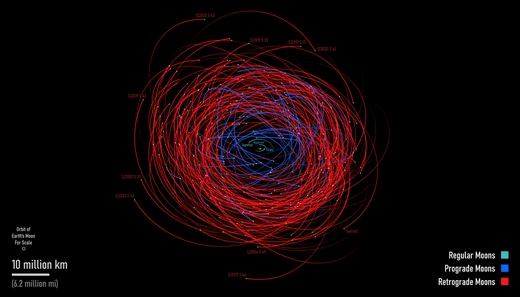
It orbits Saturn in a retrograde direction—opposite to Saturn's rotation—strongly suggesting it was not formed in place but captured from the outer solar system.
What is a key 'notable moment' in the discovery history covered here?
The confirmation that Hyperion's spin is truly chaotic, rather than just appearing irregular due to observational gaps, was a major milestone that reshaped how the community thinks about small-body dynamics.
How does Part 2 differ in tone and scope from Part 1?
Part 1 reads like a structured survey of large, geologically active worlds, while Part 2 has a more 'deep-cut' feel, spending time on orbital quirks, capture histories, and moons too small to have ever been visited by a spacecraft.
Do the entries in Part 2 include any original fan analysis or speculation?
Yes. Alongside the factual data, each entry carries a short 'Fan Notes' section where contributors share their own hypotheses—such as why Hyperion's porosity might be a record of a past collision—clearly labeled as speculation rather than established science.