Frequently Asked Questions
The most-asked questions about moons of jupiter.
What is this encyclopedia actually about?
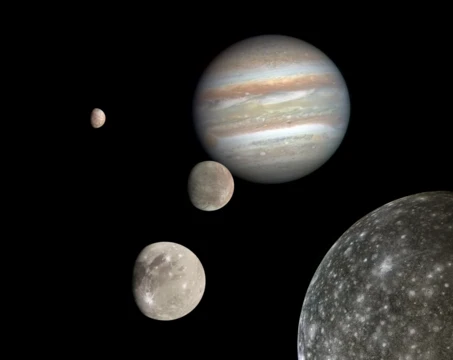
It is a fan-made reference covering Jupiter's satellite family, treating each moon as a distinct 'character' with its own geology, history, and role in the Jovian system. The focus is on the four Galilean moons plus the dozens of smaller irregular satellites.
Who are the four main characters everyone talks about?
Io, Europa, Ganymede, and Callisto—the Galilean moons discovered by Galileo in 1610. They are the four largest satellites, each with a radically different surface and scientific story.
Where should a total newcomer start reading?
Begin with the Ganymede entry, since it is the largest moon in the solar system and gives you the biggest 'big picture' context. Then move to Io for the most visually dramatic content before tackling the more subtle Europa and Callisto profiles.
How many moons does Jupiter actually have?
As of recent confirmations, Jupiter has over 90 known moons, though the count keeps growing as smaller irregular satellites are detected. The four Galilean moons dominate the system by mass, but the outer irregular groups add hundreds of tiny worlds.
Why is Io considered the most 'dramatic' moon?
Io is the most volcanically active body in the solar system, with hundreds of active vents and plumes driven by tidal flexing from Jupiter and its neighbors. Its surface is essentially a constantly resurfacing lava landscape with no craters to speak of.
What is the big mystery surrounding Europa?
Beneath its cracked ice shell, Europa likely hosts a global saltwater ocean containing more liquid water than all of Earth's seas combined. This makes it a prime target in the search for extraterrestrial life, though we have not yet directly confirmed the ocean's chemistry.
What makes Ganymede stand out from the others?
Ganymede is larger than the planet Mercury and is the only moon known to generate its own intrinsic magnetic field. It also has a heavily cratered 'highland' hemisphere and smoother 'grooved' terrain, suggesting a complex internal history.
What is Callisto's 'role' in the family?
Callisto is the most heavily cratered large body in the solar system, essentially a frozen record of billions of years of impacts. It likely has a thin outer ice layer over a rocky interior and possibly a small subsurface water layer, but far less internal activity than its siblings.
Which space missions count as the key 'seasons' for the moons?
Galileo (1995–2003) provided the first close-up orbital data, while the upcoming JUICE (ESA) and Europa Clipper (NASA) missions are expected to deliver the next major wave of discoveries in the 2030s. Voyager flybys in 1979 first revealed Io's volcanism and Europa's ice.
What is the single most surprising fact a fan should know?
Ganymede's diameter of roughly 5,268 km makes it bigger than both Mercury and Pluto, meaning the largest 'moon' in the solar system outweighs two entire planets. The line between moon and planet is genuinely blurry in Jupiter's family.