Himalia (moon)
Last updated
Jupiter's largest irregular satellite is Himalia, which is also designated Jupiter VI.[1] Within the prograde-orbiting Himalia group—a collisional family thought to originate from a captured asteroid—Himalia is the biggest member.[1]
Key facts and history
Charles Dillon Perrine discovered Himalia on 3 December 1904 at Lick Observatory using the 36-inch Crossley reflecting telescope.[1] Himalia appears neutral in color, similar to a C-type asteroid, with a spectrum strikingly similar to that of asteroid 52 Europa.[2] Himalia is Jupiter's most easily observed small satellite, though Amalthea is brighter but harder to view due to the planet's glare.[3] The nymph Himalia, who according to myth bore three sons of Zeus, is the namesake for this moon.[4]
Only in 1975 did Himalia receive its current name; earlier, it was referred to simply as Jupiter VI.[4] Between 1955 and 1975, the Greek goddess Hestia was an alternate name sometimes used for this moon.[5] A rotation period of 7 hours, 46 minutes, and 55 seconds has been measured for Himalia.[6] Precise size measurements of Himalia became possible in May 2018 when it occulted a star.[7]
The U.S. state of Georgia was the location from which that occultation was observed.[8]
What the cited sources add
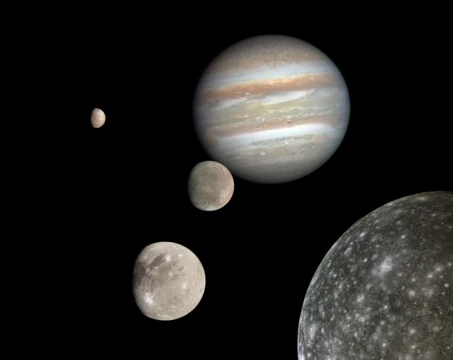
The New Horizons spacecraft captured the best image of Himalia on 1 March 2007, showing it as about 170 kilometers in diameter.[9] Rick Scott's 2003 account states that Himalia is the only moon other than the Galilean moons visible in an amateur-size telescope.[10] Scott notes that Himalia has a visible magnitude of about 15 and an orbit around Jupiter taking just over 250 days.[10]
References
- Wikipedia, "Himalia (moon)" (CC BY-SA 4.0), which cites: Perrine, "Orbits of the sixth and seventh satellites of Jupiter", Astronomische Nachrichten, 1905, p. 1 (original not read by us) en.wikipedia.org
- Wikipedia, "Himalia (moon)" (CC BY-SA 4.0), which cites: Chamberlain, "Near-infrared spectroscopy of Himalia", Icarus, 2004, p. 163–169; Brown, "THE 3 μm SPECTRUM OF JUPITER's IRREGULAR SATELLITE HIMALIA", The Astrophysical Journal, 2014-09-19, p. L44 (original not read by us) en.wikipedia.org
- Wikipedia, "Himalia (moon)" (CC BY-SA 4.0), which cites: "Himalia, Jupiter's "fifth" moon", October 2009; Rick Scott, "Finding Himalia, The Fifth Brightest Moon Of Jupiter", Astronomy.net, October 20, 2003 (we also read that source) en.wikipedia.org
- Wikipedia, "Himalia (moon)" (CC BY-SA 4.0), which cites: Marsden, "IAUC 2846: N Mon 1975 (= A0620-00); N Cyg 1975; 1975h; 1975g; 1975i; Sats OF JUPITER", Central Bureau for Astronomical Telegrams, 7 October 1975 (we also read that source) en.wikipedia.org
- Wikipedia, "Himalia (moon)" (CC BY-SA 4.0), which cites: Payne-Gaposchkin, "Introduction to Astronomy", Prentice-Hall, 1970 (we also read that source) en.wikipedia.org
- Wikipedia, "Himalia (moon)" (CC BY-SA 4.0), which cites: Pilcher, "Photometric lightcurve and rotation period of Himalia (Jupiter VI)", Icarus, 2012, p. 741–742 (original not read by us) en.wikipedia.org
- Wikipedia, "Himalia (moon)" (CC BY-SA 4.0), which cites: Porco, "Cassini Imaging of Jupiter's Atmosphere, Satellites, and Rings", Science, March 2003, p. 1541–1547; Jewitt, "Irregular Satellites of the Planets: Products of Capture in the Early Solar System", Annual Review of Astronomy and Astrophysics, 2007-09-01, p. 261–295; Porco, "Cassini Imaging of Jupiter's Atmosphere, Satellites, and Rings", Science, March 2003, p. 1541–1547; Archinal, "Report of the IAU Working Group on Cartographic Coordinates and Rotational Elements: 2015", Celestial Mechanics and Dynamical Astronomy, 2018-02-23 (orig en.wikipedia.org
- Wikipedia, "Himalia (moon)" (CC BY-SA 4.0), which cites: "Jupiter (06) Himalia", www.asteroidoccultation.com, 12 May 2018 (original not read by us) en.wikipedia.org
- Lakdawalla, E., "The Bruce Murray Space Image Library – Jupiter's moon Himalia", 1 March 2007. facts only, no text reused. planetary.org
- Rick Scott, "Finding Himalia, The Fifth Brightest Moon Of Jupiter", Astronomy.net, October 20, 2003. facts only, no text reused. astronomy.net
Each numbered sentence above was checked against the source it cites before publication. Sentences citing Wikipedia adapt text from the English Wikipedia article Himalia (moon) (contributors), used under CC BY-SA 4.0; this entry is available under the same licence. Other sources were used for facts only; no text or images are copied from them.
More in Moons of Jupiter
Sources
Compiled from Wikipedia and the sources listed below. Text from Wikipedia is available under CC BY-SA 4.0; this entry is adapted from it.
- Wikipedia: Himalia (moon) (CC BY-SA 4.0).
Spotted an error? Know more?
Reader corrections go straight into our review queue. Suggest an edit · How this site is sourced